4/15/2021

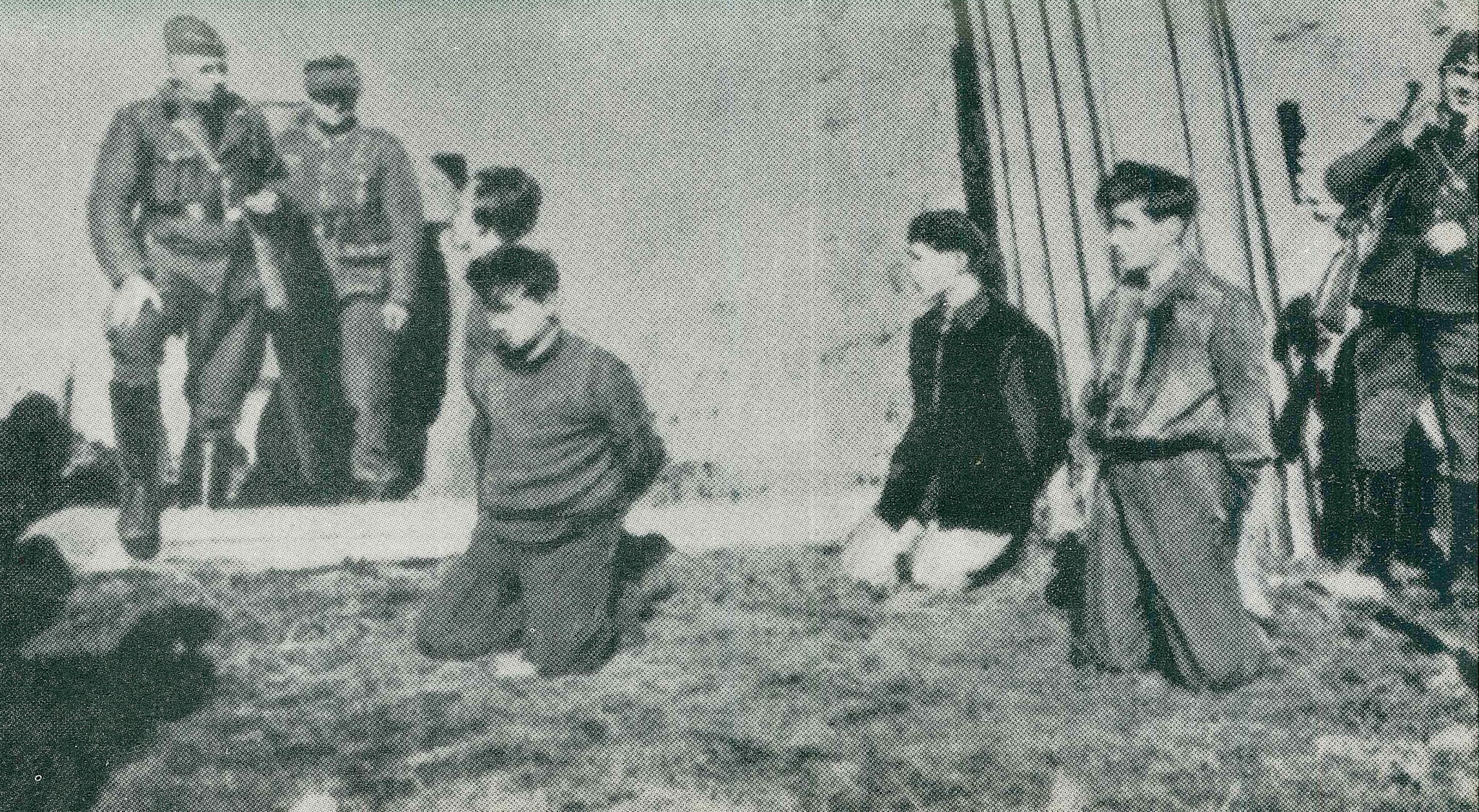
France Four young French patriots are murdered in Mangy (Seine et Oise) by Nazi German Troops during World War 2nd.

Nazi German troops rounded up and shot resistance leaders in the back of the head in France from November 11, 1942, when they occupied all of France, until the surrender of Nazi Germany in May 1945. Four French youths of the Resistance were executed by the Nazi Germans by firing squad from the back of the head after the French Patriots arrested them in Manny, in the northern basin of the Seine and Oise rivers in central and western France.

 The Free French Movement began at 6:00 p.m. on June 18, 1940, with a six-minute speech by Charles de Gaulle on the BBC in London. He fervently rejected the armistice between the Vichy government of Pétain and Nazi Germany and clamored for a world war. Throughout France, grassroots groups of resistance emerged in late 1940 and 1941, independent of de Gaulle and independent of each other. a private military organization (CMO: Organisation Civile et Militaire) was born in Paris in December 1940, composed of middle class citizens and reservists. On November 11, 1942, Nazi German troops occupied all of France, and in May 1943, the resistance united behind Free France. In May 1943, the Resistance united behind Free France, and Nazi Germany's abuses and massacres of the Resistance intensified. Some 21,600 suspected French citizens were deported to concentration camps. The British interfered with BBC broadcasts and imprisoned the Resistance. during 1942, about 3 million French people sympathized with Free France. The shadowy resistance army always represented a minority, with between 300,000 and 500,000 men and women out of a population of about 39.6 million in 1945 joining the resistance; many of the approximately 120,000 Spaniards who fled Franco's regime in 1939 joined the resistance out of a continuing anti-fascist struggle.

 In northern France, the resistance targeted only Nazi German troops, but in the south, the Vichy regime was targeted as well as the German army. The first resistance movement took place in northern France by the end of 1940, and six underground newspapers were regularly printed in the north. 1941 By June, the resistance movement became more organized. Between January 1943 and September 1943, they committed about 530 acts of sabotage against railroad lines, etc. Between 1943 and 1944, they sabotaged about 150 factories in France. Between 1943 and 1944, they sabotaged about 150 factories in France. The Allied forces landed in Normandy on June 6, 1944, liberated Paris at the end of August 1944, and forced the total unconditional surrender of Nazi Germany on May 8, 1945. 


4/14/2021

A temporary graveyard was set up behind the Korean War front, and only the corpses of South Korean soldiers were buried in the temporary graveyard, and the corpses of US soldiers were repatriated to the United States.

The transportation of corpses to the military cemeteries of American soldiers far from the battlefields of the Korean War was very difficult and dangerous. Bodies that could not be moved due to the urgency of the battle were hastily buried in any soft ground that would allow for a quick burial. Behind the battle lines, temporary cemeteries were set up. Only the bodies of Korean soldiers were buried in the temporary cemeteries. The bodies of American soldiers who died in the war were placed in coffins and repatriated to the United States. Isolated cemeteries could not always be maintained, and many of the rough indicators were lost, removed by residents or North Korean troops, or destroyed in the fighting.

 As the Korean War, which broke out on June 25, 1950, intensified and the death toll of American soldiers increased, it became necessary for each combat unit to establish and operate its own cemetery. The first temporary UN memorial cemetery in Korea was established by the US military in Daejeon on July 9, 1950. However, Daejeon was occupied by North Korean forces shortly thereafter. The cemetery, which contains about 46 burial sites, was abandoned. Other temporary cemeteries were established in Kwanui, Geumcheon, and Sindong, but they were occupied under the control of the North Korean army after the UN forces withdrew to the Busan border.

 Faced with difficult war conditions at a time when it was time to set up its own cemetery, the combat troops could not avoid digging graves. As the Koreans fleeing from the combat zone became refugees and abandoned their towns and villages, it became impossible to use civilian labor for the construction of the cemetery. A morgue was set up to hold the bodies until the cemetery could be dug and recorded. Due to the unfavorable war situation, a temporary UN cemetery was set up elsewhere as the UN forces withdrew to the Pusan area. American troops landed in Incheon and struck back, establishing a temporary UN military cemetery in Incheon on September 8, 1950. The search and recovery operations of differentiated or deteriorating corpses in the areas recaptured from the North Korean troops were immediately started and the corpses were accumulated in the cemetery.

 The entry into North Korea of vast Chinese armies from October 25, 1950, to reinforce the collapsing North Korean army, forced the UN forces into an emergency withdrawal. All temporary cemeteries in the retreat area, including those on the outskirts from Hungnam, and even Pyongyang were placed under communist control. The Commander-in-Chief of the U.N. forces said that the bodies of all U.S. dead troops were accumulated in the U.N. military cemetery, ready for transport to Japan. The bodies of the U.N. troops deposited in Incheon left the port of Incheon by loaded ships on December 28, 1950. U.S. military corpses were evacuated to the U.S. grave registration facility established in Kokura, Japan, starting January 3, 1951. The decision was made to return to the U.S. home country the bodies of about 16,000 American soldiers who died during the hostilities of the Challenge War.


4/13/2021

38-year-old Ryotoku Higa, a farmer on Ie Island around Okinawa, was robbed and killed by a bomb from the US military.

On September 6, 1959, 38-year-old Ryotoku Higa, a farmer from Ie Island in the vicinity of Okinawa, lost his land to the U.S. military and was killed in a bombing (Okinawa Without a Homeland, edited by the Okinawa Prefectural Students Association, 1970). Mr. Yoshitoku Higa was deprived of his land by the U.S. military and had no choice but to live by picking up bombs that had fallen in his fields and scrapping them. He was killed in the explosion while dismantling the bomb. In April 1953, the U.S. military began forcibly seizing land on Iejima. In 1954, the U.S. military gave eviction notices to the residents of Iejima. In March 1955, about 300 armed U.S. soldiers forcibly took land from the Mahe area of Ie Island.

 Ie Island, Okinawa Prefecture, was once a fierce battleground in the Battle of Okinawa. After the U.S. occupation, about 60% of Ie Island was used as a training ground for dropping bombs and paratroopers. The farmers of Iejima were supposed to live on the fertile land and farm. The U.S. military took away the farmland and demolished the houses of the farmers of Iejima. The farmers of Iejima had no choice but to stand up in desperate struggle against the American forces. Even after the Battle of Okinawa, the farmers of Iejima, who were forced to live a life of hardship, struggled long and tenaciously against the American forces. However, even though Ie Island is located only 9km northwest of the main island of Okinawa, it is still a remote island and the struggle against the US military was disposed of in secret. 

 Under the U.S. military's administration after the Pacific War, bases and facilities were built halfway across the country. Incidents involving vicious accidents and murders by U.S. soldiers were frequent, resulting in a series of casualties among the Okinawans. Disillusioned with the U.S. military administration, Okinawans called for the return to mainland Japan. Okinawan volunteers launched resistance movements such as the Shimagurumi Struggle. As the U.S. military was about to withdraw completely from the Vietnam War on March 31, 1973, Okinawa was reverted to the mainland on May 15, 1972, when the administration of Okinawa was returned from the United States to Japan.


4/12/2021

Miss Michiko Kanba, who was in critical condition in the US-Japan security struggle, was taken out of the Diet premises in the rain and escorted, and was diagnosed dead at the police hospital.

Michiko Kaba (born November 8, 1937, died June 15, 1960) was a student activist, a third-year female student at the University of Tokyo who died in the Japan-U.S. Security (Anpo) Struggle. Michiko Kaba, who became seriously ill on June 15, 1960 during the Security Treaty Struggle, was carried out of the Diet premises in the rain and escorted away. On the day of her death, she was wearing a pale cream cardigan, white blouse, and dark blue slacks. After she was pronounced dead at the police hospital where she was taken, the students held a silent vigil for Michiko Kaba's death inside the Diet building.

 Students, workers, and citizens surrounded the Diet building in ten or twenty layers, demanding opposition to the Security Treaty and the resignation of the Kishi Cabinet, and in a demonstration on June 15, 1960, the mainstream faction of the All-Japan Federation of Student Self-Defense Associations rushed into the Diet from the south gate of the House of Representatives. He died at the age of 22 when he clashed with police forces in the process. An autopsy at the police hospital indicated that the cause of death was chest compression and internal bleeding of the head. The police claimed that the crushing death was caused by Michiko Kaba's fall. They concluded that she died of respiratory distress due to compression of the chest and abdomen caused by being trapped under the collapsed people after the protesters rushed into the parliament premises. The results of the examination were not disclosed to the family of the deceased, and the students claimed that the death was caused by an assault by riot police.

 In 1957, he entered the Department of Japanese History in the Faculty of Letters at the University of Tokyo's second (now third) class. He participated in the Sunagawa Struggle against the expansion of the U.S. military base at Tachikawa in a demonstration against British hydrogen bomb tests. He belonged to the History Study Group and aimed to explore the principles that drive history. He became the vice chairman of the autonomy committee of the Faculty of Letters, University of Tokyo. He joined the Japan Communist Party in preparation for the looming security struggle. In December 1958, he joined the Vanguard Party and the Communist League, which was formed by student members of the Communist Party who broke away from the party to pursue a more radical ideology and policy. As a mainstream member of the All-Japan Federation of Student's Associations, he fought a militant struggle, including being arrested in the Haneda Incident. He was arrested in the Haneda Incident.

 In the early hours of May 20, 1960, the House of Representatives forcibly adopted the draft of the new Security Treaty in a plenary session. It continued to allow the stationing of U.S. troops in Japan as the U.S. Forces in Japan and recognized the right of collective self-defense, which was in conflict with the Constitution. On June 16, 1960, President Eisenhower's scheduled visit to Japan was cancelled. A month later, on July 15, the Kishi Cabinet, which had forcefully adopted the new Security Treaty, resigned. The death of Michiko Kaba became an incident that had a profound impact on Japanese society.

 The death of Michiko Kaba had a profound impact on Japanese society. But I won't laugh forever, I won't be able to laugh forever, and that's all right, I just want to smile at the end, if I'm allowed.


4/11/2021

Japanese tanks were light and poorly armored, offering little protection for its crew. Enemy lost 8,122 before atoll fell to Marines. Kwajalein and Roi, which had an air-strip, were the first isles in the Marshalls to be recaptured.

During the Battle of Kwajalein in the Marshall Islands in the Pacific War, the Japanese soldiers were annihilated by the overwhelming military might of the U.S. Army and their bodies were scattered on the beaches of Kwajalein Island. The American soldiers smiled in relief as they looked around at the dead bodies of the Japanese soldiers. The number of Japanese troops was only about 8,000, while the number of American troops reached about 41,000.

 In order to occupy Kwajalein Atoll, the American forces put time on the target and public opinion. The Japanese tanks were light and poorly armored, with no protection for their crews. By the time the Kwajalein Atoll fell to the Americans, the Japanese had lost about 8,122 men. The southern island of Kwajalein, which had an airfield airstrip, and the northern islands of Loy and Namur were the first islands in the Marshall Islands to be recaptured. The main objective of the battle was to take over the airstrips on most of the islands. The airstrips were modified for bombers and used as a springboard for the Tokyo Air Raids.

 In the Pacific War, on January 31, 1944, American forces conducted an amphibious assault on Kwajalein Atoll in the heart of the Marshall Islands, which on February 1, 1944, became the target of the most intensive bombardment of Japanese forces in nearly two months prior to the Battle of Kwajalein Atoll. Some 36,000 shells struck Kwajalein Atoll from naval vessels and ground guns from nearby islets. American B-24 bombers bombed the island from the air and it collapsed. Of the approximately 8,782 Japanese soldiers deployed on Kwajalein Atoll (including forced conscripts from Korea), approximately 7,870 Japanese soldiers were killed. With a mortality rate of about 90%, only 917 survived the bloody annihilation of the Japanese forces at the tiny Tarawa Atoll in the Gilbert Islands of the Central Pacific Ocean between November 21 and November 23, 1943, with spectacular casualties. The ensuing Pacific war was a harbinger of the final annihilation of Japanese soldiers.

 Many Marshallese fled the island in canoes just before the battle, but about 200 were killed during the fighting. Marshallese who took refuge in the trenches were killed when a grenade destroyed their shelter.On February 6, 1944, Kwajalein Atoll, along with the rest of the Marshall Islands, was designated a United Nations Trust Territory under the United States military.


4/10/2021

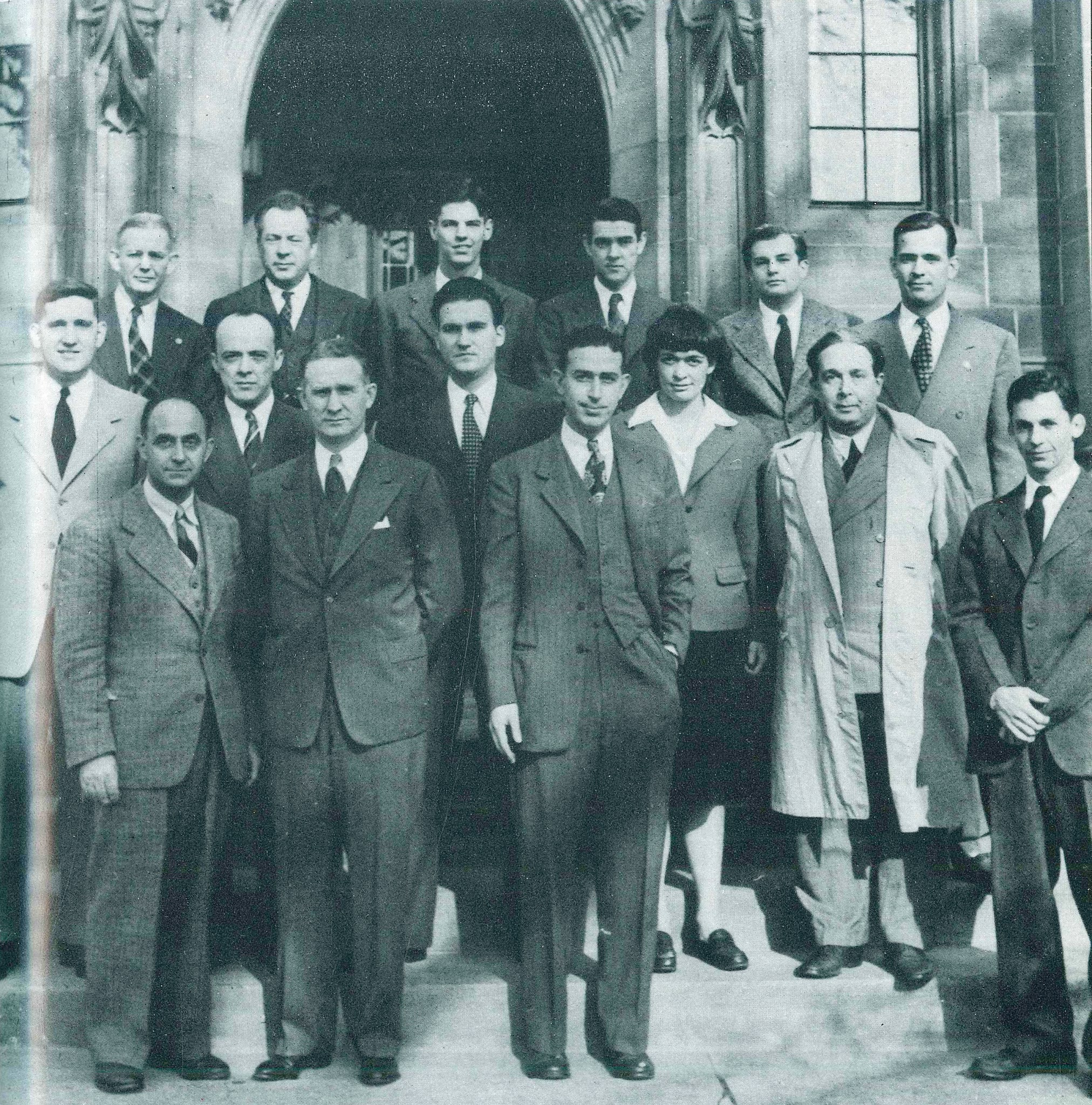
Reunion of atomic scientists on the 4th Anniversary (1946) of the first controlled nuclear fission chain reaction, December 2, 1942, pictured in front of Bernard A. Eckhart Hall at the University of Chicago.

The CP-1 (Chicago Pile 1) reactor became the first reactor in human history to reach criticality and trigger a fission chain reaction on December 2, 1942, at the University of Chicago's experimental reactor, producing plutonium-239, the material used in the atomic bomb. On its fourth anniversary, December 12, 1946, CP-1 atomic scientists pose for a group photo in front of Bernard A. Eckhart Hall at the University of Chicago, where they won a glorious victory for their contribution to the atomic bomb. The U.S. had been based in Manhattan, New York since August 3, 1942, when a group of scientists and the military began secretly working together to test the atomic bomb. Shortly thereafter, CP-1 was incorporated into the Manhattan Project's development of the atomic bomb.

  The nuclear age began at 5:30 a.m. on July 16, 1945. A nuclear weapon exploded at Trinity, near Alamogordo, New Mexico. A prelude to the atomic bombings of Hiroshima and Nagasaki, which forced the surrender of Japan and ended World War II, the Trinity test was the culmination of a menacing devil's work by scientists, private industry, and the U.S. military to elicit atomic fission. During World War II, if Nazi Germany could have designed the first atomic bomb, Allied victory would have been almost lost. The U.S. Manhattan Project involved everything from a world war to a global war in order to design the world's first atomic bomb. From the clandestine origins of nuclear weapons at Oak Ridge, Hanford, and Los Alamos, the Manhattan Project unfolded until the day the U.S. military snatched victory from the Axis powers and won the war against Japan.

 At the pinnacle of nuclear weapons history, the Manhattan Project exploded Albert Einstein's famous equation E = MC2 against a staggering tyranny. In 1907, Einstein hypothesized an equation for the equivalence of mass and energy: energy (E) = mass (m) x speed of light (c) squared. In other words, he proved that any matter can produce an infinite and enormous amount of energy as the square of the speed of light. He suggested the birth of matter from the infinite and enormous energy of outer space. The Manhattan Project, which produced the atomic bomb, was led by scientist Robert Oppenheimer, who realized a working nuclear weapon on July 16, 1945. The project was actually manifested by President Roosevelt from a letter from Einstein and Leo Szilard. The Manhattan Project was the first project to set off a nuclear chain reaction, threatening the existence of the earth where atomic nuclei continue to split and explode.

  Pioneers of the CP-1 (Chicago Pile 1) reactor reunited for their fourth anniversary in front of Bernard A. Eckhart Hall at the University of Chicago. Back row, left to right: Norman Hilberry, Samuel Allison, Thomas Brill, Robert G. Nobles, Warren Nyer Nyer, and Marvin Wilkening. Middle row: Harold Agnew, William Sturm, Harold Lichtenberger, Leona W. Marshall, Leo Szilard.) Front row: Enrico Fermi, Walter H. Zinn, Albert Wattenberg, and Herbert L. Anderson.


4/09/2021

During the Korean War, a riot by POWs of North Korean soldiers broke out at Geoje-POW Camp on the South Korean side, and the Allied Forces shot and killed the POWs of the North Korean army to suppress the riot.

In June 1953, a riot by North Korean POWs broke out in a prisoner-of-war camp on Geoje Island in South Korea. Allied forces shot and killed the North Korean POWs to quell the riot. The bodies of many of the shot dead North Korean soldiers were laid to rest in parallel in the camp. The magazine LIFE had an internal rule not to photograph the faces of the dead, but in the photographs, many of the corpses were bleeding profusely and were stripped naked, with only the lower half of their bodies covered with blankets. In another month, the POW camp was to be liberated under an armistice agreement between the South Korean and US armies and North Korea.

  Geoje-POW Camp was established in February 1951 in Geoje City and other parts of Geoje Island to hold captured Korean People's Army and Chinese Communist Army POWs during the Korean War, and operated until July 1953. Located on Geoje Island at the southern tip of Korea, the POW camp at the time of the Korean War held up to about 170,000 POWs, including about 150,000 Korean People's Army POWs and 20,000 Chinese Army POWs by the end of February 1951.On June 18, 1953, an anti-communist group refused to deport the Geoje POW camp, which was under the control of the Allied Forces, to North Korea. On June 18, 1953, President Syngman Rhee had about 27,389 POWs released, and the camp was closed after the signing of a ceasefire agreement on July 27.

 The biggest obstacle to the armistice talks was the POW issue. The prisoners of war held by the UN forces are properly managed, but the number of prisoners of war held by the North Korean communist forces is less than half. China and North Korea demanded a full exchange of POWs. The communist forces massacred the POWs and even incorporated them into their own forces and forced them into combat. When the communists occupied Seoul and other cities, they forcibly recruited many young people in the occupied areas and incorporated them into the North Korean army. Therefore, the captured Koreans refused to be repatriated to North Korea in a prisoner exchange. The problem was complicated by the fact that the majority of them, including Chinese soldiers, refused to return to North Korea. Due to the lax controls in the Geoje POW camp, numerous violent incidents occurred among the groups of communist and anti-communist POWs that were not separated.

 On May 7, 1952, Communist POWs abducted Brigadier General FT Dodd of the US Army, the director of the Geoje POW camp. As a condition for his release, they offered to improve the treatment of POWs, revoke the policy of repatriating POWs of their own free will, suspend the examination of POWs, and recognize the delegation of POWs. This riot was led by Ihakgu and others who surrendered to the US Army's 1st Cavalry Division at the Nakdong River front. The American troops refused to negotiate and confronted them, and the Americans opened fire, killing about 70 POWs and wounding about 140 others.

 The Communist POWs refused to be tortured, assaulted, and abused, and based on instructions from Pyongyang, they planned an uprising in all the POW camps to be held on June 20, 1952. The newly appointed UN commander, Mark Clark, decided to disperse the POWs to prevent riot incidents and appointed Brigadier General H.L. Boatner as the POW camp commander, and from June 7 to 10, an incident at the Pusan POW camp where one Communist POW was killed while defying the guard triggered another riot. Brigadier General Boatner began to disperse the POWs while rescuing Brigadier General Dodd on June 10, but in the process 105 anti-communist POWs were killed by communist POWs. 


4/08/2021

At the end of the Pacific War, the city of Yokohama was destroyed by indiscriminate carpet bombing by incendiary bombs by the US military on May 29, 1945 in the daytime.

At the end of the Pacific War, the city of Yokohama was destroyed by indiscriminate carpet bombing with incendiary bombs by the U.S. Army in the daytime of May 29, 1945. Burned corpses charred by the incendiary bombs were strewn about. The burnt corpses were raked up and covered with tin sheets to house them. A large number of Yokohama citizens stood around and searched for their relatives.

 The bombing of Yokohama was an indiscriminate bombing of central Yokohama by the U.S. military during the daytime hours of May 29, 1945, at the end of World War II. approximately 517 B-29 bombers and 101 P-51 fighters attacked the city with incendiary bombs, killing approximately 14,157 Yokohama residents. About 14,157 Yokohama citizens were killed. Approximately 2,570 tons of incendiary bombs indiscriminately bombed and P-51s gunned down the old city of Yokohama, destroying it. About 79,017 houses were destroyed, and about 42% of the city was burned down.

 Allied forces carried out many air raids on Japan during World War II, destroying urban areas on a massive and indiscriminate scale, killing about 333,000 people and leaving about 473,000 Japanese civilians injured or missing. The strategic bombing of the Pacific began in June 1944 and continued until the end of the war on August 15, 1945. It was greatly expanded around November 1944 when air bases in the Marianas became available. Curtis E. LeMay of the U.S. Army Air Forces decided in early March 1945 to switch from daytime precision bombing of selected targets to nighttime incendiary attacks on Japanese cities. Bombers switched to dropping low-altitude nighttime incendiary bombs on urban areas, many of which were small workshops and homes where Japanese weapons were manufactured. Japan's military defenses were unable to stop Allied air raids, and its fighter planes and anti-aircraft guns were inadequate and had difficulty reaching the altitudes of the frequently operated B-29 bombers.

 Japan's urban areas, with their many wooden buildings, were vulnerable to incendiary attacks, and lacked firefighting training and equipment, and air-raid shelters for civilians were scarce, resulting in serious casualties. Urban areas were densely populated and most buildings were constructed of highly combustible materials such as paper and wood. Industrial and military facilities in urban areas were surrounded by densely populated residential areas. The production of napalm bombs used by the U.S. military for flamethrowers and incendiaries increased from about 0.23 kt in 1943 to about 3.6 kt in 1944. Most of the napalm bombs were transferred from nine factories in the US to bomb assembly plants. Indiscriminate bombing with incendiary bombs was a war crime of deviation from precision bombing of targets, and the U.S. military justified the war by propagating the need and sacrifice for a quick end to the war.


4/07/2021

As Allied troops moved from Beijing into the North China countryside, they killed or beheaded unknown numbers of people accused or suspected of being or resembling Boxers, which became the subject of an early short film.

Countless Chinese civilians suspected of being members of Yihe Dan were publicly executed during and after the rebellion. A large number of Chinese civilians, mixed with British soldiers, watched with great interest as Qing officials seized and beheaded suspected members of Yihe Dan. In descending order of number of soldiers, the Octagon Allied Forces consisted of about 45,000 soldiers from eight countries: Japan (about 20,840), Russia (about 13,150), Britain (about 12,020), France (about 3,520), the United States (about 3,420), Germany (about 900), the Austro-Hungarian Empire (about 296), and Italy (about 80). It consisted of about 45,000 troops from eight countries.

 The Yihe Dan and some Qing imperial troops besieged about 900 diplomats and foreign citizens of the Beijing legation in Dongguangmin Alley for about 55 days from June 20 to August 14, 1900. The Eight-Nation Alliance invaded Beijing on August 14, 1900, and occupied it on September 15. In several battles, they defeated the Wuwei Legion of the Qing Imperial Army and surrounded Yihe Dan, quickly ending the Yihe Dan Rebellion. Empress Dowager Xi, the emperor and government officials of the Qing Empire fled from the Forbidden City in Beijing to Xian. As they swept from Beijing into the countryside of northern China, the Eight-Nation Alliance killed or beheaded an unknown number of Chinese suspected of being members of the Yihe Army. During the punitive expedition, indiscriminate killings were frequently carried out by soldiers of the Eight-Nation Alliance. The Eight-Nation Alliance raped and massacred Chinese women suspected of being members of Yihe Dan. The Eight-Nation Alliance became barbaric and brutal, often targeting hapless and innocent Chinese citizens as subhuman.

 While stationed in Beijing, the Eight-Nation Alliance looted Beijing's cultural heritage, antiquities, and art. They stripped the cultural relics and other sites of their gold and bronze artifacts. The looted artifacts were auctioned off in their home countries. Some of the looted artifacts are in the custody of museums in London and Paris.On September 7, 1901, the Eight-Nation Alliance and the Qing Empire signed the Peking Protocol peace agreement.On January 7, 1902, Empress Dowager Xi and others returned from Xi'an to the Forbidden City in Beijing, and Qing imperial rule was restored.


4/06/2021

Former Hungarian Prime Minister LászlóBárdossy during World War II was shot dead in a prison courtyard against a brick wall loaded with sandbags.

Bárdossy LászlóBárdossy, former Hungarian prime minister during World War II, was in the prison courtyard facing a brick wall with sandbags to prevent ricochets. Slenderly built and upright, he faced the firing squad with restraint. God protect Hungary from these outlaws," he said as the bodies of the gunmen burst from the sandbags. After he was shot, a priest ran up to him and blessed his soul.

On November 20, 1940, the Kingdom of Hungary joined the Axis powers; the Kingdom of Yugoslavia, which had joined the Axis powers on March 25, became an anti-German kingdom in a coup d'etat on March 27. Prime Minister Teleki Paar, who was asked by Nazi Germany for the right of passage of the Kingdom of Bungary, committed suicide on April 3. In his suicide note, Teleki stated that Hungary would be the most abominable kingdom to become a robbery of corpses. Immediately afterwards, the right-wing Baldossi László converted to a pro-German government when he was appointed prime minister by the regent, Admiral Nicholas Holty, from April 1941 to March 7, 1942. The Axis powers invaded the Kingdom of Yugoslavia with the Nazi German invasion from April 6 to April 17, 1941. On December 15, Prime Minister Bar-Dossi László declared war on the United States as well.

 On December 15, Prime Minister Bar-Dossi László declared war on the U.S. as well. Bar-Dossi László pursued a pro-German policy in order to regain and expand the territory lost under the Treaty of Trianon, and supported the Axis invasion of Yugoslavia, bringing Hungary into the war. In August 1941, the Third Jewish Law deprived Hungarian Jews of their economic, social, and other fundamental rights. It led to the enactment of anti-Communist and anti-Semitic laws. It deported non-Hungarians from the territories it occupied in Yugoslavia and massacred thousands of Jews. After the end of World War II, he was found guilty of war crimes and nationalism by the People's Court in Budapest and sentenced to death; he was executed by firing squad on January 10, 1946.


Fifteen Vietnamese civilians were killed and four injured by the explosion of a mine on a country road 8 km west of Tuy Hòa, March 18, 1966.A mother became a victim of a landmine explosion and her daughter cried out beside the corpse.

About 15 Vietnamese civilians were killed and four others wounded in a landmine explosion on a rural road about 8 km west of Tuy Hoa in Sout...