5/05/2021

British Bristol Biplane collides with a German Fokker during a mid-air dogflight 1916. According to Smithsonian Museum (1984), these images were faked by models and trick photography.

 In 1931, Officer Gladys Maud Cockburn Lange, a Royal Air Force pilot in World War I, published a shocking photograph of an aerial battle in which a British Bristol biplane fighter collided with a German Fokker fighter during an aerial battle in 1916, causing both aircraft to crash and die. In 1931, Officer Gladys Maud Cockburn Lange, a Royal Air Force pilot in World War I, published a shocking photograph of an aerial battle. It was hailed as the most vividly realistic of all aviation records. It was said to have been taken from a camera attached to an airplane. The photos were published in British newspapers and other media after 1932 as Death in the Air - A Pilot's Combat Diary of the Battle of the Air. Some of the images were also used for book covers, and many people went wild buying the phenomenal images. In Britain, fighter pilots were portrayed as knights of World War I, and many became popular heroes. However, it wasn't until 1984 that the Smithsonian National Air and Space Museum in the U.S. received a donation of aerial combat images from a deceased friend, which were discovered to be forgeries.

 Since World War I, fighter planes have fought in dog fligts at close range, with the first real aerial battle taking place during the Mexican Revolution in 1913. In World War I, aircraft were initially used for reconnaissance. In World War I, aircraft were initially used for reconnaissance, and then aerial combat at close range became more frequent. In addition, they began shooting at enemy aircraft with machine guns and other weapons. The first aerial combat by aircraft in World War I occurred in August 1914, when the Austro-Hungarian Empire fought the Battle of Zell against Serbia.

 In World War I, the first French fighter equipped with a machine gun on its biplane wing shot down a German aircraft over France in October 1914. During World War I, in July 1915, German Fokker fighters with machine guns mounted on the nose of their planes went on a rampage that was dubbed the Fokker Punishment.

 The Allies reestablished air superiority in January 1916 with new fighter aircraft, just in time for the Battle of the Somme and the end of the Fokker Punishment. In April 1917, the British Army Air Corps suffered heavy casualties in what was called "Bloody April. In April 1917, the British Army Air Corps suffered heavy casualties in what became known as the Bloody April. Gradually, the Allies overwhelmed the Germans in terms of both quantity and quality of air power, but until the end of the war, the Germans had the upper hand in the race to develop the most advanced fighter aircraft, thanks to their engine munitions industry.


5/04/2021

The Kassel World War II bombings were a set of Allied strategic bombing attacks which took place from February 1942 to March 1945. On 22–23 October 1943, 150,000 inhabitants were bombed-out, at least 10,000 people died.

From February 1942 to March 1945, the Allied forces launched about 40 strategic bombing raids on Kassel in the central German state of Hesse during World War II. The bodies of the victims of the air raids on Kassel residents were placed in the square. It took weeks to accumulate all the dead bodies of Kassel citizens from the streets and abandoned cellars in the streets. The American army occupied Kassel on April 3, 1945. Kassel had a population of about 236,000 in 1939, of which only about 50,000 remained. At least 90 percent of the old city center was in ruins. The indiscriminate and intensive bombing in the name of demoralizing the German people was condemned after the war as a terrorist bombing. Extensive sweeps of bombed and un-bombed buildings devastated the city.

 The worst attack was the British bombing raid of October 22-23, 1943, which destroyed most of Kassel's city center, but the city's industrial areas remained. The only victims of the targets were the citizens of Kassel. About 150,000 inhabitants were bombed and at least about 10,000 people were killed. The heaviest air raids caused fires that burned for about seven days. About 569 bombers dropped about 1,800 tons of bombs and 460,000 magnesium incendiary bombs on the old city of Kassel for about 80 minutes.

 The pressure wave of the explosions tore off roofs, windows and doors. Many of the buildings, mostly wooden, were engulfed in flames within about 15 minutes by the bombs raining down from the sky. Kassel had narrow streets where the fire could easily spread. The highest temperature reached about 1,500 degrees Celsius, and the wind speed reached about 160 km/h. All the oxygen was sucked out of the air and the inhabitants who reached the first safety of the basement soon suffocated to death. Most of the residents fled to the basement of the building they were living in. Ventilation pumps sucked in flames and smoke from the outside world in the opposite direction. Many residents could not find their way out to the surface, leading to chaotic hellish conditions in the narrow rooms and hallways where they got lost.


5/03/2021

A German U-boat torpedoed the British-owned steamship Lusitania, killing 1,195 people including 128 Americans, on May 7, 1915, whose disaster would led to the U.S. entering World War I.

Funeral services for the victims of the catastrophe of the British-flagged Lusitania, sunk by a German submarine U-boat, were held on May 10, 1915, at a graveyard in Queenstown, Ireland. Of the victims of the sinking of the Lusitania at Kinsale in the waters around Ireland, about 120 bodies were pulled from the Atlantic Ocean and buried in a mass grave. On May 7, 1915, the German submarine U-boat torpedoed and sank the British-owned steamship Lusitania. About 1,195 people were killed, including about 128 Americans. This catastrophe set in motion a series of events that led to America's entry into World War I.

 The Lusitania catastrophe eventually fueled anti-German sentiment in the neutral United States, which eventually led the United States to enter World War I. After World War I began in 1914, the British secretly converted the passenger ship Lusitania into a transport ship. In February 1915, the Germans declared the waters surrounding Britain a war zone, and German submarines ignored warnings against merchant ships, contrary to international treaties. Allied troops were unable to transport arms and supplies from the United States.

 The German embassy had declared on April 20, 1915 that the U.S. was at war with Great Britain and that ships under the British flag were targets for attack. Later on May 1, the Lusitania, sailing from New York to Liverpool, was torpedoed without warning by a German U-boat and sank about 20 minutes later. Passengers died in the water without having time to get on a lifeboat. The tragic fate of the distant ocean liner Lusitania was reported in the newspapers on May 18, 1915. Immediately, the British clamored emphatically for condemnation and outrage over the German attacks on civilians. Riots broke out in London as groups of British citizens took revenge against the Germans.

 German U-boats also sank another British vessel, the SS Arabic, in August 1915. The succession of incidents heightened the tension of hatred between the US and Germany. The U.S. government warned that it would break off diplomatic relations with Germany and join Britain in World War I if it attacked ships without cause. Germany had announced in September 1915 that it would warn ships before attacking them. British intelligence intercepted a Zimmerman telegram in early 1917 in which Germany resumed indiscriminate ship attacks in central alliance with Mexico, and the newspaper published it on March 1. Shortly after the Germans resumed full-scale indiscriminate submarine attacks on February 3, the U.S. Congress declared war on the Central Allies on April 6, 1917, and entered the Allies in World War I.


5/02/2021

Death on the Scaffold awaited the conspirators, after a trial by a special military court, the sentence to be hanged was carried out, in the Washington prison yard on July 7, 1865.

Four conspirators involved in the assassination of President Abraham Lincoln were executed on the gallows where they were viewed by Union troops. David E. Herold, George A. Adselot, Lewis Payne, and the first woman, Mrs. Mary E. Surratt (pictured far left), were hanged after a trial by a special military tribunal. Mrs. Surratt was the janitor of a boarding house in Washington where the conspirators met. The trial of the eight arrested conspirators took the form of a court-martial, and all eight were found guilty. The hanging took place on July 7, 1865 at the prison inside Fort McNair in Washington. Others, Michael O'Laughlin, Edward Spangler, Samuel Arnold, and Dr. Samuel A. Mudd, who tended to Booth's broken bones, were convicted of conspiracy and sentenced to life in prison. O'Laughlin died in a military prison. Others later had their sentences commuted.

 The Civil War, which lasted about four years, ended with a Union victory on April 12, 1861-May 9, 1865. Five days later, President Abraham Lincoln was assassinated. Lincoln, who had fought in the Civil War, freed the slaves, and was hailed as "the greatest man since Christ," gave a comedy performance called "Our American Cousin" at Ford's Theatre in Washington, D.C. at about 10 p.m. on April 14, 1865. Lincoln was assassinated on April 14, 1865 at about 10:00 p.m. at Ford's Theatre in Washington, D.C. while watching a comedy called Our American Cousin. John Wilkes Booth, an actor from the South, assassinated Lincoln by shooting him in the back of the head with a pistol. After the assassination and his escape from the theater, he was tracked down and shot dead. It was the first assassination of a president in the history of the United States.

 In a special seat on the second floor of Ford's Theater, Room 8, Booth walked up behind Lincoln and shot him in the back of the head with a pistol at close range. He shouted "Southern revenge" and jumped down to the stage about four meters below. The tyrant ran past him, shouting that he was dead, and escaped. President Lincoln, who was shot, died at 7:22 a.m. the next day, April 15, at the age of 56.

 Booth did not act alone, and six other conspirators were arrested. Booth escaped by boat on the Anacostia River, and three Confederate soldiers helped him escape. During the arrest of Booth and his co-conspirators, who were hiding in a barn, after setting it on fire, Booth was shot in the neck and killed. Herold, who was holed up in the barn with him, was arrested. At the military trial, four of Booth's six accomplices were hanged, and two were sentenced to life in prison.


5/01/2021

On August 6, 1945, the atomic bomb is dropped on Hiroshima. Gen's father and siblings perish in the fires, but he and his mother escape.Hiroshima lies in ruins, and the city is full of people dead and dying from severe burns and radiation sickness.

 In Barefoot Gen "Vol. 1: The Appearance of Gen Aomugi", an atomic bomb was dropped on Hiroshima City by the U.S. military on August 6, 1945 and exploded. Immediately afterwards, houses collapsed and burned, and the father, sister and brother, who were buried together and could not move, burned to death all at once. Barefoot Gen and his mother, who were left behind after the atomic bomb exploded, fled the area around the hypocenter, which had become a burning place with Hibakusha suffering from burns. Later, Barefoot Gen fled with his mother, who was carrying a newborn baby. Since the end of the war, he has lived through a variety of hardships.

 Nakazawa Keiji, the author of Barefoot Gen, used his own experience of the atomic bombing of Hiroshima in the first year of elementary school as the source of his long manga series in Shonen Jump, which depicted the harsh lives of atomic bomb survivors during and after the war, when the Hiroshima bomb exploded. Barefoot Gen was published at the end of the Pacific War, set in the aftermath of the Hiroshima atomic bombing and featuring second-year elementary school student Nakaoka Gen as the main character. The Nakaoka family, engaged in the manufacture of painted clogs, was very poor, and their five children grew up healthy during the war. However, when their father spoke out against the Pacific War, they were marginalized and discriminated against as unpatriotic, and were driven into the shadows. 

 Eventually, after the war, he met his eldest son, Koji Nakaoka, who had volunteered to join the Japanese army's preliminary training program, and his second son, Akira Nakaoka, who had been evacuated to a school. They were joined by Ryuta, an orphan who bore a striking resemblance to his younger brother, Shinji Nakaoka, who had been burned to death. The lives of the Hibakusha unfolded more fully, but the point of the manga was to depict the cruelty and misery of war through the reality of their miserable lives.

 The point of this manga is to depict the cruelty and misery of war through the realities of the Hibakusha's miserable lives. The younger generation after the war has no experience and ignorance of the mass abuse and genocide of war. They have been brainwashed with a distorted sense of war through television, movies, cartoons, and games. The horrors and deprivations of war are not limited to the bursting of atomic bombs, shooting and air raids on the battlefield. Anyone who does not criticize, oppose, or actively cooperate with the war effort is discriminated against, ostracized, abused, and slaughtered. Moreover, the aftereffects of the war have left grievous wounds even after the war.

 Barefoot Gen never gave up and crawled through such circumstances during and after the war. The boy known as Barefoot Gen becomes the protagonist of the story, which depicts more poignantly the tragic lives of the atomic bomb survivors during and after the war, when the Hiroshima atomic bomb exploded. During the war, the Nakaoka family was evacuated from their surroundings as an unpatriotic family, and after the war, they were marginalized as outsiders. To the generation born after the war, which was completely indifferent and ignorant of the cruelty and misery of war, Barefoot Gen manga depicts war and peace in a small, light and gentle way.

 In 2005, at least, English, French, German, Italian, Korean, Russian, Spanish, Indonesian, Thai, Esperanto, Norwegian, and Polish editions of Barefoot Gen have already been published.

 The author, Nakazawa Keiji, talked about Barefoot Gen as follows. It's hard to draw a manga about an atomic bomb, but children can honestly discern what is true. That is why I continued to draw while relaxing and hoping that the children would be able to enter the work, rather than straining their shoulders. It is my hope that they will be able to grasp the real thing and understand what the atomic bomb is. 


4/30/2021

Corpses and bombs were removed from the rubble from the ruins of Hamburg, which was destroyed by a British indiscriminate air raid.

 Civilian German citizens worked to remove bodies and bombs from the rubble from the ruins of Hamburg, which had collapsed in an indiscriminate British air raid. The corpses of civilian German citizens who were killed in the bombing by plunging headfirst into the rubble were buried in the scattered rubble. Civilian German citizens searched for their relatives and bodies in the rubble.

 In the eleven days of the summer of 1943 alone, Allied bombers carried out six massive, indiscriminate raids on some 1.75 million civilians in Hamburg, Germany's second largest city. In addition to attacking German munitions factories, they also targeted German workers and their families in all cities with a population of over 100,000 to demoralize the war effort. The Royal Air Force (RAF) went crazy with civilian Germans as part of the German war machine. The only defense was offense, killing more enemy women and children faster to save their country. German citizens in the city of Hamburg called it a deadly catastrophe (die Katastrophe). A notorious, dangerous and indiscriminate air raid bombed Hamburg, collapsing some 280,000,000 buildings. Buildings were pulverized, set on fire, roads were blocked, water pipes burst, and windows and roofs were blown off. Hot winds reached a maximum of about 240 km/h, temperatures reached about 800 degrees Celsius, and residents were sucked into the flames. About 17,000 bombers bombed the city with more than 90,000 tons of bombs. About 34,000 to 43,000 German civilians, half the number of victims of the Nagasaki bomb, were killed.

 Starting on July 24, 1943, British bombers launched a midnight raid on Hamburg, Germany in Operation Gomorrah. Some 167 British civilians had been killed in the Luftwaffe's July bombing raids alone, and beginning in the evening of July 24, some 791 British bombers dropped some 2,300 tons of incendiary bombs on Hamburg in just a few hours. More than about 1,500 German civilians were killed in the first British air raid. Meanwhile, the U.S. Air Force (USAAF) launched two raids on Hamburg during the day and then bombed extensively from northern Germany during Blitz Week. It continued its strategy of wiping out Berlin, Dresden, and dozens of other cities until the end of World War II.


4/29/2021

Memorial park dedicated to South Korean soldiers, killed in the Vietnam War. Between 1965 and 1973 more than 300 thousand South Korean soldiers were sent to Vietnam to fight in the war on the South Vietnamese side.

The Korean Military Cemetery is located in a park in Seoul where Korean soldiers who died in the Vietnam War are buried. In the Korean War Cemetery in the memorial park, a mother wept over the grave where she buried the remains of her son who was killed in the Vietnam War in 1965, while her relatives supported her as she wept over her son's grave while burying flowers on New Year's Day, January 1, 1966. The Vietnam War Memorial Park was lined with the graves of countless Koreans who had died in the war, and a vast cemetery had been established for future Korean war dead. In the past, many Korean families had their last meeting with their children at the Vietnam War Deployment Convocation Ceremony. After being reviewed by Korean military officials, they saw their children off from Busan Port to be deployed to South Vietnam.

 The South Korean military entered the Vietnam War in earnest in 1965 and withdrew in 1973. A total of more than 400,000 South Korean soldiers were sent to South Vietnam to fight in the war between the South Vietnamese government forces and the U.S. forces. About 40,000 South Vietnamese soldiers were stationed in South Vietnam at any one time, including the elite forces of the Menh Ho, White Horse and Blue Dragon. Korean soldiers fighting in the Vietnam War were sent one after another from bases all over Korea to the port of Pusan, and then set sail for South Vietnam. During the Vietnam War, approximately 5,300 Korean soldiers were killed. This was the first time since prehistoric times that Korean soldiers had gone overseas to fight. Korea, a people in white, broke with its history of not persecuting other nations even when persecuted.

 It was a request from the United States to enter the Vietnam War. President Park Chung-hee of the South Korean military junta seized state power in a military coup on May 16, 1961, and became president in 1963. Seeking explosive economic growth that would become the Han River Miracle, an alliance with the United States, and a stronger Korean military, he entered the Vietnam War. He suppressed his political opponents and the pro-democracy movement, cozying up to conglomerates and becoming corrupt. he was shot dead at a banquet on October 26, 1979 by his close aide Kim Jae-gyeong of the Central Intelligence Agency (KCIA).


4/28/2021

The body of a Japanese soldier, lying on his back after being killed by British and Indian troops on the Burma front, drifts down the Shweley River in northern Burma.

On the Burma front of the Greater East Asia War, the bodies of Japanese soldiers, lying on their backs after being killed by British and Indian troops, drift down the Shweli River in northern Burma in February 1945. The British and Indian forces conducted the heaviest air and land bombardment against the Japanese forces in the Shweli River area. The British and Indian troops then forced the bombers to cross the Shweli River to the village of Myitsone for more air and land strikes. The Shweley River was the last river that prevented British and Indian troops from invading central Burma. Japanese troops fiercely resisted the crossing of the ferry. British and Indian troops invaded the village of Myitsone through the jungle after crossing the Shweley River on February 1, 1945.

 The Shweley River formed part of the boundary between Burma and China's Yunnan Province. Japanese troops moved from Rangoon in southwestern Burma to Lashio in early 1942 by rail to the north, cutting off the supply route for supplies across the border with China via the Burma Road. The Japanese occupied Burma and closed the Burma Road in 1942, cutting off the supply of Chinese Nationalist troops from Allied forces by land. The Allied forces dispatched troops to the upper reaches of the Shwe Li River in northern Burma to reach the Burma Road. On the Burma Road, the Japanese forces fiercely resisted the invasion of the Allied and Chinese forces. In early January 1945, the Allied soldiers drove the Japanese from the slopes overlooking the Burma Road. In early January 1945, they drove the Japanese out of the slope overlooking the Burma Road, firing on the Burma Road with cannons and mortars and laying mines.

 On December 26, 1941, Aung San established the Burma Independence Volunteer Army and invaded the Japanese and British-controlled Burma. Under the Japanese occupation, the Burmese nation became independent from August 1, 1943 to March 27, 1945. After the Japanese were defeated at Imphal in July 1944, Aung San's Burmese National Army recaptured the occupation by the Japanese on March 27, 1945. The British reoccupied the country until after the war when Aung San was assassinated on July 19, 1947. The Burmese military government was replaced by the official name of Burma, Myanmar, after 1989, and the ruling National League for Democracy (NLD), led by Aung San Suu Kyi, took over the civilian government in 2011. Suddenly, on February 1, 2021, the national army seized power in a coup d'état, and Supreme Commander Min Aung Hlaing took over the power of the Myanmar state.


4/27/2021

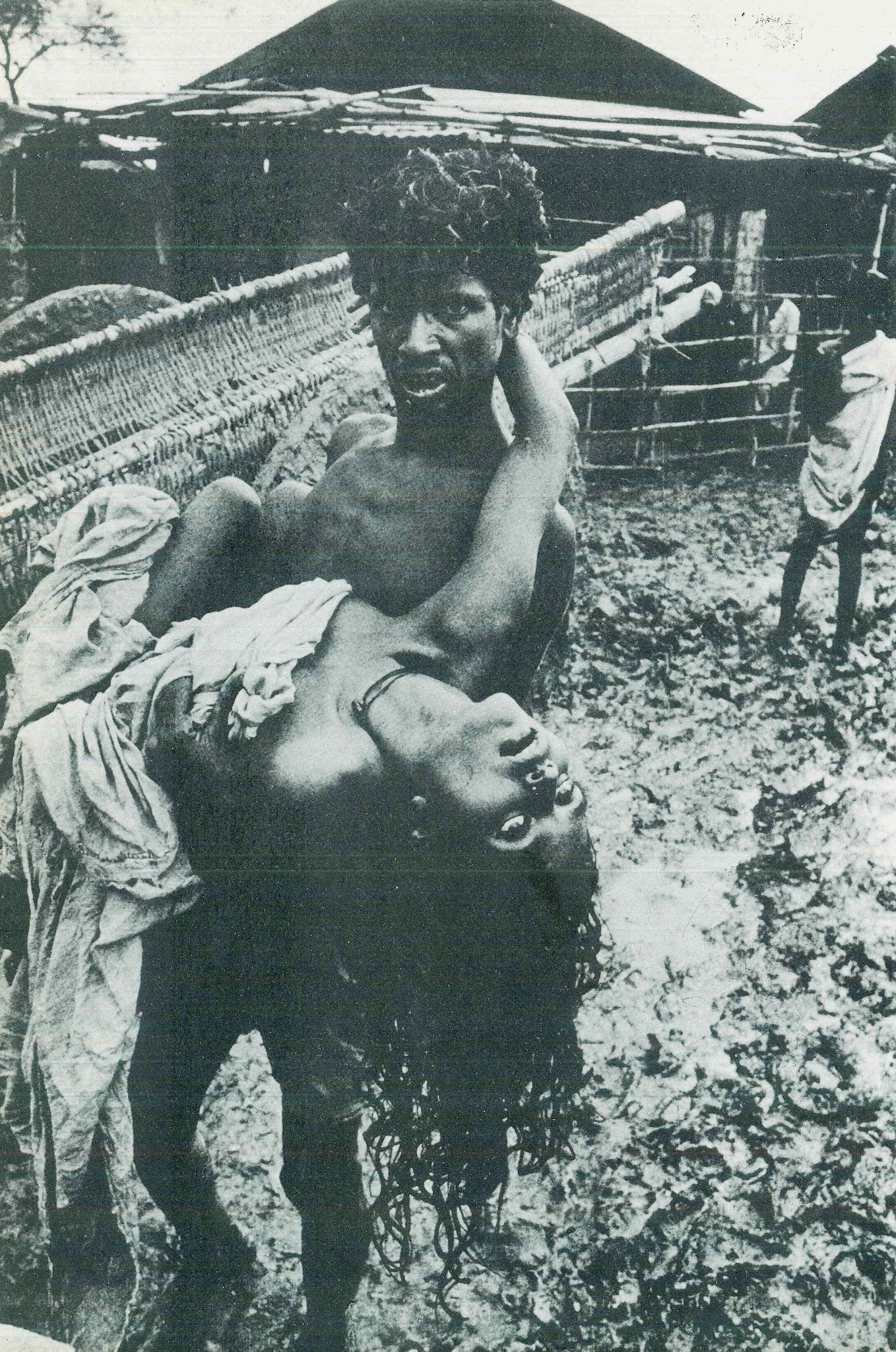
The woman with cholera was held by her husband during the 1971 Bangladesh genocide by West Pakistan, West Dinajpur, Bangladesh.

The Bangladesh Liberation War broke out from March 26, 1971 until it ended on December 16, 1971. In a refugee camp in West Dinajpur, Bangladesh, a Bangladeshi husband carried the body of his female wife, debilitated and dying of severe cholera, in his arms for help in poor conditions. The Pakistani army searched for people who were particularly likely to join the resistance, sweeping up the youth in particular. The corpses of Bangladeshi youths were scattered floating in the fields and rivers.

 The Bangladesh massacre was triggered by West Pakistan in East Pakistan on March 26, 1971. West Pakistani soldiers and military militias intervened in the Bangladesh genocide. West Pakistani troops attacked people in sight on the sidewalks of the capital Dhaka and destroyed buildings on the way. Tanks shelled the streets of Dhaka, indiscriminately blowing up people and buildings. They also shot and set fire to crowds of people in settlements. Tanks roared and cannons exploded in the main streets. The University of Dhaka and Hindu institutions were especially targeted. They executed genocide by looting valuables, raping women, and massacring unarmed civilians.

 West Pakistan's military crackdown led to the outbreak of genocide in Bangladesh, known as East Pakinstan, on March 26, 1971; on March 27, rival Bangladesh declared independence. During the nearly nine-month-long Bangladesh Liberation War, West Pakistani troops and Islamist militias crushed Bengali nationalism, killing some 200,000 to 3,000,000 people. They also massively raped some 200,000 to 400,000 Bengali women in Bangladesh. About 8 to 10 million people, mostly Hindus in Bangladesh, have fled to neighboring countries as refugees. About 30 million Bangladeshis became refugees out of a total of about 70 million. The Bengalis committed racial genocide of the Urdu Biharis, about 1,000 to 150,000.

 The U.S. made West Pakistan an ally in the Cold War. By December 16, India had forced West Pakistan into unconditional surrender and Bangladesh achieved independence.The 1948 United Nations Convention on the Crime of Genocide defined genocide as mass abuse and genocide that results in the total or partial destruction of a national, ethnic, racial, or religious group. 


4/26/2021

The Greek Civil War erupted in December 1944, pulling British forces into combat in Athens. Over the next five years this devastating conflict would shatter Greece and transform Europe.

During the Greek Civil War, the Greek Democratic National Army (GNA), attacked by Andante guerrillas, launched mortars at the village of Kastania. The mortar exploded outside an open window of a house. The inhabitant was blown to the left side of the head and died instantly. The dead body of the bombed Andante guerrilla was lying on the ground. His family and the wives of the neighbors surrounded the body. On the body's chest was a bouquet of flowers and a 10,000 drachma bill worth $2, the price of passage to the afterlife. They surrounded the corpse of the guerrilla and chanted a Christian chant while wailing. The village of Kastania, a stronghold of the Greek guerrillas, was occupied by the Nazi Germans during World War II, and about 260 of its 280 houses were destroyed. After that, about 600 Greek residents went into hiding. The Greek guerrillas were called Andantes, and when the Andantes resumed their guerrilla activities around September 1946, the military police of the Greek government forces left without being able to capture the guerrillas hiding in the area of the Pindus mountain range.

 The military police countered the guerrilla activities with a strict economic blockade. The military police countered the guerrillas with a severe economic blockade, blocking the local residents of the Pindus mountain range from bringing in food, clothing, and all other daily necessities. The biggest victims of the economic blockade were the local residents, who risked being mistreated and massacred if they went to the nearby village of Caravada to buy groceries because they were suspected of being Andante guerrillas.

 During the occupation of Greece by Nazi Germany, Andante guerrillas who joined the Greek People's Liberation Army (ELAS) took part in the resistance movement. When the occupation of Greece was liberated, the leftist resistance movement branded them as communists. Locally, they were excluded because of their background and fell into unemployment. On the contrary, the Greek Democratic National Army (GNA), which included collaborators against Germany, was supplied with weapons by the Greek government to capture ELAS. Driven into a corner, the Andante guerrillas had no choice but to hide in the Pindus mountain range. The Andante guerrilla forces split up and became separate and independent groups.

 The Greek government forces suffered about 48,000 casualties between 1946 and 1949. The armed rebels probably suffered about half of those casualties. But death squads on both sides killed thousands of civilians, and many more died of atrocities, disease, and starvation. It was estimated that some 158,000 Greeks died as a result of the civil war. Greece was almost plunged into economic devastation.

 Italian troops withdrew from Greece in the summer of 1943 and German troops in September 1944. In December 1944, the Greek National Army (GNA), with the support of British troops, defeated the EAM and ELAS. The GNA gained the upper hand by receiving a large supply of military supplies from the US.

 Greece was liberated from the Axis forces and the government-in-exile returned; the December Incident broke out on December 3, 1944, and the conflict between the Communist Left (EMA/ELS) and the Royalist Right (EDES) became more acute, leading to the outbreak of the Greek Civil War in 1946. The communist forces, supported by the Soviet Union and neighboring Yugoslavia, organized a guerrilla force called the Greek Democratic Army (DAG). The United States of America replaced Britain, which was suffering from financial difficulties after the war, and began to fully support the royalist right-wing government with the Marshall Plan. Furthermore, after 1948, Yugoslavia and the Soviet Union came into conflict, and the communist forces in Greece supported the Soviet Union, so the aid from Yugoslavia was lost, and the civil war ended with the defeat of the communist forces in 1949. 


Fifteen Vietnamese civilians were killed and four injured by the explosion of a mine on a country road 8 km west of Tuy Hòa, March 18, 1966.A mother became a victim of a landmine explosion and her daughter cried out beside the corpse.

About 15 Vietnamese civilians were killed and four others wounded in a landmine explosion on a rural road about 8 km west of Tuy Hoa in Sout...