5/10/2021

A mother weeps over the body of her son, killed whena viet Cong mine blew up the truck in which they were riding, August 1964.

 A young Vietnamese man was killed when the truck he was riding in was blown up by a landmine laid by the Vietcong in August 1964. The Vietnamese mother wept and wailed over the body of her dead son. At that time, the United States and South Vietnam were preparing to declare war on North Vietnam.

 President Johnson announced on August 5, 1964, that he would respond cautiously to any North Vietnamese attack and had no intention of expanding the war. Fighter-bombers from the aircraft carrier USS Ticonderoga and the aircraft carrier USS Constellation bombed four naval bases and oil depots in North Vietnam. An estimated 25 torpedo boats were destroyed and about 90 percent of Vinh's oil storage facilities went up in flames. Two American fighter planes were shot down by North Vietnamese anti-aircraft fire, damaging two of them. No North Vietnamese fighter jets were encountered in the air.

 The Gulf of Tonkin Resolution and air raids on North Vietnamese naval bases boosted South Vietnamese morale, but Ambassador Taylor warned the State Department that the effect would be temporary and unlikely to sustain Khanh's military regime. On August 16, 1964, Khanh's military government in South Vietnam promulgated a new constitution that gave him dictatorial powers due to the instability of his political base. The newly established Military Revolutionary Council was approved, but the Buddhists felt threatened by the political ambitions and started more riots, encouraged by Viet Cong sympathizers and dissident students. The discontent in the urban areas spread to the rural areas, and the military government of Khan, who had antagonized the people, resigned the presidency and abrogated the constitution, and the dissidents immediately launched a military coup, but the military coup was foiled by threats to bomb the rebel positions.

 Believing that the situation in South Vietnam would worsen further if the U.S. did not have its own identity, the Joint Chiefs of Staff deliberately provoked North Vietnamese attacks on U.S. forces with the Gulf of Tonkin incident. The U.S. could also have reason to launch airstrikes against North Vietnam. The Joint Chiefs of Staff decided that the military actions of the communists would determine the extent of the destruction of North Vietnam. President Johnson approved limited measures to put pressure on North Vietnam and agreed to launch airstrikes in the event that North Vietnam attacked U.S. forces. President Johnson agreed to respond with air raids in the event North Vietnam attacked American troops.

 The attack on North Vietnam was launched. President Johnson resumed patrols, which had been suspended since the Gulf of Tonkin incident. Despite Johnson's caution, the resumption of U.S. Navy patrols and covert operations off the coast of North Vietnam soon led to a new problem: On the night of September 18, the destroyers Morton and Parsons, sailing in the Gulf of Tonkin, reported on radar that they had spotted what appeared to be a torpedo boat. Both ships maneuvered for about 40 minutes, but were unable to escape their pursuers and were hit by the gunfire they fired. The image of the supposed enemy ship disappeared from the radar screen. On two more occasions, the image on the radar disappeared after being hit by gunfire. In total, both Morton and Parsons fired about 200 more 127-meter and 100 76.2-mm shells. None of the torpedoes or shells seen on radar exploded. President Johnson questioned the attack and did not bomb North Vietnam in retaliation. Judging the situation in the Gulf of Tonkin to be delicate, President Johnson again suspended patrols and postponed the resumption of South Vietnam's maritime operations in North Vietnamese waters. on October 4, he authorized the continuation of tightly controlled, covert operations against North Vietnam.

 President Johnson restrained himself, and two days later, the Gulf of Tonkin incident paid off politically, as he defeated Goldwater in the presidential election with an unprecedented 61 percent of the vote. However, there was a dark side to this victory. The American people gave strong support to President Johnson. However, a survey conducted by the polling firm Lewis Harris on the day of the vote showed that less than 42% of the public gave the president high marks for his handling of the Vietnam War; by early December, the figure for the Vietnam War had dropped to 38%. The American people were not certain whether President Johnson would take decisive military action to win the Vietnam War or withdraw from Vietnam. It was doubtful that President Johnson would lose the war if he did not take military action in Vietnam.


5/09/2021

The wreckage of an RAF bomber and its dead crew after the Nuremberg Raid. It resulted in the highest number of aircrew losses for any single air mission in World War 2 for the RAF.

 A British Halifax bomber after the Nuremberg raid was shot down and crashed at Stickgrass near Delmenhorst on its way to the city. The bodies and wreckage of the dead crew of British soldiers littered the surrounding area. The wreckage and corpses of this tragic battlefield were photographed and published by the Germans. 795 bombers of the Royal Air Force (RAF) were involved in the war effort during the Nuremberg raid on March 30, 1944, and about 95 were lost. This was more than about 11% of the bombers engaged. Many more aircraft crashed, damaged by fighter bombardment and blasts. Five hundred and forty-five British soldiers were killed, about one hundred and fifty more were taken prisoner, and a large number of the wounded were reported missing. The Nuremberg raid was the largest loss of aircraft by British bombers in a single operation. The damage to Nuremberg, the target, was relatively minor.

 The British bombed the city at night with light bombs. Cities and towns were targeted and collapsed with large amounts of explosives. Although munitions industries and military facilities were damaged, it was an indiscriminate terrorist bombing of civilians to demoralize the Germans. By March 1944, British bombs had been dropped on German cities in large numbers. Cities such as Mannheim, Cologne, and the capital Berlin had already been targeted, leaving behind a large amount of smoky rubble and many civilian casualties.

 Nuremberg, a city of about 150,000 people, was certainly a military target, but not a military city that would become an important fighting force for the German army. As Hitler's famous meeting place before the war, he regarded it as the spiritual center of Nazism. The Nuremberg raid was to be the last of the massive urban air raids by the Royal Air Force before the near future Normandy landings.

 The Germans were able to clearly see the British bombers coming over the Belgian coast from the moonlight and the plane clouds. More than 200 German fighter planes were urgently launched to intercept them, and the Royal Air Force was effectively ambushed. The German fighters attacked the British bombers from below. The German fighters shot at the fuselage of the bomb-laden British bombers, tearing off both wings carrying heavy fuel. The German night fighters continued to shoot down the British bombers. They lost sight of their target and disappeared into the clouds. Their formation was broken and they were knocked off course by crosswinds. Some were shot down in the nearby farming village of Lauf. About 150 bombers dumped their payloads in the field. Under heavy anti-aircraft fire from the ground, many of the bombers crashed away from the city. On the return journey, British bombers continued to be targeted by German fighters and anti-aircraft guns. The formation was broken up and the bombers were heavily scattered. Several bombers crashed along the way, either due to battle damage or running out of fuel.

 The Germans recorded the urban damage in Nuremberg as about 133 dead (about 75 in the city), about 412 wounded, about 198 houses completely destroyed, about 3,804 damaged, and about 11,000 homeless. The number of fires was about 120 large fires and 485 medium and small fires. Industrial damage was minor with railroads cut off, three large factories heavily damaged and about 96 industrial buildings destroyed.

 The greatest damage to Nuremberg occurred in an air raid on January 2, 1945, when some 521 British bombers dropped some 6,000 high-explosive bombs and about one million incendiary bombs on the city. More than about 1,800 of the population were killed and about 100,000 people were left homeless. Nuremberg's old town was almost completely destroyed and the entire city was badly damaged. the air raids ended on April 11, 1945, and American troops occupied Nuremberg on April 20.


5/08/2021

On 25 July 1946, the United States conducted the first-ever underwater nuclear explosion at test Baker detonated at the Bikini Atoll in the Pacific Ocean.

On July 25, 1946, the United States conducted the first-ever nuclear explosion of an atomic bomb underwater. The Baker test, detonated at Bikini Atoll in the Pacific Ocean, was the fifth of more than 2,000 nuclear detonation tests conducted to date. Of these tests, only a few, such as the Baker test, were conducted with underwater explosions, primarily to assess damage to ships and submarines; with the exception of a few in space, such as the Starfish Prime test in 1962, about three-quarters of the tests were conducted primarily underground, with the remainder in the atmosphere.

 The device for the Baker nuclear test was suspended about 30 meters below the surface of the sea from beneath a ship; it detonated an atomic bomb equivalent to about 23 kilotons of TNT explosives. The Baker test followed the atmospheric Able test of July 1, 1946, both of which used the same type of protonium atom bomb as the Nagasaki bomb. They evaluated the effects of nuclear explosions on a fleet of ships and on animals by underwater detonation. Both the Baker and Able nuclear tests were part of Operation Crossroads, which involved the evacuation of approximately 42,000 personnel, 242 ships, 156 aircraft, and all 162 residents of Bikini Atoll.

 During the Baker test, all pigs and most rats aboard the ships died from the blast or from radiation exposure. Of the approximately fifty-seven target ships, about eight were severely damaged, sinking or capsizing as a direct result of the explosion. Most of the remaining ships were exposed to high radiation. Despite decontamination efforts such as wiping and spraying the decks, the high radioactivity remained. The Baker nuclear test produced considerably more radioactivity than the Able. Most of the remaining ships were subsequently unable to operate due to overheating and were forced to sink.

 It was not until 1947, the year after the Baker and Able nuclear tests, that a team of scientists and engineers conducted a scientific re-examination of the Bikini Atoll. Clearly, radiation had entered the Pacific food chain. Plankton glistened on the photographic dry plates. So did the intestinal tracts of the fish that ate them. Whether Bikini Atoll will return to the ecological balance it had before the Able nuclear test is uncertain in the short term. In 1998, almost 50 years and half a century after the tests, the International Atomic Energy Agency (IAEA) recommended that Bikini Atoll, where 23 nuclear tests had been conducted, should not be resettled without special radioactive decontamination. Residents of Bikini, Eniweck, Rongelap, and Utirik who were exposed to nuclear testing and radioactive contamination filed lawsuits against the U.S. government in the 1980's. The 1986 Free Association Agreement provides for compensation to the U.S. government for the health and environmental effects of nuclear testing.


On 25 July 1946, the United States conducted the first-ever underwater nuclear explosion at test Baker detonated at the Bikini Atoll in the Pacific Ocean.


Operation Crossroads (Baker Event 1946)

5/07/2021

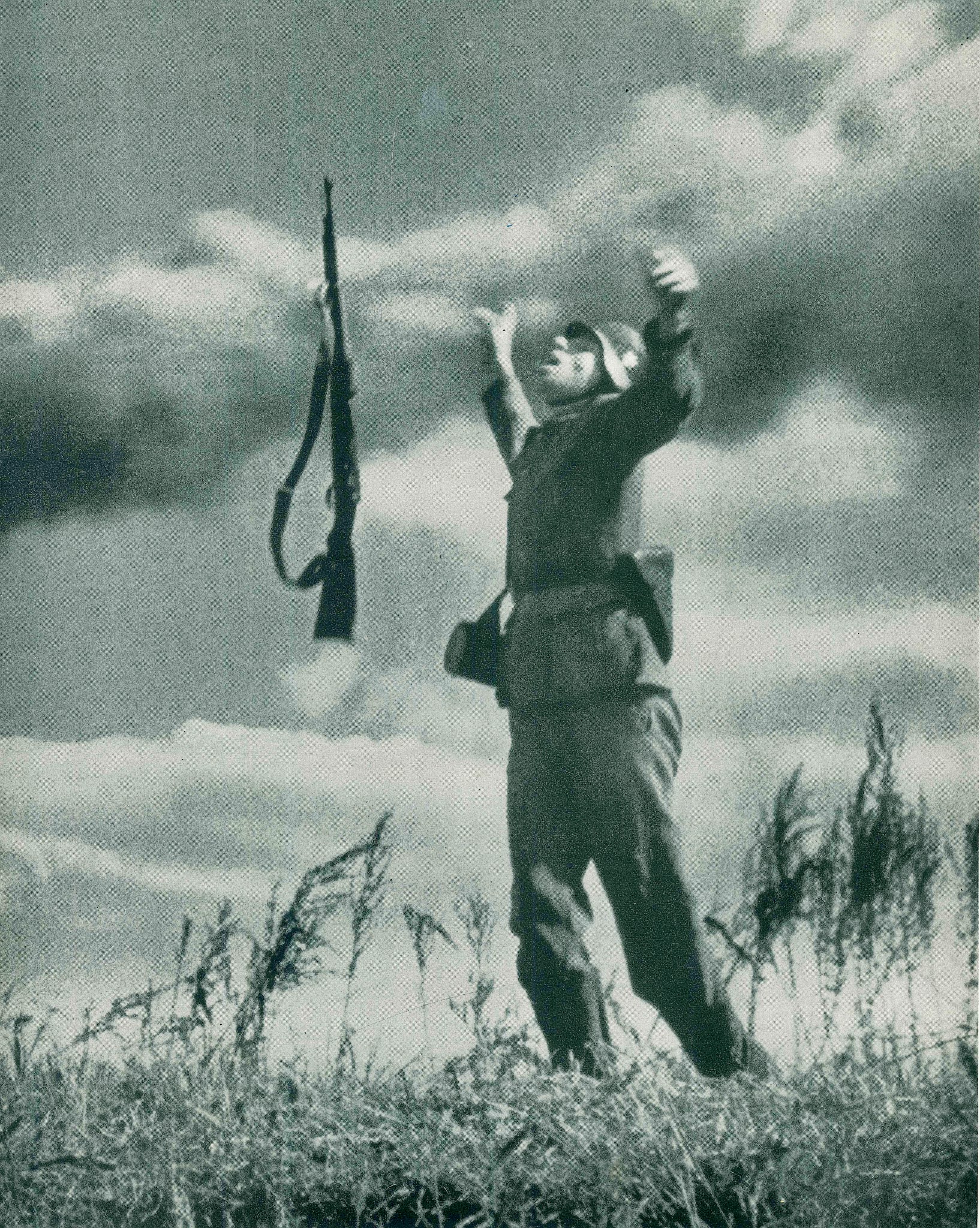
A dying German soldiers takes the bullets in the East, who was photographed on the field of battle by a Russian frontline cameraman a split second after a Red Army sniper fired his rifle.

A German soldier is shot standing by a Soviet sniper on the Eastern Front in World War II. The dying German soldier raised both upper limbs and threw his rifle out of his right hand. On the front lines of the Eastern Front, a German soldier fell to the battlefield after receiving a bullet that would end his life. Shortly after a Soviet Red Army sniper fired his rifle, a photograph of his death in battle was taken by a Soviet frontline photographer.

 Operation Barbarossa, the largest invasion of Nazi Germany's forces in World War II, began on June 22, 1941. After crossing the Soviet border, some four million German soldiers, supported by some 600,000 vehicles and 750,000 horses, attacked a front line that stretched some 3,000 kilometers long. In just the first seven days of the invasion, Nazi German troops had invaded about 300 kilometers into Soviet territory, about a third of the way to Moscow. The Blitzkrieg initially went well, the Nazi German offensive overwhelmed the Soviets with threats, and early Soviet losses were catastrophic. Most devastating were the human losses: by December 1941, the Soviets had killed about 2.7 million soldiers across their armed forces and captured about 3.3 million. For every German soldier lost, the Soviets lost about 20 soldiers. In just the first nine days of the Soviet invasion, the Luftwaffe lost about 40% of its fighters in the entire Soviet air force, about 1,400 in the air and 3,200 on the ground. The Nazi Germans lost only about 330 fighters. Furthermore, by mid-August 1941, the Soviets had disintegrated about 3,300 tanks, while the Nazi Germans had lost only about 220, an astonishing ratio of losses of about 15:1.

 From the end of 1941, as the Soviets recovered from the blitzkrieg of the Nazi Germans, their resistance hardened, and German losses gradually piled up. by August 1941, the Nazi Germans had lost about 46,000, and by December 1941, about 25% had been killed or wounded in action. by November 1941. By November 1941, the situation for the Soviet army was extremely dire. By November 1941, the Soviet army was in a state of extreme misery. Nazi Germany claimed to have won the war. About 2 million Soviet soldiers were taken prisoner, about 22,000 artillery pieces were seized and destroyed, about 18,000 tanks were destroyed, and 14,500 fighter planes were shot down. The Nazi German army was only about 16 kilometers from the capital, Moscow. The Soviets had only about 90,000 soldiers and about 150 tanks left. The fall of Moscow seemed imminent, and on November 7, 1941, Stalin held a military parade in Moscow's Red Square.


 In December 1941, the temperature plummeted to -35 degrees Celsius. It was unusually extremely cold in Russia, even colder than the normal year. From January 1942, resupplied and equipped Soviet troops pushed the exhausted and weakened Nazi German army back about 100 to 200 kilometers to the west. The Soviet army, supplied and equipped since January 42, pushed the exhausted and weakened Nazi German army back about 100 to 200 kilometers to the west. This was the first major defeat and retreat suffered by the Nazi German army in World War II. In the bloodiest battle of the war, the Battle of Moscow, about one million German soldiers lost their lives.


5/06/2021

During Russian Civil War, White Guards shot Red Army soldiers and Soviet citizens with civilian massacres, hostage takings, deportations of populations collectively considered as "enemies."

 After the October Revolution of 1917 in Russia, the Russian Civil War broke out between the Red Army and the White Army. The White Army massacred the workers and peasants who made up the Red Army. The peasants, who had been oppressed as serfs during the Russian Empire, were wary that the White Army would bring back the former Empire. During the civil war, there were an estimated 7 to 12 million casualties, most of them civilians. During the Russian Civil War, many civilians became refugees and were forced to flee their homes at the hands of both the Red and White armies. When one side committed atrocities, the other side retaliated in equal measure. In addition, the Red Army had its own secret police force, the Chequers, created in December 1917, which arrested citizens without warrants and executed them for crimes they did not commit.

 The White Army is the general term for the former regime forces on the counter-revolutionary side against the Red Army on the revolutionary side during the Russian Revolution after the October Revolution of 1917. In the Russian Civil War, the White Army and the Red Army fought each other. The White Army opposed the October Revolution led by the Bolsheviks under Lenin. The White Army consisted of the former Russian Imperial Army, the White Army Faction, and the Cossack Army, many of whom were republicans, who established republics in various regions and opposed the Soviet communist Red Army with support from Britain and France. The Red Army was led by Lenin.

 The Red Army was formed by the Bolsheviks, led by Lenin, with workers and peasants by Trotsky in January 1918. They signed the Treaty of Brest-Litovsk in March 1918, ceding vast territories to the German Reich and accepting the terms of large reparations. Many opponents of the old regime rose up and assassinated the Russian and German ambassadors in July 1918, and on August 30, 1918, an assassination attempt was made on Lenin. On August 30, 1918, an attempt was made to assassinate Lenin, who had just finished a speech at a factory rally in Moscow and was getting into his car when three shots rang out, two of which hit him in the shoulder and lung. The Bolsheviks took this as an opportunity to declare a civil war of "Red Terror" by the Red Army starting September 5, 1918, and began a massive crackdown and executions of many opponents of the old regime.

 After the Red Army ended the Russian Civil War, the Red Bolsheviks were able to reunify the Russian land, but it was in a state of extreme devastation and destruction, further impoverished by the drought of 1920-1921. In order to abolish the market economy, food was forcibly requisitioned from starving areas in reverse, resulting in many starvation deaths. Within just a few years of the outbreak of the October Revolution, some 8 million civilians died. Due to the atrocities of the Russian Civil War, civilians were involved in inhuman acts of mass abuse and genocide.


5/05/2021

British Bristol Biplane collides with a German Fokker during a mid-air dogflight 1916. According to Smithsonian Museum (1984), these images were faked by models and trick photography.

 In 1931, Officer Gladys Maud Cockburn Lange, a Royal Air Force pilot in World War I, published a shocking photograph of an aerial battle in which a British Bristol biplane fighter collided with a German Fokker fighter during an aerial battle in 1916, causing both aircraft to crash and die. In 1931, Officer Gladys Maud Cockburn Lange, a Royal Air Force pilot in World War I, published a shocking photograph of an aerial battle. It was hailed as the most vividly realistic of all aviation records. It was said to have been taken from a camera attached to an airplane. The photos were published in British newspapers and other media after 1932 as Death in the Air - A Pilot's Combat Diary of the Battle of the Air. Some of the images were also used for book covers, and many people went wild buying the phenomenal images. In Britain, fighter pilots were portrayed as knights of World War I, and many became popular heroes. However, it wasn't until 1984 that the Smithsonian National Air and Space Museum in the U.S. received a donation of aerial combat images from a deceased friend, which were discovered to be forgeries.

 Since World War I, fighter planes have fought in dog fligts at close range, with the first real aerial battle taking place during the Mexican Revolution in 1913. In World War I, aircraft were initially used for reconnaissance. In World War I, aircraft were initially used for reconnaissance, and then aerial combat at close range became more frequent. In addition, they began shooting at enemy aircraft with machine guns and other weapons. The first aerial combat by aircraft in World War I occurred in August 1914, when the Austro-Hungarian Empire fought the Battle of Zell against Serbia.

 In World War I, the first French fighter equipped with a machine gun on its biplane wing shot down a German aircraft over France in October 1914. During World War I, in July 1915, German Fokker fighters with machine guns mounted on the nose of their planes went on a rampage that was dubbed the Fokker Punishment.

 The Allies reestablished air superiority in January 1916 with new fighter aircraft, just in time for the Battle of the Somme and the end of the Fokker Punishment. In April 1917, the British Army Air Corps suffered heavy casualties in what was called "Bloody April. In April 1917, the British Army Air Corps suffered heavy casualties in what became known as the Bloody April. Gradually, the Allies overwhelmed the Germans in terms of both quantity and quality of air power, but until the end of the war, the Germans had the upper hand in the race to develop the most advanced fighter aircraft, thanks to their engine munitions industry.


5/04/2021

The Kassel World War II bombings were a set of Allied strategic bombing attacks which took place from February 1942 to March 1945. On 22–23 October 1943, 150,000 inhabitants were bombed-out, at least 10,000 people died.

From February 1942 to March 1945, the Allied forces launched about 40 strategic bombing raids on Kassel in the central German state of Hesse during World War II. The bodies of the victims of the air raids on Kassel residents were placed in the square. It took weeks to accumulate all the dead bodies of Kassel citizens from the streets and abandoned cellars in the streets. The American army occupied Kassel on April 3, 1945. Kassel had a population of about 236,000 in 1939, of which only about 50,000 remained. At least 90 percent of the old city center was in ruins. The indiscriminate and intensive bombing in the name of demoralizing the German people was condemned after the war as a terrorist bombing. Extensive sweeps of bombed and un-bombed buildings devastated the city.

 The worst attack was the British bombing raid of October 22-23, 1943, which destroyed most of Kassel's city center, but the city's industrial areas remained. The only victims of the targets were the citizens of Kassel. About 150,000 inhabitants were bombed and at least about 10,000 people were killed. The heaviest air raids caused fires that burned for about seven days. About 569 bombers dropped about 1,800 tons of bombs and 460,000 magnesium incendiary bombs on the old city of Kassel for about 80 minutes.

 The pressure wave of the explosions tore off roofs, windows and doors. Many of the buildings, mostly wooden, were engulfed in flames within about 15 minutes by the bombs raining down from the sky. Kassel had narrow streets where the fire could easily spread. The highest temperature reached about 1,500 degrees Celsius, and the wind speed reached about 160 km/h. All the oxygen was sucked out of the air and the inhabitants who reached the first safety of the basement soon suffocated to death. Most of the residents fled to the basement of the building they were living in. Ventilation pumps sucked in flames and smoke from the outside world in the opposite direction. Many residents could not find their way out to the surface, leading to chaotic hellish conditions in the narrow rooms and hallways where they got lost.


5/03/2021

A German U-boat torpedoed the British-owned steamship Lusitania, killing 1,195 people including 128 Americans, on May 7, 1915, whose disaster would led to the U.S. entering World War I.

Funeral services for the victims of the catastrophe of the British-flagged Lusitania, sunk by a German submarine U-boat, were held on May 10, 1915, at a graveyard in Queenstown, Ireland. Of the victims of the sinking of the Lusitania at Kinsale in the waters around Ireland, about 120 bodies were pulled from the Atlantic Ocean and buried in a mass grave. On May 7, 1915, the German submarine U-boat torpedoed and sank the British-owned steamship Lusitania. About 1,195 people were killed, including about 128 Americans. This catastrophe set in motion a series of events that led to America's entry into World War I.

 The Lusitania catastrophe eventually fueled anti-German sentiment in the neutral United States, which eventually led the United States to enter World War I. After World War I began in 1914, the British secretly converted the passenger ship Lusitania into a transport ship. In February 1915, the Germans declared the waters surrounding Britain a war zone, and German submarines ignored warnings against merchant ships, contrary to international treaties. Allied troops were unable to transport arms and supplies from the United States.

 The German embassy had declared on April 20, 1915 that the U.S. was at war with Great Britain and that ships under the British flag were targets for attack. Later on May 1, the Lusitania, sailing from New York to Liverpool, was torpedoed without warning by a German U-boat and sank about 20 minutes later. Passengers died in the water without having time to get on a lifeboat. The tragic fate of the distant ocean liner Lusitania was reported in the newspapers on May 18, 1915. Immediately, the British clamored emphatically for condemnation and outrage over the German attacks on civilians. Riots broke out in London as groups of British citizens took revenge against the Germans.

 German U-boats also sank another British vessel, the SS Arabic, in August 1915. The succession of incidents heightened the tension of hatred between the US and Germany. The U.S. government warned that it would break off diplomatic relations with Germany and join Britain in World War I if it attacked ships without cause. Germany had announced in September 1915 that it would warn ships before attacking them. British intelligence intercepted a Zimmerman telegram in early 1917 in which Germany resumed indiscriminate ship attacks in central alliance with Mexico, and the newspaper published it on March 1. Shortly after the Germans resumed full-scale indiscriminate submarine attacks on February 3, the U.S. Congress declared war on the Central Allies on April 6, 1917, and entered the Allies in World War I.


5/02/2021

Death on the Scaffold awaited the conspirators, after a trial by a special military court, the sentence to be hanged was carried out, in the Washington prison yard on July 7, 1865.

Four conspirators involved in the assassination of President Abraham Lincoln were executed on the gallows where they were viewed by Union troops. David E. Herold, George A. Adselot, Lewis Payne, and the first woman, Mrs. Mary E. Surratt (pictured far left), were hanged after a trial by a special military tribunal. Mrs. Surratt was the janitor of a boarding house in Washington where the conspirators met. The trial of the eight arrested conspirators took the form of a court-martial, and all eight were found guilty. The hanging took place on July 7, 1865 at the prison inside Fort McNair in Washington. Others, Michael O'Laughlin, Edward Spangler, Samuel Arnold, and Dr. Samuel A. Mudd, who tended to Booth's broken bones, were convicted of conspiracy and sentenced to life in prison. O'Laughlin died in a military prison. Others later had their sentences commuted.

 The Civil War, which lasted about four years, ended with a Union victory on April 12, 1861-May 9, 1865. Five days later, President Abraham Lincoln was assassinated. Lincoln, who had fought in the Civil War, freed the slaves, and was hailed as "the greatest man since Christ," gave a comedy performance called "Our American Cousin" at Ford's Theatre in Washington, D.C. at about 10 p.m. on April 14, 1865. Lincoln was assassinated on April 14, 1865 at about 10:00 p.m. at Ford's Theatre in Washington, D.C. while watching a comedy called Our American Cousin. John Wilkes Booth, an actor from the South, assassinated Lincoln by shooting him in the back of the head with a pistol. After the assassination and his escape from the theater, he was tracked down and shot dead. It was the first assassination of a president in the history of the United States.

 In a special seat on the second floor of Ford's Theater, Room 8, Booth walked up behind Lincoln and shot him in the back of the head with a pistol at close range. He shouted "Southern revenge" and jumped down to the stage about four meters below. The tyrant ran past him, shouting that he was dead, and escaped. President Lincoln, who was shot, died at 7:22 a.m. the next day, April 15, at the age of 56.

 Booth did not act alone, and six other conspirators were arrested. Booth escaped by boat on the Anacostia River, and three Confederate soldiers helped him escape. During the arrest of Booth and his co-conspirators, who were hiding in a barn, after setting it on fire, Booth was shot in the neck and killed. Herold, who was holed up in the barn with him, was arrested. At the military trial, four of Booth's six accomplices were hanged, and two were sentenced to life in prison.


5/01/2021

On August 6, 1945, the atomic bomb is dropped on Hiroshima. Gen's father and siblings perish in the fires, but he and his mother escape.Hiroshima lies in ruins, and the city is full of people dead and dying from severe burns and radiation sickness.

 In Barefoot Gen "Vol. 1: The Appearance of Gen Aomugi", an atomic bomb was dropped on Hiroshima City by the U.S. military on August 6, 1945 and exploded. Immediately afterwards, houses collapsed and burned, and the father, sister and brother, who were buried together and could not move, burned to death all at once. Barefoot Gen and his mother, who were left behind after the atomic bomb exploded, fled the area around the hypocenter, which had become a burning place with Hibakusha suffering from burns. Later, Barefoot Gen fled with his mother, who was carrying a newborn baby. Since the end of the war, he has lived through a variety of hardships.

 Nakazawa Keiji, the author of Barefoot Gen, used his own experience of the atomic bombing of Hiroshima in the first year of elementary school as the source of his long manga series in Shonen Jump, which depicted the harsh lives of atomic bomb survivors during and after the war, when the Hiroshima bomb exploded. Barefoot Gen was published at the end of the Pacific War, set in the aftermath of the Hiroshima atomic bombing and featuring second-year elementary school student Nakaoka Gen as the main character. The Nakaoka family, engaged in the manufacture of painted clogs, was very poor, and their five children grew up healthy during the war. However, when their father spoke out against the Pacific War, they were marginalized and discriminated against as unpatriotic, and were driven into the shadows. 

 Eventually, after the war, he met his eldest son, Koji Nakaoka, who had volunteered to join the Japanese army's preliminary training program, and his second son, Akira Nakaoka, who had been evacuated to a school. They were joined by Ryuta, an orphan who bore a striking resemblance to his younger brother, Shinji Nakaoka, who had been burned to death. The lives of the Hibakusha unfolded more fully, but the point of the manga was to depict the cruelty and misery of war through the reality of their miserable lives.

 The point of this manga is to depict the cruelty and misery of war through the realities of the Hibakusha's miserable lives. The younger generation after the war has no experience and ignorance of the mass abuse and genocide of war. They have been brainwashed with a distorted sense of war through television, movies, cartoons, and games. The horrors and deprivations of war are not limited to the bursting of atomic bombs, shooting and air raids on the battlefield. Anyone who does not criticize, oppose, or actively cooperate with the war effort is discriminated against, ostracized, abused, and slaughtered. Moreover, the aftereffects of the war have left grievous wounds even after the war.

 Barefoot Gen never gave up and crawled through such circumstances during and after the war. The boy known as Barefoot Gen becomes the protagonist of the story, which depicts more poignantly the tragic lives of the atomic bomb survivors during and after the war, when the Hiroshima atomic bomb exploded. During the war, the Nakaoka family was evacuated from their surroundings as an unpatriotic family, and after the war, they were marginalized as outsiders. To the generation born after the war, which was completely indifferent and ignorant of the cruelty and misery of war, Barefoot Gen manga depicts war and peace in a small, light and gentle way.

 In 2005, at least, English, French, German, Italian, Korean, Russian, Spanish, Indonesian, Thai, Esperanto, Norwegian, and Polish editions of Barefoot Gen have already been published.

 The author, Nakazawa Keiji, talked about Barefoot Gen as follows. It's hard to draw a manga about an atomic bomb, but children can honestly discern what is true. That is why I continued to draw while relaxing and hoping that the children would be able to enter the work, rather than straining their shoulders. It is my hope that they will be able to grasp the real thing and understand what the atomic bomb is. 


Fifteen Vietnamese civilians were killed and four injured by the explosion of a mine on a country road 8 km west of Tuy Hòa, March 18, 1966.A mother became a victim of a landmine explosion and her daughter cried out beside the corpse.

About 15 Vietnamese civilians were killed and four others wounded in a landmine explosion on a rural road about 8 km west of Tuy Hoa in Sout...