In the early morning hours of August 10, 1945, the day after the Nagasaki atomic bomb exploded on August 9, 1945, the area around the Catholic Nakamachi Church collapsed and burned down after the bombing. It was located about 2.5 meters south-southeast of the hypocenter of the Nagasaki atomic bomb. The area was completely destroyed by a second fire and the whole area was burnt to the ground. The heat rays from the atomic bomb caused combustible materials to ignite and reignite, leading to a huge fire. The Catholic Nakamachi Church was destroyed by the atomic bombing of Nagasaki on August 9, 1945, leaving the outer walls and steeple.
The situation in Nagasaki was different from other air raids in that the entire city was instantly turned into a burnt earth by the blast and the fire. Efforts to extinguish the fire and the medical team's efforts to rescue the victims were chaotic. As we waited for the time to pass, a small number of Nagasaki citizens who had survived because of their location gathered to search their homes and relatives. The Nagasaki atomic bomb was dropped at 11:02 a.m. on August 9, 1945, and exploded, killing or injuring about 120,820 people and setting about 18,409 houses on fire.
At 11:02 a.m. on August 9, 1945, the explosion of the Nagasaki atomic bomb broke the windows of the cathedral and the interior collapsed due to the blast. A few hours later, the fire destroyed the roof of the cathedral, leaving only the steeple with the cross and the outer walls of the cathedral. Construction of the Nakamachi Church, located about 2.6 km south-southeast of the hypocenter, began in August 1981 with a donation from a French woman, and the dedication ceremony was held on September 8, 1897 to commemorate the 300th anniversary of the martyrdom of the 26 saints. The chapel is a grand Romanesque building with brick walls painted with cement, and the main entrance has a steeple with four large clocks, one on each side of the exterior walls.
In October 1951, the church was rebuilt with its exterior walls and steeple intact. In October 1951, the church was rebuilt with its exterior walls and steeple intact, and as such, it has been designated by the city of Nagasaki as a valuable remains of the atomic bombing, and an inscription has been placed by the church gate. The city of Nagasaki installed the nameplate to pray for the souls of those who were killed in and around the Nakamachi area of Nagasaki City, and to hope that such a horrific disaster will never be repeated.
Yosuke Yamabata (1917-1966), a member of the press corps of the Army Headquarters, was transferred from Tokyo on August 1 to Fukuoka City on August 6. He had passed through Hiroshima City the night before, where a new type of atomic bomb was dropped and exploded on August 6. I arrived at Michinoo Station in the northern part of Nagasaki City at 3:00 a.m. on August 10. I stayed in Nagasaki City for about 12 hours and recorded about 115 photographs, which I developed on August 12 and took back to Tokyo after being advised by my colleague Shihei Hino that the military would destroy them. After the war, on September 9, GHQ imposed strict censorship on the press. After keeping it sealed for about seven years, the peace treaty with Japan came into effect on April 28, 1952, and on August 6, 1952, the atomic bomb photos were published in the August 6 issue of the Asahi Graph.
In every age, it is the citizens who are made the perpetrators and victims of war. INWN wants the generation of peaceful citizens who have never known war to remember the "Truth of Wars". Keep in mind that blogs that record the facts of war and peace should be viewed not only for their interest and significance. Only "The Truth of Wars" can be a true deterrent to war by peaceful citizens. Let's explore international peaces as the Citizens for Global Peace from International No War NGO.
5/15/2021
In the day after the Nagasaki atomic bomb exploded, the area around the Catholic Church of Nakamachi collapsed and burned down. The citizens of Nagasaki survived in only gathered together to search for their relatives and homes.
5/14/2021
Since the Edo period (1603-1867), seppuku in Japan was accompanied by a ritual, in which the warrior dressed in white in front of onlookers and had his head cut off by an intercessor if he did not die immediately after the seppuku with a Japanese sword.
From World War II until the Emperor Showa's decree ending the war, some Japanese soldiers chose to commit suicide by seppuku. Since the Edo period, seppuku in Japan was accompanied by detailed rituals. Not only was seppuku performed on the battlefield, it was also performed in front of onlookers. The warrior would take a bath, dress in white, have a last meal or cup of sake, and the Japanese sword and cloth would be placed on separate three sides and handed to the warrior. Placing the Japanese sword in front of him, the samurai wrote a poem of resignation just before his death and wished to commit seppuku (a colorized photographic reproduction of the seppuku scene).
In Japan, Seppuku was considered to be a final suicide ritual to protect the honor of the samurai. A samurai would choose to end his life by committing seppuku when he failed to protect his lord, when he defiled his lord, or when he caused serious misconduct in the house. The Japanese believed that a samurai with a stain on his life was not worthy of the name of samurai, and that the best way to end his life was to commit seppuku. Seppuku became a way for samurai to atone for their sins, repent, relieve their shame, blaspheme others, and prove their loyalty. Although seppuku was a serious crime, it allowed the warrior to commit seppuku and retain his honor.
From the Heian to the Edo period, Japanese warriors considered it shameful to be captured or killed by someone else's sword. The first record of this practice was in 988 during the Heian period, when the nobleman Fujiwara Yasusuke was arrested as a bandit and committed suicide by seppuku in prison. Seppuku, also known as harakiri, was a common act of suicide. Seppuku was widely recognized in Japanese society as a means of demonstrating the highest virtues such as loyalty, filial piety, and courage of the samurai. In the era of militarism after the Meiji era, seppuku was glorified as the core of Japan's Yamato spirit. Seppuku was abolished from judicial punishment in 1873; Article 1 of the "Imperial Rescript for Soldiers" issued in 1882 stipulated that soldiers must commit suicide if necessary.
There are four types of seppuku: single, double, triple, and cross, as well as two limb positions: standing and sitting. The most common form of seppuku began with cutting the belly. If the seppuku resulted in blood loss but not immediate death, the seppuku victim, who did not commit suicide, would stretch his neck and have his neck cut off by an aide. This was done with the cooperation of the intercessor who usually achieved final death by cutting off the head. The core of seppuku is not to die prematurely, but to endure the pain. The complicated procedure leading up to seppuku has a more ritualistic meaning. Before committing seppuku, a samurai usually changes into a white kimono, places his favorite sake and food in front of him, and then performs the entire ritual of seppuku himself. In addition to samurai suicides, women have also been asked to commit seppuku in Japan. Most often, this happens when their husbands die or when they have done something seriously wrong. Many of the knives these women used to commit seppuku were given to them by their own fathers or the groom's father at the time of their marriage.
The Japanese chose to commit seppuku as an act of patriotic loyalty. On September 13, 1912, the day of Emperor Meiji's burial, Japanese army general Kigenori Nogi and his wife Shizuko Nogi both chose to commit seppuku at home to show their loyalty to the emperor. The Japanese people went crazy over this act, calling it a great achievement, and during the Meiji era, they revered Kishinori Nogi as a god of war and a symbol of Bushido. From World War II until the Emperor Showa's decree ending the war, some Japanese soldiers chose to commit suicide by seppuku. It was not until 1968 that the Japanese government officially banned seppuku as a form of bushido; in 1970, Yukio Mishima and others committed seppuku at the Self-Defense Forces garrison in Ichigaya. In Japan's underground underworld, seppuku is still incubated.
5/13/2021
The bodies of American soldiers killed north of the airfield by Japanese artillery fire during the Battle of Peleliu Island, with his right lower leg blown off at the base.
During the Battle of Peleliu Island, an American soldier was killed by Japanese artillery fire north of the airfield on Peleliu Island. The body of the slain American soldier had his right lower leg blown off at the base.
In the Pacific War, American troops landed on Peleliu Island in the Palau archipelago in the Western Pacific on September 15, 1944. After fierce Japanese resistance and heavy casualties, American forces were finally able to capture the island on November 27. The attack on Peleliu Island was the deadliest amphibious landing in American military history.
Peleliu Island had a linkage of caves made of rock, which the Japanese connected with tunnels to serve as fortifications. When the Japanese invaded, they did so from directly above the caves, inflicting maximum damage on the American troops directly below.
More than 10,000 Japanese troops were stationed on Peleliu Island, a volcanic island six miles long and two miles wide. The island had an airfield and was invaded in an amphibious assault that neutralized this threat. on the morning of September 15, 1944, American forces landed on the southwestern tip of Peleliu Island. On the morning of September 15, 1944, American forces landed on the southwestern tip of Peleliu Island, preceded by raids and bombings by carrier-based aircraft. The landings came in waves, gathering on the island's shores and pushing inland.
However, it took the Japanese many days to stop the American invasion, resulting in massive casualties. Peleliu Island had many caves and a network of tunnels connecting it, and the Japanese were largely unscathed from the Allied bombardment. The Japanese defended their airstrip on the southwestern part of Peleliu Island for four days.
As the Americans moved northward and began their invasion, they became the target of a volley of Japanese heavy artillery and rifle fire from a cave dug into the rock face of Umbrugol Mountain, dubbed Bloody Nose Ridge along the way. Over the next eight days, American troops engaged in one of the most harrowing and costly battles of the Pacific War, suffering about 50% casualties.
Meanwhile, U.S. reinforcements sent in re-attacked Nosebleed Ridge from the west on September 24. Allied forces were able to encircle the Japanese positions on the mountain. The Japanese held out and finally retreated after much bloodshed during October. More American reinforcements arrived, and on November 25, the ridge was finally occupied, and the Japanese refused to surrender, nearly all of them killed.
The Battle of Peleliu produced the highest casualty rate for amphibious operations in American military history. Of the 28,000 U.S. soldiers who participated in the battle, about 40 percent were killed or wounded, with 1,800 killed in action and 8,000 wounded, for a total of about 9,800 casualties. On the other hand, the U.S. forces achieved their objectives from the capture of Peleliu Island to the recapture of the Philippines and the invasion of the Japanese main islands.
5/12/2021
American forces invaded the island on February 19, 1945, and the ensuing Battle of Iwo Jima lasted for five weeks. It's eatimated that all but 200 or so of the 21,000 Japanese forces on the island were killed, as were almost 7,000 Marines.
During the Battle of Iwo Jima in the Pacific War, a Japanese soldier was murdered by American troops and his grisly corpse was scattered in the sandy wilderness southwest of Motoyama No. 2 Airfield. The murdered bodies were lying on their backs with their helmets removed around them, both knees bent and both upper limbs hugged and in rigor mortis. American forces had taken Motoyama No. 2 Airfield by February 27. The Japanese defended themselves on the battlefield of Iwo Jima, which was filled with man-made and natural defenses. They bombarded American troops with artillery during the day, and came up behind them at night, planting mines in their path to block the invasion. The American forces broke through and swept away with massive and overwhelming attacks, flamethrowers, packing explosives, and grenades.
The Battle of Iwo Jima was the first major battle fought on Japanese soil during World War II. It was an extremely fierce and costly battle for the American forces. During the first five days of the landing, there were about 1,200 casualties each day. As many as one-third of the U.S. troops who landed suffered casualties. On March 26, Iwo Jima was conquered by the Americans after Japanese soldiers were annihilated in a banzai charge against American troops near the beach. Only about 216 Japanese troops survived capture, and all the rest were killed in action.
The battle of Iwo Jima was more costly for the Americans than for the Japanese, with about 7,000 of the landing force killed and about 19,000 wounded. Details of the casualties of the 36-day battle of Iwo Jima are suggested as follows: Approximately 110,000 American soldiers participated in the battle of Iwo Jima, less than 19% of the total number of Japanese soldiers, about 20,530. The number of American casualties was about 6,821, and the number of Japanese casualties was about 19,900. American casualties were about 21,865, and Japanese casualties were about 1,033. The total number of casualties was approximately 28,686 for the U.S. forces and 20,933 for the Japanese. In total, the American side suffered about 7,753 more casualties than the Japanese side in the Pacific War. The casualty count at Iwo Jima shocked the American people. Giving no time to condemn the bloody and barbaric battle, the invasion of Okinawa began four days after the fall of Iwo Jima. Beyond the battle of Iwo Jima, the entire Japanese archipelago was bombed in a long and bloody war of revenge that engulfed the civilian population in indiscriminate and tragic casualties.
5/11/2021
As the Yanks moved up, they found the Allied battered and weary from years of furtile warfare. Here French poilus carry a corpse post a wounded comrade. French troops after an German attack and bombardment, World War I, 30th June 1915.
In World War I, on June 30, 1915, French troops were attacked and shelled by German troops in the trenches of Massige in northeastern France near the German border. A French soldier was carrying the body of a French soldier who had been killed in the trench, wrapped in cloth. As they advanced through the trenches, they found French soldiers who had fallen, battered and tired and wounded from the barren fighting.
The French army alone lost nearly 900 men a day between 1914 and 1918, while the Germans lost about 1,300. About 86% of those deaths occurred on the battlefield, and about 14% resulted from disease or captivity. Battlefield casualties who were unable to return home on their own were almost certainly doomed to death due to fatigue, new wounds, and pressure. The wounds were gruesome, with bullets penetrating the chest, stomach, and skull, and one of the wounded had his mandible shattered into a bead of blood. The wounds were coated with iodine to fix the blood. No intravenous fluids or blood transfusions were administered. After the wound was cleaned, a large, ready-made military bandage was applied. There was not enough water to wash their muddy hands.
Many of the war wounded could only be rescued at night. It took about four days and nights and a great deal of effort to bring back some of the battle wounded who were near the French positions. Most of the soldiers left behind in the trenches were already dead.
Carrying about 30 kilos of ammunition and food, the soldiers noiselessly climbed the trenches in the first group in the middle of the night. After hours of marching, the trenches stretched for several kilometers and connected. The trenches were riddled with shell holes and the cries of the wounded and the screams of bombs drifted through the air. If you got lost without warning in front of an enemy trench, you had to give up your head, torso, or legs to machine guns.
In the trenches, the main weapon of the French soldiers was the rifle. The 1.80 meter bayonet with bayonet was very impractical in the narrow trenches of positional warfare. In hand-to-hand combat, the most terrifying ordeal for a soldier, he would shudder in fear when the order to shoot with bayonets rang out. When they reached the trenches, the infantrymen found it extremely difficult to operate the bayonet. Since bayonets could not be used hand-held, the soldiers used trench shovels and iron-wood headbreakers instead. We had to cross the plains where bullets were flying. We approached the enemy and a terrible hand-to-hand battle began. My rifle was no longer useful, so I attacked with my shovel. I staggered and dove into a whirlpool of men I didn't recognize and could no longer hear. My nose and ears were bleeding, I was losing my mind, I could no longer see or think of danger, and I ceased to give my life.
5/10/2021
A mother weeps over the body of her son, killed whena viet Cong mine blew up the truck in which they were riding, August 1964.
A young Vietnamese man was killed when the truck he was riding in was blown up by a landmine laid by the Vietcong in August 1964. The Vietnamese mother wept and wailed over the body of her dead son. At that time, the United States and South Vietnam were preparing to declare war on North Vietnam.
President Johnson announced on August 5, 1964, that he would respond cautiously to any North Vietnamese attack and had no intention of expanding the war. Fighter-bombers from the aircraft carrier USS Ticonderoga and the aircraft carrier USS Constellation bombed four naval bases and oil depots in North Vietnam. An estimated 25 torpedo boats were destroyed and about 90 percent of Vinh's oil storage facilities went up in flames. Two American fighter planes were shot down by North Vietnamese anti-aircraft fire, damaging two of them. No North Vietnamese fighter jets were encountered in the air.
The Gulf of Tonkin Resolution and air raids on North Vietnamese naval bases boosted South Vietnamese morale, but Ambassador Taylor warned the State Department that the effect would be temporary and unlikely to sustain Khanh's military regime. On August 16, 1964, Khanh's military government in South Vietnam promulgated a new constitution that gave him dictatorial powers due to the instability of his political base. The newly established Military Revolutionary Council was approved, but the Buddhists felt threatened by the political ambitions and started more riots, encouraged by Viet Cong sympathizers and dissident students. The discontent in the urban areas spread to the rural areas, and the military government of Khan, who had antagonized the people, resigned the presidency and abrogated the constitution, and the dissidents immediately launched a military coup, but the military coup was foiled by threats to bomb the rebel positions.
Believing that the situation in South Vietnam would worsen further if the U.S. did not have its own identity, the Joint Chiefs of Staff deliberately provoked North Vietnamese attacks on U.S. forces with the Gulf of Tonkin incident. The U.S. could also have reason to launch airstrikes against North Vietnam. The Joint Chiefs of Staff decided that the military actions of the communists would determine the extent of the destruction of North Vietnam. President Johnson approved limited measures to put pressure on North Vietnam and agreed to launch airstrikes in the event that North Vietnam attacked U.S. forces. President Johnson agreed to respond with air raids in the event North Vietnam attacked American troops.
The attack on North Vietnam was launched. President Johnson resumed patrols, which had been suspended since the Gulf of Tonkin incident. Despite Johnson's caution, the resumption of U.S. Navy patrols and covert operations off the coast of North Vietnam soon led to a new problem: On the night of September 18, the destroyers Morton and Parsons, sailing in the Gulf of Tonkin, reported on radar that they had spotted what appeared to be a torpedo boat. Both ships maneuvered for about 40 minutes, but were unable to escape their pursuers and were hit by the gunfire they fired. The image of the supposed enemy ship disappeared from the radar screen. On two more occasions, the image on the radar disappeared after being hit by gunfire. In total, both Morton and Parsons fired about 200 more 127-meter and 100 76.2-mm shells. None of the torpedoes or shells seen on radar exploded. President Johnson questioned the attack and did not bomb North Vietnam in retaliation. Judging the situation in the Gulf of Tonkin to be delicate, President Johnson again suspended patrols and postponed the resumption of South Vietnam's maritime operations in North Vietnamese waters. on October 4, he authorized the continuation of tightly controlled, covert operations against North Vietnam.
President Johnson restrained himself, and two days later, the Gulf of Tonkin incident paid off politically, as he defeated Goldwater in the presidential election with an unprecedented 61 percent of the vote. However, there was a dark side to this victory. The American people gave strong support to President Johnson. However, a survey conducted by the polling firm Lewis Harris on the day of the vote showed that less than 42% of the public gave the president high marks for his handling of the Vietnam War; by early December, the figure for the Vietnam War had dropped to 38%. The American people were not certain whether President Johnson would take decisive military action to win the Vietnam War or withdraw from Vietnam. It was doubtful that President Johnson would lose the war if he did not take military action in Vietnam.
5/09/2021
The wreckage of an RAF bomber and its dead crew after the Nuremberg Raid. It resulted in the highest number of aircrew losses for any single air mission in World War 2 for the RAF.
A British Halifax bomber after the Nuremberg raid was shot down and crashed at Stickgrass near Delmenhorst on its way to the city. The bodies and wreckage of the dead crew of British soldiers littered the surrounding area. The wreckage and corpses of this tragic battlefield were photographed and published by the Germans. 795 bombers of the Royal Air Force (RAF) were involved in the war effort during the Nuremberg raid on March 30, 1944, and about 95 were lost. This was more than about 11% of the bombers engaged. Many more aircraft crashed, damaged by fighter bombardment and blasts. Five hundred and forty-five British soldiers were killed, about one hundred and fifty more were taken prisoner, and a large number of the wounded were reported missing. The Nuremberg raid was the largest loss of aircraft by British bombers in a single operation. The damage to Nuremberg, the target, was relatively minor.
The British bombed the city at night with light bombs. Cities and towns were targeted and collapsed with large amounts of explosives. Although munitions industries and military facilities were damaged, it was an indiscriminate terrorist bombing of civilians to demoralize the Germans. By March 1944, British bombs had been dropped on German cities in large numbers. Cities such as Mannheim, Cologne, and the capital Berlin had already been targeted, leaving behind a large amount of smoky rubble and many civilian casualties.
Nuremberg, a city of about 150,000 people, was certainly a military target, but not a military city that would become an important fighting force for the German army. As Hitler's famous meeting place before the war, he regarded it as the spiritual center of Nazism. The Nuremberg raid was to be the last of the massive urban air raids by the Royal Air Force before the near future Normandy landings.
The Germans were able to clearly see the British bombers coming over the Belgian coast from the moonlight and the plane clouds. More than 200 German fighter planes were urgently launched to intercept them, and the Royal Air Force was effectively ambushed. The German fighters attacked the British bombers from below. The German fighters shot at the fuselage of the bomb-laden British bombers, tearing off both wings carrying heavy fuel. The German night fighters continued to shoot down the British bombers. They lost sight of their target and disappeared into the clouds. Their formation was broken and they were knocked off course by crosswinds. Some were shot down in the nearby farming village of Lauf. About 150 bombers dumped their payloads in the field. Under heavy anti-aircraft fire from the ground, many of the bombers crashed away from the city. On the return journey, British bombers continued to be targeted by German fighters and anti-aircraft guns. The formation was broken up and the bombers were heavily scattered. Several bombers crashed along the way, either due to battle damage or running out of fuel.
The Germans recorded the urban damage in Nuremberg as about 133 dead (about 75 in the city), about 412 wounded, about 198 houses completely destroyed, about 3,804 damaged, and about 11,000 homeless. The number of fires was about 120 large fires and 485 medium and small fires. Industrial damage was minor with railroads cut off, three large factories heavily damaged and about 96 industrial buildings destroyed.
The greatest damage to Nuremberg occurred in an air raid on January 2, 1945, when some 521 British bombers dropped some 6,000 high-explosive bombs and about one million incendiary bombs on the city. More than about 1,800 of the population were killed and about 100,000 people were left homeless. Nuremberg's old town was almost completely destroyed and the entire city was badly damaged. the air raids ended on April 11, 1945, and American troops occupied Nuremberg on April 20.
5/08/2021
On 25 July 1946, the United States conducted the first-ever underwater nuclear explosion at test Baker detonated at the Bikini Atoll in the Pacific Ocean.
On July 25, 1946, the United States conducted the first-ever nuclear explosion of an atomic bomb underwater. The Baker test, detonated at Bikini Atoll in the Pacific Ocean, was the fifth of more than 2,000 nuclear detonation tests conducted to date. Of these tests, only a few, such as the Baker test, were conducted with underwater explosions, primarily to assess damage to ships and submarines; with the exception of a few in space, such as the Starfish Prime test in 1962, about three-quarters of the tests were conducted primarily underground, with the remainder in the atmosphere.
The device for the Baker nuclear test was suspended about 30 meters below the surface of the sea from beneath a ship; it detonated an atomic bomb equivalent to about 23 kilotons of TNT explosives. The Baker test followed the atmospheric Able test of July 1, 1946, both of which used the same type of protonium atom bomb as the Nagasaki bomb. They evaluated the effects of nuclear explosions on a fleet of ships and on animals by underwater detonation. Both the Baker and Able nuclear tests were part of Operation Crossroads, which involved the evacuation of approximately 42,000 personnel, 242 ships, 156 aircraft, and all 162 residents of Bikini Atoll.
During the Baker test, all pigs and most rats aboard the ships died from the blast or from radiation exposure. Of the approximately fifty-seven target ships, about eight were severely damaged, sinking or capsizing as a direct result of the explosion. Most of the remaining ships were exposed to high radiation. Despite decontamination efforts such as wiping and spraying the decks, the high radioactivity remained. The Baker nuclear test produced considerably more radioactivity than the Able. Most of the remaining ships were subsequently unable to operate due to overheating and were forced to sink.
It was not until 1947, the year after the Baker and Able nuclear tests, that a team of scientists and engineers conducted a scientific re-examination of the Bikini Atoll. Clearly, radiation had entered the Pacific food chain. Plankton glistened on the photographic dry plates. So did the intestinal tracts of the fish that ate them. Whether Bikini Atoll will return to the ecological balance it had before the Able nuclear test is uncertain in the short term. In 1998, almost 50 years and half a century after the tests, the International Atomic Energy Agency (IAEA) recommended that Bikini Atoll, where 23 nuclear tests had been conducted, should not be resettled without special radioactive decontamination. Residents of Bikini, Eniweck, Rongelap, and Utirik who were exposed to nuclear testing and radioactive contamination filed lawsuits against the U.S. government in the 1980's. The 1986 Free Association Agreement provides for compensation to the U.S. government for the health and environmental effects of nuclear testing.
On 25 July 1946, the United States conducted the first-ever underwater nuclear explosion at test Baker detonated at the Bikini Atoll in the Pacific Ocean.
5/07/2021
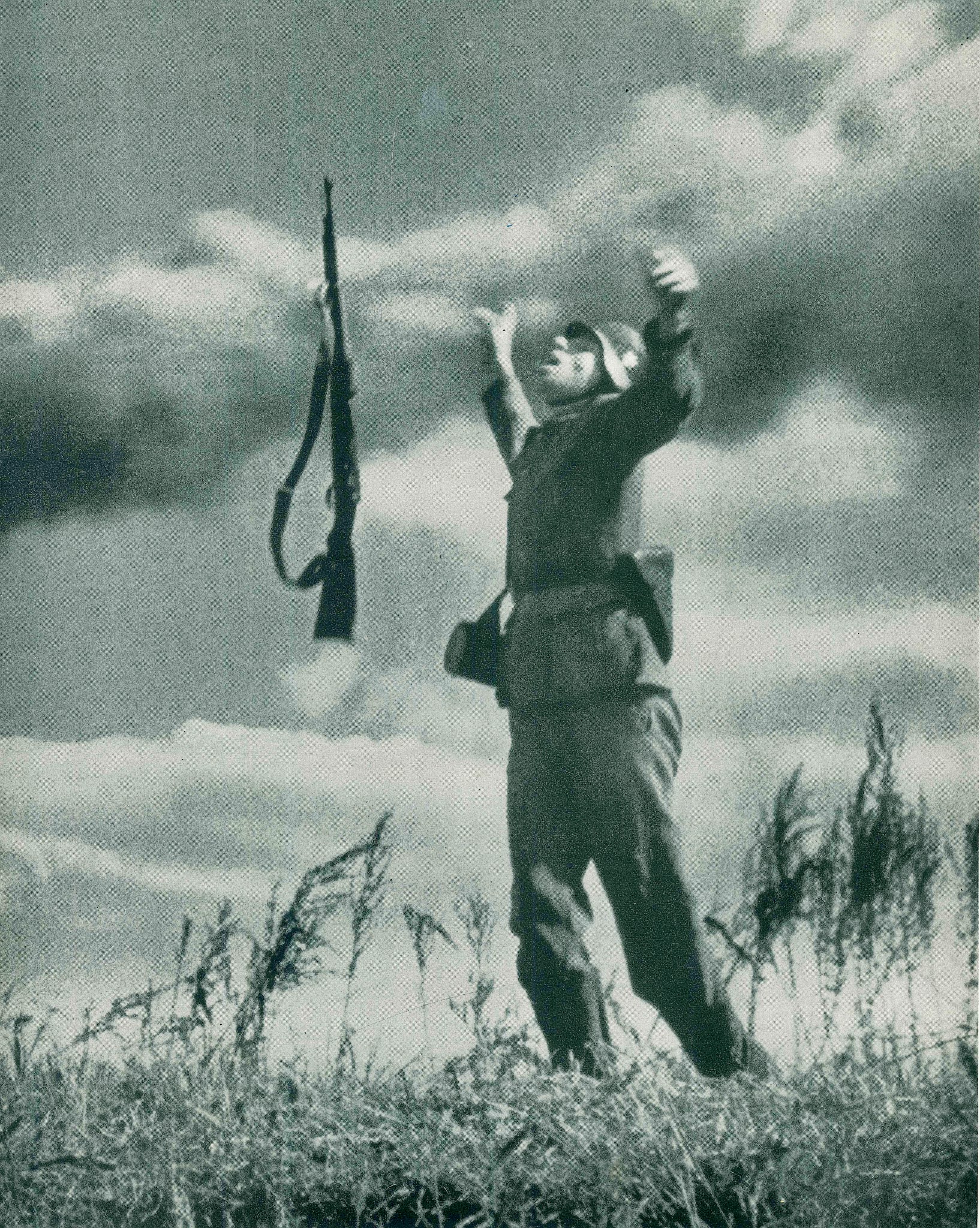
A dying German soldiers takes the bullets in the East, who was photographed on the field of battle by a Russian frontline cameraman a split second after a Red Army sniper fired his rifle.
A German soldier is shot standing by a Soviet sniper on the Eastern Front in World War II. The dying German soldier raised both upper limbs and threw his rifle out of his right hand. On the front lines of the Eastern Front, a German soldier fell to the battlefield after receiving a bullet that would end his life. Shortly after a Soviet Red Army sniper fired his rifle, a photograph of his death in battle was taken by a Soviet frontline photographer.
Operation Barbarossa, the largest invasion of Nazi Germany's forces in World War II, began on June 22, 1941. After crossing the Soviet border, some four million German soldiers, supported by some 600,000 vehicles and 750,000 horses, attacked a front line that stretched some 3,000 kilometers long. In just the first seven days of the invasion, Nazi German troops had invaded about 300 kilometers into Soviet territory, about a third of the way to Moscow. The Blitzkrieg initially went well, the Nazi German offensive overwhelmed the Soviets with threats, and early Soviet losses were catastrophic. Most devastating were the human losses: by December 1941, the Soviets had killed about 2.7 million soldiers across their armed forces and captured about 3.3 million. For every German soldier lost, the Soviets lost about 20 soldiers. In just the first nine days of the Soviet invasion, the Luftwaffe lost about 40% of its fighters in the entire Soviet air force, about 1,400 in the air and 3,200 on the ground. The Nazi Germans lost only about 330 fighters. Furthermore, by mid-August 1941, the Soviets had disintegrated about 3,300 tanks, while the Nazi Germans had lost only about 220, an astonishing ratio of losses of about 15:1.
From the end of 1941, as the Soviets recovered from the blitzkrieg of the Nazi Germans, their resistance hardened, and German losses gradually piled up. by August 1941, the Nazi Germans had lost about 46,000, and by December 1941, about 25% had been killed or wounded in action. by November 1941. By November 1941, the situation for the Soviet army was extremely dire. By November 1941, the Soviet army was in a state of extreme misery. Nazi Germany claimed to have won the war. About 2 million Soviet soldiers were taken prisoner, about 22,000 artillery pieces were seized and destroyed, about 18,000 tanks were destroyed, and 14,500 fighter planes were shot down. The Nazi German army was only about 16 kilometers from the capital, Moscow. The Soviets had only about 90,000 soldiers and about 150 tanks left. The fall of Moscow seemed imminent, and on November 7, 1941, Stalin held a military parade in Moscow's Red Square.
In December 1941, the temperature plummeted to -35 degrees Celsius. It was unusually extremely cold in Russia, even colder than the normal year. From January 1942, resupplied and equipped Soviet troops pushed the exhausted and weakened Nazi German army back about 100 to 200 kilometers to the west. The Soviet army, supplied and equipped since January 42, pushed the exhausted and weakened Nazi German army back about 100 to 200 kilometers to the west. This was the first major defeat and retreat suffered by the Nazi German army in World War II. In the bloodiest battle of the war, the Battle of Moscow, about one million German soldiers lost their lives.
5/06/2021
During Russian Civil War, White Guards shot Red Army soldiers and Soviet citizens with civilian massacres, hostage takings, deportations of populations collectively considered as "enemies."
After the October Revolution of 1917 in Russia, the Russian Civil War broke out between the Red Army and the White Army. The White Army massacred the workers and peasants who made up the Red Army. The peasants, who had been oppressed as serfs during the Russian Empire, were wary that the White Army would bring back the former Empire. During the civil war, there were an estimated 7 to 12 million casualties, most of them civilians. During the Russian Civil War, many civilians became refugees and were forced to flee their homes at the hands of both the Red and White armies. When one side committed atrocities, the other side retaliated in equal measure. In addition, the Red Army had its own secret police force, the Chequers, created in December 1917, which arrested citizens without warrants and executed them for crimes they did not commit.
The White Army is the general term for the former regime forces on the counter-revolutionary side against the Red Army on the revolutionary side during the Russian Revolution after the October Revolution of 1917. In the Russian Civil War, the White Army and the Red Army fought each other. The White Army opposed the October Revolution led by the Bolsheviks under Lenin. The White Army consisted of the former Russian Imperial Army, the White Army Faction, and the Cossack Army, many of whom were republicans, who established republics in various regions and opposed the Soviet communist Red Army with support from Britain and France. The Red Army was led by Lenin.
The Red Army was formed by the Bolsheviks, led by Lenin, with workers and peasants by Trotsky in January 1918. They signed the Treaty of Brest-Litovsk in March 1918, ceding vast territories to the German Reich and accepting the terms of large reparations. Many opponents of the old regime rose up and assassinated the Russian and German ambassadors in July 1918, and on August 30, 1918, an assassination attempt was made on Lenin. On August 30, 1918, an attempt was made to assassinate Lenin, who had just finished a speech at a factory rally in Moscow and was getting into his car when three shots rang out, two of which hit him in the shoulder and lung. The Bolsheviks took this as an opportunity to declare a civil war of "Red Terror" by the Red Army starting September 5, 1918, and began a massive crackdown and executions of many opponents of the old regime.
After the Red Army ended the Russian Civil War, the Red Bolsheviks were able to reunify the Russian land, but it was in a state of extreme devastation and destruction, further impoverished by the drought of 1920-1921. In order to abolish the market economy, food was forcibly requisitioned from starving areas in reverse, resulting in many starvation deaths. Within just a few years of the outbreak of the October Revolution, some 8 million civilians died. Due to the atrocities of the Russian Civil War, civilians were involved in inhuman acts of mass abuse and genocide.
Fifteen Vietnamese civilians were killed and four injured by the explosion of a mine on a country road 8 km west of Tuy Hòa, March 18, 1966.A mother became a victim of a landmine explosion and her daughter cried out beside the corpse.
About 15 Vietnamese civilians were killed and four others wounded in a landmine explosion on a rural road about 8 km west of Tuy Hoa in Sout...