6/03/2021

In a shell-devastated forest near Ypres at Battle of Passchendaele, an Australian soldier stops to pull up the body of a fallen comrade.

An Australian soldier stops to help a fallen comrade in the shell-devastated forest near Ypres during World War I. Nearly a quarter of a million soldiers were killed in the Battle of Passchendaele, a battle that had been fought since 1914 and had already turned the Ypres area into a barren plain devoid of trees and vegetation, left behind by shells. The ancient Flemish drainage system, which drained rainwater into the fields, was also destroyed. With millions of shells exploding and the addition of torrential rains, the battlefield quickly became a swamp dotted with craters that held water deep enough to drown a man, made worse by the caved-in graves of soldiers killed in the early battles. On porridge-wet mud, in an open, gray landscape with little in the way of buildings or natural cover, the attack and counterattack were repeated under a relentless, bitter rain of exploding shells, flying debris, and machine gun fire.
 The Ypres area was subjected to fierce fighting and constant shelling, and the bodies of soldiers and horses from both sides were buried and left to rot. The bodies were not salvaged and few of the dead were buried. The battlefield is a vast muddy swamp, littered with the remains of water-filled shells. Soldiers and packhorses invaded with their feet on the narrow tracks that were laid between the craters. If they slipped, they drowned in the craters of their size. Under the almost incessant rain and shelling, the situation of the soldiers was miserable. Soldiers were huddled in shell holes or lost in the blown mud, and the front line separating their positions was unknown.
 The Battle of Passchendaele was the third Battle of Ypres, which took place between July 31 and November 10, 1917, during the First World War. The battlefield was the Ypres salient on the Western Front in Belgium, where German and Allied forces had been locked in a stalemate for nearly three years.On July 31, the British Allied forces launched a new offensive, but were unable to break through the German lines by occupying a ridge near the ruined village of Passchendaele. After unsuccessful attacks by British, Australian and New Zealand troops, Canadian troops entered the battle on October 26. The Canadians captured the ridge on November 6, but torrential rain and artillery fire bogged down the battlefield, killing and wounding some 16,000 Canadian soldiers. The Battle of Passchendaele became a symbol of the senseless carnage of World War I, as the Allied forces achieved nothing in the battle.
 In the spring of 1917, the Germans launched a series of indiscriminate submarine attacks that sank Allied merchant ships and other vessels in international waters. As a result of the German submarine attacks, the United States entered the war on the side of the Allies. The shipping routes carrying munitions and food to the UK were threatened. The Royal Navy pressed the government to allow the Allied forces to break through the German front line in Belgium and invade up to the coast to liberate the military port in order to drive the German forces out of the occupied port on the Belgian coast, which was the German submarine base. A massive French offensive on the Western Front failed, and French soldiers, tired of years of fierce warfare, began to mutiny. Some French troops temporarily lost their will to fight and were incapacitated. In order to draw the resources and attention of the German army away from the French, the British army engaged in a reckless battle in the summer of 1917.
 The British forces had only a small force advantage over the Germans. Even if they could break through the German lines at Ypres, they could not capture the military ports on the Belgian coast. Attacking and defending Belgium did not lead to the end of the war. The only thing that was inevitable was the loss of large numbers of lives. The Third Battle of Ypres, commonly known as the Battle of Passchendaele, which was approved by the British War Cabinet, began in July. British troops, supported by dozens of tanks and aided by French troops, attacked the German trenches on July 31. Over the next month, hundreds of thousands of soldiers on the German side and nearly 70,000 British troops were killed or wounded from numerous assaults. in early September, Australian and New Zealand troops were thrown into the exhausted British army. Allied forces bombarded, attacked, and occupied parts of enemy territory only to be driven back by counterattacking German forces. The Battle of Passchendaele was arguably the muddiest and bloodiest battle of the war and symbolizes the worst horrors of World War I. Much of the fighting was utterly futile, and the war brass showed a reckless disregard for the lives of their men. in the spring of 1918, the Germans launched a massive offensive, and the Allied forces failed to liberate Belgium's coastal military ports. The battle at Passchendaele was called a wasteful expenditure of courage and lives.  


6/02/2021

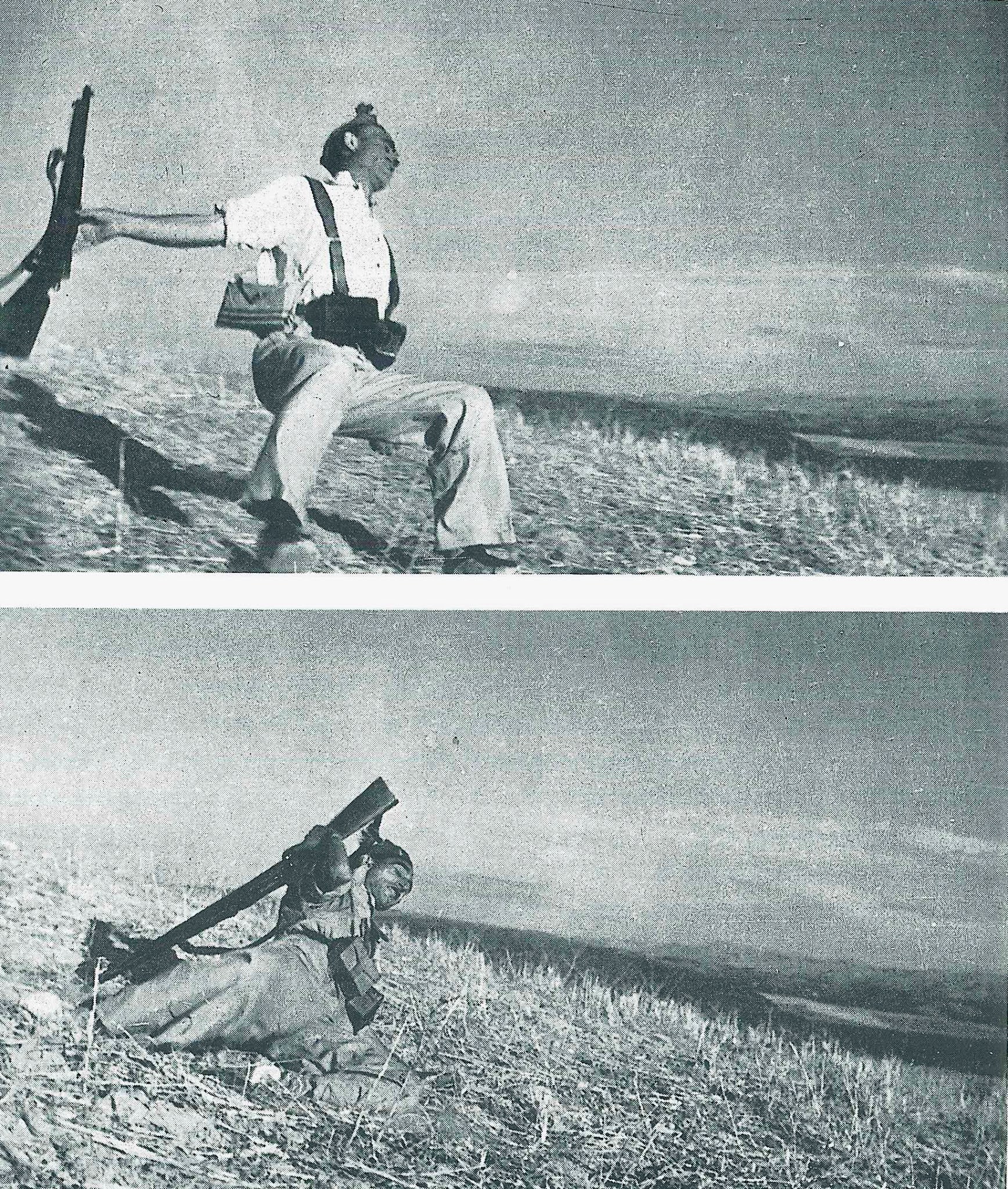
The Civil War in Spain. The Falling Soldiers: How they fell. Photographer: Robert Capa. Vu, France, 23, September 1936, p. 1106.

The Moroccan sniper of the regulars Tabor, who belonged to the Coronal Saens of the Bruaga Corps under the command of General Barrera, a Franco insurgent, shot a Republican militiaman running down a hillside. It was at 10:30 a.m. on September 5, 1936 in Cordoba, about a month after the outbreak of the Spanish Civil War. When the Moroccan sniper, who had been hiding in a trench, pulled the trigger, a Mauser rifle's Mauser round of approximately 7x57mm caliber was fired ruthlessly at about 730 meters per second on an updraft. Federico Borrell Garcia, an anarchist military militiaman from Alicante, was killed instantly by a bullet through the heart while running down the slope of Cerro de la Caja (above). War photographer Robert Capa, who was a few meters to the left of the sniper, took the famous "The Falling Soldier" war photo at close range from inside the trench with his 35 mm Leica III. In 1996, he discovered the identity of a militiaman who had fallen backwards after being shot with a Mauser rifle. To the right of the militiaman, who died instantly from a bullet through the heart, can be seen a mountain near the beginning of a small ravine on the eastern slope of Cerro de la Caja hill. The identity of the other Second Republic militiaman who was killed by sniper fire on La Coja Hill is unknown to this day (below).
 On July 17, 1936, General Franco and his Iberian generals revolted against the Republican government, which had been democratically formed in the general elections of February 6, and the Spanish Civil War broke out. Robert Capa, whose real name was Endre Enrey Friedman, was a Budapest-born Jewish-Hungarian photographer In 1935, the Deput Agency ordered Capa to travel to Spain to take photographs for a German magazine. In 1935, the Depto Agency ordered Capa to travel to Spain to take photographs for a German magazine; in 1936, Capa photographed the French Popular Front's post-victory rallies, etc. When the Spanish Civil War broke out in 1936, the French luxury photography magazine Vu ordered Capa to photograph the Spanish Civil War; on September 23, 1936, "Popular Front Soldiers at the Moment of Death" was published in Vu.

  Arriving in Barcelona on August 5, 1936, Capa found that the rebels had been defeated in Barcelona and armed militias of workers and anarchists had seized power. Thousands of militiamen boarded trains bound for the Aragon front. They arrived at Cerro Muriano, in the northern suburbs of Cordoba, the capital of the Guadalquivir Highlands, where the Republican army had launched a major offensive.
 On August 20, 1936, about 5,000 Republican troops invaded Cordoba, which was defended by rebel forces. Fierce fighting ensued, and the insurgents inflicted heavy casualties on the Republican militia due to the firing of African Moroccan specialists. About 10,000 Republican troops dispersed to villages in the province of Cordoba, and around the village of Cerro Muriano, the Republican troops set up a solid defensive position after two weeks.
 The rebels avoided the industrial areas and invaded Andalusia and Extremadura. On September 5, both the rebels and the Moroccan militia destroyed the Republican forces in the northern suburbs of Cordoba. The Republican militia, the majority of whom had picked up rifles for the first time about a month and a half earlier, including civilians and laborers, charged the regular African army and the rebels in the village of Cerro Muriano, north of Cordoba. The two armies fired at each other with all kinds of weapons, including artillery and machine guns. After numerous casualties began to occur and weapons fire, the fighting became so fierce that on September 5, 1936, the insurgents completely overwhelmed the Republican militia.


6/01/2021

Renato Tabasa Zabate was abducted by armed men in September 1991. Five days later his body with 31 wounds was found to be bound with electriccal wire and gaged with a towel.

In the Philippines, more than 550 people have been victims of political killings by the Philippine government or forces supporting the government since 1988. Some of the murdered citizens have been tortured or mutilated. Entire families, including infants and the elderly, were massacred. Women were raped before being stabbed to death.On February 25, 1986, the dictatorship of Ferdinand Marcos was overthrown by the government of President Corazon Aquino, and the new government introduced measures to protect human rights. However, the abuses and massacres continued with the execution of extrajudicial executions in the Philippines after 1988.
 In Cebu, Philippines, 21-year-old Renato Tabitha Zabate was massacred on September 8, 1991. A member of the United Farmers Organization (UFO), he was found dead in Candoman, Mandaue City, Cebu Province on September 13, 1991, five days after he was abducted by armed men of the National Police (PNP). His body clearly showed signs of having been tortured. Renato left his relative's house with his friend on September 8 at around 1 p.m. As the two were walking on the road, two armed men approached them on the street. They put a gun to the back of Renate and her friend. They were then pushed into a waiting jeep and drove off in the direction of Talamban. Renato was taken to the PNP's Cebu Metropolitan District Command in Sotelo, Cebu City. Renato's body was found by school children in Sogod, about 62 kilometers north of Cebu City, on September 13. The victim was bound with electric wires and gagged with his own towel. An autopsy revealed that the body had about 31 wounds, including abrasions and contusions, and the cause of death was strangulation.
 Renato's death is linked to his activities in the UFO organization, which belongs to a militant peasant organization in Cebu province. in the early 1990s, members of the UFO and other local labor organizations were harassed and threatened by government forces and anti-communist vigilantes as suspected supporters of the New People's Army (NPA). Renato's wife, whose relatives were also active in the UFO, was charged with state overthrow along with four others in Cebu City In May 1987, Renato was arrested and detained by government military agents. He was detained along with two others in an unofficial detention center in a safe house southwest of Cebu City; the three were released without charges 11 hours later.
 Since 1988, at least 550 unarmed civilians have been killed in the Philippines by the Philippine government or government-sponsored forces. The Philippine government has claimed that this is a long-term justifiable sacrifice to eradicate the armed opposition. In reality, however, entire families, villagers working in the fields, were gunned down. Women were raped by soldiers before being murdered. The most inhuman tortures were inflicted on those who were targeted for murder. Socially and economically disadvantaged citizens and politically vulnerable citizens were targeted the most. Armed opposition groups have also carried out political killings. Victims have included residents of rural areas, trade unionists, government officials, and military suspects.
 In 1986, a people's power revolution against President Ferdinand Marcos led to the inauguration of Corazon Aquino as president. Although the new government promised to restore democracy and sever rights abuses, massive political killings were carried out after 1988. Extrajudicial executions included those of the Philippine Army (PA), Philippine Constabulary (PC), Integrated National Police (INP), the newly created Philippine National Police (PNP), Civil Armed Forces (CAFGU) militia units, Civilian Self-Defense Organizations (CVOs), semi-official paramilitary groups, and anti-communist vigilantes.
 Extrajudicial executions are a serious violation of human rights in the Philippines: since 1986, hundreds of people have disappeared and been killed or tortured in police and military custody. Those held in clandestine detention were particularly vulnerable to killing and torture. This is heightened in situations such as the Philippines, where the police and military can carry out violations without fear of punishment; in 1991, at least 12 prisoners of conscience were identified. Hundreds more were among the hundreds of political prisoners, and many political detainees were subjected to torture and ill-treatment while in custody.Between 1990 and 1991, senior military and government officials reinstated the death penalty for heinous crimes, including political offenses such as sedition and vandalism. Certain groups of citizens were targeted, including trade unionists, human rights lawyers, religious leaders, and peasant activists. Eighty-five people were killed by the government or government-backed forces, and several others by armed opposition groups.
 Extrajudicial executions in the Philippines occurred against the backdrop of more than two decades of intense political conflict between government forces and armed opposition groups. The most important factors are the armed wing of the Communist Party of the Philippines (CPP), the New People's Army (NPA) and the Moro National Liberation Front (MNLF). The Philippine military and government authorities treated victims of human rights violations as legitimate targets for counterinsurgency operations and political killings as an inevitable byproduct of armed conflict. By pointing to human rights violations by armed opposition forces, they justified extrajudicial executions and absolved the security forces of responsibility for human rights violations.
 In recent years, the urban population of the Philippines has grown by about 6 percent a year, largely due to migration from rural to urban areas. Legitimate political organizations that support the urban poor, including the growing squatter community, emerged in the 1970s and 1980s. Urban organizations organized resistance to forced evictions as well as social movements to improve services such as garbage collection, water supply, and drainage. Activists from the urban poor have promoted development projects and workshops in cities. Citizens who participated in social activities were accused by the government forces of being involved in the CPP/NPA and were killed by members of the security forces. After being arrested for no clear reason, the victim died in police custody. The authorities propagated that the victim tried to escape, took weapons from the arrested, or committed suicide. Forensic evidence obtained by the victim's lawyers and relatives cast doubt on the claims.  


5/31/2021

Terror in South Vietnam. These children were killed by Viet Cong guerrillas during a raid on a village 10miles north of the Capital, Saigon.

Just after the U.S. military entered the Vietnam War, the Vietcong attacked a village 10 kilometers north of Saigon, the capital of South Vietnam. The Vietcong guerrillas indiscriminately murdered numerous South Vietnamese children.
 By November 1964, when Johnson was re-elected as US president, the South Vietnamese government was experiencing a series of unstable civil unrest, and the South Vietnam Liberation Front (Viet Cong) shifted from guerrilla warfare to large-scale conventional warfare. The U.S. forces were tougher, and in March 1965, U.S. troops landed in Da Nang and launched a sustained air offensive against North Vietnam. When South Vietnamese government leaders began to call for an immediate attack, the U.S. military offered a quid pro quo of air strikes on North Vietnam in exchange for reforms on the South Vietnamese side. The U.S. military stepped up its attacks on North Vietnamese infiltration routes in Laos and dared the U.S. Navy to conduct covert operations along the North Vietnamese coast. In retaliation for North Vietnamese looting in the South, U.S. and U.S. South Vietnamese forces conducted joint aerial bombardments of the North.
 On the afternoon of December 24, 1964, while many Americans in Saigon were preparing to celebrate Christmas Eve, the Vietcong bombed the Brink Hotel, a dormitory for American officers near Saigon's business district. The Vietcong bombed the Brink Hotel, a dormitory for American officers near Saigon's business district. The bombing was one of the most devastating acts of Viet Cong terrorism, killing two Americans and wounding 51 Americans and South Vietnamese.
 On January 17, 1965, South Vietnam issued a decree expanding the army's draft. Buddhists revolted in the streets, and the civil war quickly spread from city to city in South Vietnam, culminating in the destruction of the U.S. intelligence agency in Hue and the burning to death of a 17-year-old girl. The regime in Saigon was overthrown, while fierce fighting continued in the provinces surrounding the capital, and the Vietcong gradually gained the upper hand. The armed Viet Cong occupied Binh Gia village, a coastal village near Saigon with a population of about 6,000, for four days, killing about six American soldiers and 177 South Vietnamese soldiers. To break the tide of the war, they conducted retaliatory air strikes against North Vietnam in late January.
 On the morning of February 7, 1965, the Vietcong attacked the U.S. Army's Holloway base and airstrip near Pleiku in the Central Highlands, killing about nine U.S. soldiers and wounding more than 100 others. On the same day, about 49 U.S. fighter jets attacked Dong Hoi Barracks in Viet Cong over the Demilitarized Zone, and the next day, South Vietnamese government forces attacked Vinh Barracks in Viet Cong. on February 10, Viet Cong blew up a hotel in Qui Nhon, killing about 23 soldiers and injuring many others trapped in the rubble of the collapsed building. On March 2, U.S. and South Vietnamese government warplanes blew up a North Vietnamese ammunition depot and naval base. On February 26, they reinforced the air base at Da Nang for the North bombing, and landed on March 8. The arrival of Da Nang marked an irrevocable step in the American military process of entering the Vietnam War.


5/30/2021

Cleaning out a cave on a Saipan, US Marines perched on a seaside cliff lower a charge of explosives and swing it into the cave opening in the sheer rock wall to blow up any enemy troops who may be still holed up inside.

 In the Pacific War, American troops lowered explosives from the top of a seaside cliff and swung them into the opening of a cave in a sheer rock wall to sweep away Japanese soldiers in a cave on Saipan. They also blew up and killed any Japanese soldiers and civilians who might be hiding in the cave on that cliff. On top of the cliff by the sea were the bodies of the Japanese snipers who had been killed in the explosion. Only a few minutes before, he had been sniping at American soldiers and civilians on the beach, but the American sniper had shot and killed the Japanese soldier himself. Most tragic of all was the suicide by jumping off the cliffs at the northern end of the island. A Japanese man had jumped off the cliff on the north face of Cape Mappi. American soldiers used loudspeakers to persuade the Japanese that they would not be harmed, but obviously to no avail.
 In the Battle of Saipan, many Japanese soldiers and civilians were unable to surrender or survive. In order to surrender, they had to flee under fire and shellfire. The Japanese forbade anyone to surrender to death. Anyone who surrendered to the Americans risked being killed by the Japanese soldiers. The last surviving Japanese soldier in the cave held a large Japanese sword and threatened to slit the throat of any Japanese who surrendered to the Americans. The Japanese soldier also chose to commit suicide rather than be executed by his own side for trying to surrender to the Americans.
 Shortly after sunset on July 6, the remaining Japanese soldiers began to assemble for a Hail Mary attack that would destroy them all. At 4:55 a.m. on July 7, the first Japanese officer arrived, brandishing a sword above his head and shouting Hail, followed by thousands of Japanese soldiers charging in. The largest Hail Mary attack of the Pacific War lasted about 12 hours before it was annihilated, killing a total of about 4,311 Japanese soldiers. About 406 American troops were killed in action, and about 512 were wounded. U.S. forces occupied Saipan and declared it safe on July 9, 1944, more than three weeks after the start of the invasion.
 At 4:55 a.m. on July 7, the first Japanese officers arrived, brandishing swords overhead and shouting Hail Mary, followed by a charge by thousands of Japanese soldiers. The Hail Mary attack lasted for about 12 hours before it was annihilated, and a total of about 4,311 Japanese soldiers were killed. About 406 American troops were killed in action, and about 512 were wounded.
 Saipan has been occupied and colonized by Japanese forces since World War I. When about 127,000 U.S. troops invaded from June 15, 1944, there were about 26,000 Japanese troops, 6,000 naval personnel and 30,000 civilians on Saipan. About 24,000 Japanese soldiers were killed in action and about 5,000 committed suicide. About 912 Japanese POWs survived. About 22,000 civilian Japanese were killed. About 3,426 American troops were killed and about 10,364 were wounded.


5/29/2021

Burns caused by atomic bombs developed only on the parts of the body that directly faced the flash of light emitted during the explosion. Depending on the posture, direction, and position of the victim at the time of the Atomic bombing, the burn surface faced the hypocenter where the Hiroshima bomb exploded.

Burns caused by atomic bombs developed only on the parts of the body that directly faced the flash of light emitted during the explosion. Depending on the posture, direction, and position of the victim at the time of the bombing, the burn surface faced the hypocenter where the Hiroshima atomic bomb exploded. The A-bomb survivors were escorted to the Army's Ninoshima Island Quarantine Station on Ninoshima Island, about 3 km offshore from Hiroshima Bay. Immediately after the explosion of the Hiroshima atomic bomb, the hospital was converted to a field hospital. Field hospitals in the A-bombed city were called field hospitals, and they became large-scale mobile facilities that treated the wounded in the open. Later, it functioned as a first aid station. Some of the initially admitted Hibakusha received temporary treatment in Ujina and were transported by sea from Ujina Port. Many of the survivors were severely exposed to the bombing, and about 70% of them died from the bombing despite treatment. 
 The burns caused by the atomic bombs were different from those caused by incendiary bombs and fires in conventional air raids. They developed only on the parts of the body that were directly exposed to the flash of light emitted during the explosion. According to an investigation report by the Army Medical Corps, when the Hiroshima atomic bomb exploded, members of the Army Ship Communication Corps were lined up in the schoolyard of Senda-machi National School, about 1.8 km south of the hypocenter. They were nude or semi-nude and formed a formation in the schoolyard. In a posture of resting from care, we listened to a cautionary tale from a senior officer of the ship's communications team. A strong flash of light came from the left side against the front of the formation. Instantly, all the members of the squadron either lay on the ground or took shelter in air-raid shelters. Those who were in line in the schoolyard received burns mainly on the left side of their bodies.
 After the Hiroshima atomic bomb exploded on August 6, 1945, the Japanese Army Ship Command, commonly known as the "Dawn Corps," selected the Ninoshima Island Quarantine Station as a base for the rescue of seriously injured survivors. From around 10:00 a.m. on August 6, the injured who had been exposed to the bombing in Hiroshima City were brought to Ninoshima Island one after another by boat. From around 10:00 a.m. on August 6, injured people who had been exposed to the bombing in Hiroshima City were brought to Ninoshima Island by boat one after another. The maximum number of detainees reached more than 10,000. Based on testimonies and the number of remains unearthed, it was estimated that about 70% of the A-bomb survivors died in the atomic bombing, and around September 1945, quarantine station staff and others collected the remains from the premises of the Mabiki quarantine station and erected a memorial tower in the form of a mound for 1,000 people. Later, in July 1955, about 2,000 of the remains from Ninoshima Island were enshrined in the Hiroshima City war dead memorial tower in Hiroshima Peace Memorial Park.
 After the Sino-Japanese War, the Ninoshima Quarantine Station quarantined war-wounded soldiers returning from overseas battlefields to prevent infectious diseases. The Sanyo Railway was extended to Hiroshima on June 10, 1894 before the start of the Sino-Japanese War, and the Ujina Line for military use was completed on August 4 after the declaration of war on the Sino-Japanese War. The Japanese army gathered in Hiroshima. Japanese troops were assembled in Hiroshima and shipped out from Ujina. The number of soldiers returning to Hiroshima was similarly large. Geographically, Ninoshima Island was in close proximity to Ujina. On Ninoshima Island, mountains and water were available, making it convenient for quarantine operations to prevent infectious diseases.


5/28/2021

Nazi German troops massacred a large number of surrendering Soviet prisoners of war. The bodies of captured Soviet soldiers, driven into the trenches and killed, piled up.

Nazi German troops massacred a large number of surrendering Soviet prisoners of war. The bodies of captured Soviet soldiers, driven into trenches and killed, piled up. The Nazi Wehrmacht's campaign of extermination was a war crime. During this period, Kurt Wafner (1918-2007) witnessed and collected photographs of the atrocities committed by the Nazi German army. The Wehrmacht was just as brutal as the SS and police, and after the "evacuation of the Minsk ghetto," in which some 6,000 to 10,000 Russians and Jews were purged in November 1941 alone, he went to see hell with his own eyes. The place was littered with broken glass, clothing, body parts of murdered people, and dead babies gnawed on by rats.
 Kurt Waffner was drafted into the army in 1939 and served in the labor service. His enrollment in engineering school was cut short by military service; he was released from military service in the summer of 1939, citing poor eyesight. Later overturned, he served in the artillery in Frankfurt, where his eye disease worsened, and he took a clerical job. 1941 saw him sent to guard French prisoners of war in Berlin. Using the tactics of a good soldier, he did not contribute to the war effort. The situation changed dramatically when the Nazi Germans invaded Eastern Europe, and he was sent to the Eastern Front. In his unit, he met two Communists. They were sent to guard the Russian prisoners of war in Minsk. They had been sent to guard Russian prisoners of war in Minsk. One of the Communists let some of the POWs go, excusing himself as "dead drunk," and was arrested by the military police and disappeared.
 As the Nazi German army went dark in World War II, Kurt Wachner continued his underground activities in the physics laboratory of Siemens AG in an effort to get on the sick list. After World War II, under the East German regime, he joined the militia and the Communist Party, but continued to hold anarchist views; in 1947, he was asked to help the secret police, which he refused. Suffering from tuberculosis, he quit the militia. Trained as a librarian, he left the Communist Party in 1950. He worked in a variety of jobs, including as a publishing editor, head of the Roman Zeitung, which published a weekly serial novel, author of radio plays, and journalist. He was always aware of the repression of state censorship. After the fall of the Berlin Wall in 1989, he got in touch with the German anarchist movement and wrote articles about his experiences and photographs. 2000 saw the publication of his autobiography, My Life as a Book Lover and Anarchist. He published his autobiography, My Life as a Book Lover and Anarchist, in 2000 and died on March 10, 2007.
 After the defeat of Nazi National Socialism, the military brass and general staff gathered and propagated the legend of the "clean Wehrmacht. The troops did their military duty with decency and dignity, keeping their distance from Hitler and the Nazi regime. The atrocities committed by Himmler's Einsatzgruppen were known only after the fact. Perpetrators and accomplices of serious crimes were able to speak of their innocence. However, the Wehrmacht as a whole is an organization that refuses to acknowledge its active participation in Nazi war crimes. The military was complicit in but documented three major crimes: extermination of Jews, genocide of prisoners of war, and terrorism against civilians. These war crimes, committed in violation of international law and beyond all rules of war, determined above all the brutality of the war against the Soviet Union. The same war crimes were executed in other parts of the world, such as the Balkans and Italy. The primacy of politics over war no longer applies. In the war of extermination of the Nazi National Socialists, political goals and war aims became indistinguishable.
 After 1945, thousands of perpetrators and hundreds of thousands of their accomplices returned to German soil. They found themselves in postwar German society and spoke eloquently about what had happened. What a veil of fog was then created in the journals and literature, where interest in clarification and prosecution waned.


5/27/2021

In World War II, a Soviet soldier wearing an inappropriately thin uniform froze to death on a snowy road in Finland, near the Arctic Circle, despite the fact that it was winter.

 A Soviet soldier dies after freezing to death on a snow-covered road in Finland, near the Arctic Circle, during the Eastern Front of World War II. The uniforms of the Russian troops at the Battle of Finland were inappropriately thin, even though the winter season was the coldest in European history, at about -43°C (-4°F). In a frigid, snow-covered forest where sunlight lasted only a few hours, exposed bodies frostbitten by raging blizzards and howling winds, piles of corpses froze in minutes, gaining the solidity of a brick wall. Freezing to death means organs slowly shut down until they stop shivering and doze off after hypothermia sets in. The corpse often froze to the solidity of a brick.
  While Hitler's Nazi Germans were waiting for the next blow from the invasion of Poland, Stalin's Soviet troops decided to strike a blow for Finland themselves. The Soviet-Finnish War, dubbed the Winter War, began with the Soviet invasion of Finland on November 30, 1939, three months after the outbreak of World War II. It ended about three and a half months later with the Moscow Peace Treaty on March 13, 1940. Stalin's Soviet Union invaded Finland with its fighter planes and tank corps in the early morning hours of November 30, 1939, and the next day, December 1, established a puppet government in Finland in a remote town. Surprisingly, the Soviet Red Army's campaign was not a blitzkrieg one. Stalin, a fickle dictator, thought he could invade Finland with second-rate troops and equipment. Over a period of about two months of fighting, all Allied forces, Finland, a small country of about 4 million people, bravely confronted the Soviet Union, a superpower of about 180 million people. The Allied forces cheered excitedly at the war as if it had been won on March 31, 1940, at a tragic cost to the Finnish army. Finnish casualties were about 24,923 killed in action, 43,557 wounded in action, and about 1,000 taken prisoner. Soviet casualties were approximately 126,875 killed or missing, 26,4908 wounded, and 5,600 captured.
 The Allied forces had no realistic strategy to help the Finnish army. When the Soviet Red Army finally broke out into a full-scale offensive, the Finnish forces were crushed with ruthless efficiency. in February 1940, the Soviet troops resumed their onslaught following the maximum bombardment and broke through the Finnish defenses at the Karelian isthmus. The Finnish army, low on ammunition and on the verge of a crisis, agreed to peace terms in March. However, Hitler's Nazi Germans witnessed the incompetence of the Soviet army during these almost two months in the tragic interlude in the Finnish forest. Underestimating the capabilities of the Soviet army, the Eastern Front invasion of the Soviet Union was disastrous for the Nazi German army. On June 22, 1941, after about 15 months of truce from the Winter War, Nazi Germany launched Operation Barbarossa, which continued the Winter War between Finland and the Soviet Union.


5/26/2021

A Frenchman who collaborated with the Nazi German army was shot dead by a French police firing squad in Rennes on November 21, 1944, after the liberation of France. They were photographed at the moment the bullets hit him.

A Frenchman who collaborated with the Nazi German army was shot dead by a French police firing squad in Rennes on November 21, 1944, after the liberation of France. They were photographed at the moment the bullets hit them. Just before he was put to death, the cord tied to the executioner's table flew apart.

 The legal purges (épuration légale) were a series of official trials that followed France's liberation from Nazi Germany and the fall of the Vichy regime in World War II. The trials took place mainly between 1944 and 1949, and the legal actions that followed lasted for several decades. France was liberated on August 25, 1944, when the last German troops surrendered to the Allied forces in Paris.

 Unlike the International Military Tribunal at Nuremberg, this was a legal purge that took place only in France. About 300,000 cases were investigated, ranging from the highest officials of the Vichy government who were collaborators with Nazi Germany. More than half of the cases were closed without prosecution. from 1944 to 1951, official French courts sentenced some 6,763 people to death for treason and other crimes. Of these, 3,910 were sentenced in absentia. The actual number of death sentences carried out amounted to about 791. The largest number was for the crime of national depravity, in which some 49,723 people lost their citizenship.

 In the immediate aftermath of the liberation of France from Nazi Germany, there was a series of convictions, executions, public humiliation and assaults, and detention of suspected Nazi German collaborators in what was called the Wild Purge. This period was preceded by the establishment of the Provisional Government of France, which was occupied and ruled by Nazi Germany. It was estimated that about 10,500 people were sentenced and executed, both before and after the liberation of France. The Court of Justice handed down some 6,763 death sentences. Of these, 3,910 were sentenced in absentia, and about 2,853 were sentenced in the presence of the accused. About 73% of these 2,853 sentences were commuted by Charles de Gaulle, and about 767 more were commuted. The military tribunals ordered the execution of about 770 people. The total number of people executed before and after the liberation was about 10,500, including, among others, officials and leaders of military organizations. The U.S. military estimated the number of summary executions after liberation at about 80,000; the French Minister of the Interior in March 1945 claimed that the number executed was about 105,000.

 The initial purges began before and after the liberation of Paris on August 25, 1944, when the anger of French citizens turned against collaborators of Nazi Germany. Punishments after arrest included beatings, torture interrogation, and summary executions. Most of the women collaborators had their heads shaved, and some had swastikas carved on their foreheads. There were three types of trials for Nazi German collaborators: the first was in criminal courts for violating Article 75 of the French Penal Code, which outlawed treason and sharing information with the enemy; the second was in civilian courts for suspects who did not violate specific laws but whose actions were considered unpatriotic; and the third was in public opinion, where the general public was against certain celebrities. The third was tried and executed for treason due to public outrage over a particular celebrity. 


5/25/2021

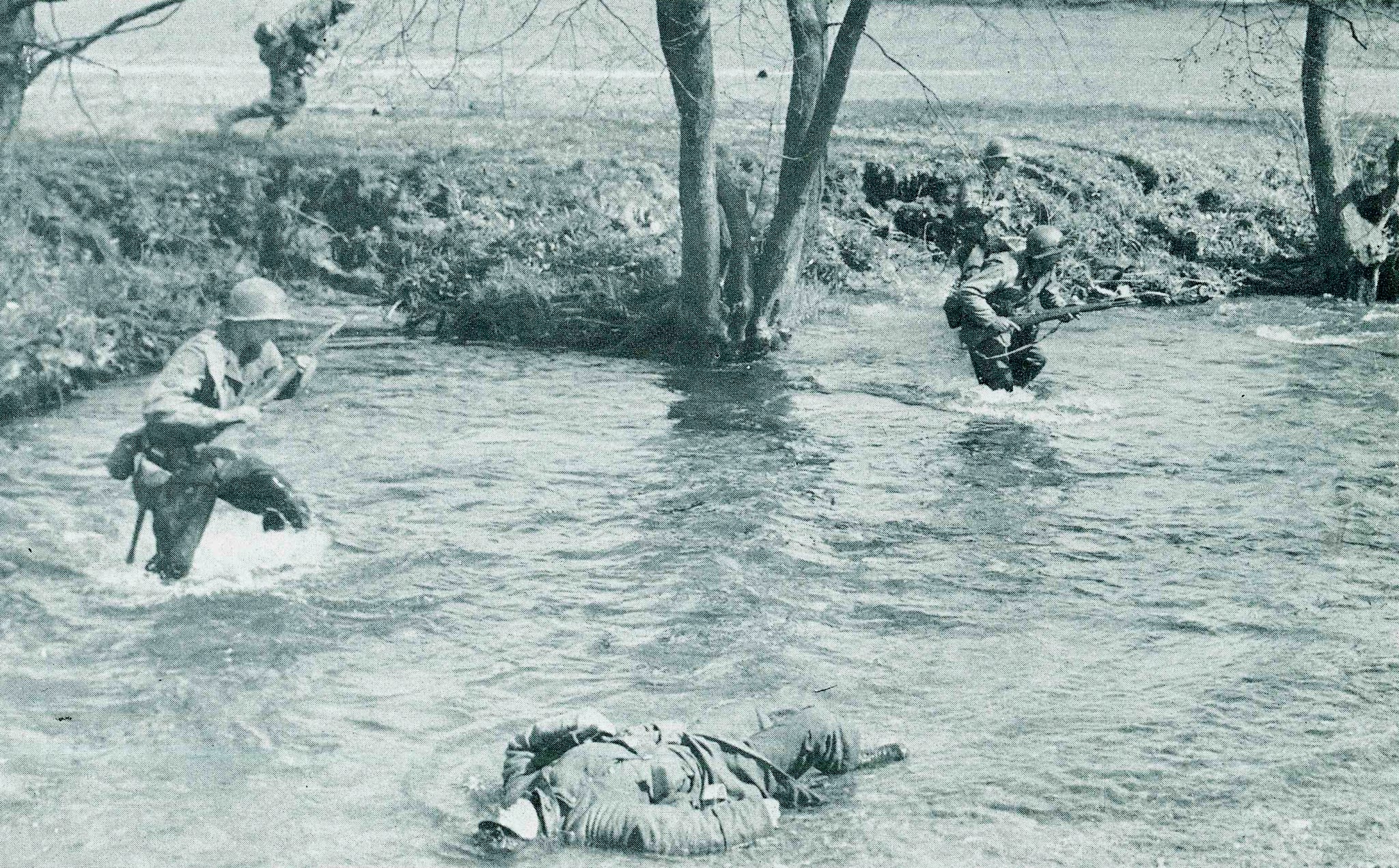
Infantrymen passed a dead German as they crossed a stream. The American Armies with the attack to the east encountered any serious organized resistance in the Harz Mountains

On the Western Front of World War II, American infantrymen passed the body of a slain Nazi German soldier as they crossed a stream. On April 10, 1945, the U.S. Army resumed its assault on the east with 22 divisions. In the Harz Mountains, they encountered serious organized resistance from the Germans. The Germans hurriedly regrouped their forces with about 10,000 soldiers and initially raided the Ruhr area. When that failed, they then rushed into the Thuringia area. This also failed, and the German army was destroyed when the last small army was surrounded by American troops.

  The Western Front in Central Europe in World War II broke out on March 22, 1945, when American troops crossed the Rhine River and arrived in the Remagen area to fight against the Germans. by the night of March 22-23, American troops crossed the Rhine River at Oppenheim. By the night of March 22-23, American troops had crossed the Rhine at Oppenheim, and occupied the area on the west bank of the Rhine from Bonn to Neuss. on March 26, American troops crossed the Rhine north and south of Worms, and encountered heavy resistance from German troops on the river bank. They broke through the resistance and expanded their bridgehead. American troops crossed south of the Weser and British troops crossed north of the Weser. Allied paratroopers parachuted into the eastern side of the Rhine. Allied forces invaded toward the east side of the Rhine, encircling Germany's vast industrial Ruhr region and capturing German defense units. The invasion continued into Germany and was met with German defiance in scattered areas.

 Soviet forces entered German territory from the Eastern Front. In an attempt to escape Soviet capture, Nazi German troops surrendered by the thousands to Allied forces in the west. American, British and Canadian troops in northern Germany halted their invasion when they reached a line where they thought they would encounter Soviet forces. American troops continued their invasion of Czechoslovakia and Austria to join up with the Soviet forces. At Strehler, a small village about 20 kilometers south of Torgau in Saxony on the Elbe River coast in eastern Germany, they met one Soviet soldier at 11:25 a.m. on April 25, 1945. It was later called "Elbe day" when the American reconnaissance team and the Soviet SS met.
  On May 2, 1945, the German forces in Italy surrendered. On May 9, 1945, the surrender of all German forces became effective, ending the Second World War in Europe. As a result, the Elbe Oath became the final symbol of the U.S.-Soviet Allied forces, and gradually deteriorated international relations, leading to the beginning of the Cold War.
 

Fifteen Vietnamese civilians were killed and four injured by the explosion of a mine on a country road 8 km west of Tuy Hòa, March 18, 1966.A mother became a victim of a landmine explosion and her daughter cried out beside the corpse.

About 15 Vietnamese civilians were killed and four others wounded in a landmine explosion on a rural road about 8 km west of Tuy Hoa in Sout...