3/04/2021

North Korean shot may have captured some of the revulsion in the Marine's face as he gathered himself to crawl over the body,

A young American soldier was shot in the head by North Korean troops around August 1950 and jumped into a ditch from the other side of the road, dying instantly, with American troops advancing by his body. The Korean War erupted on June 25, 1950, when North Korean troops raided the Korean Peninsula. With the landing at Incheon on September 15, the tide had turned and the UN forces had the upper hand.

 The air of the UN forces on the Korean peninsula around August 1950 was stifling, and American soldiers fighting in the open felt the harsh sun through their brains. It felt like it was grabbing their stomachs and pulling them inside out. The order to get up off their lazy tails and get out came down along the ranks of the American troops. They were only about 90 meters away when two North Korean machine guns exploded from across the rice paddies on their right flank. The American soldiers immediately jumped into the paddy field on the left side, spread out behind the slight cover of the road, and slumped eagle-eyed. It was fortunate that the Korean farmers who were working in the fields did not flood the paddies. But the rice was green and green and too high, and each American soldier was buried deep in the paper grass like a badly sweating doll.

 For the next forty-five minutes or so, while bullets whistled overhead, the wind was blocked around the fields where we were hiding, and the sun became very humid and hot. But even more than the heat, I was struck by the thought of North Korean troops re-entering the area occupied by American troops. But this was not the time nor the troops to scout every hill after being raided by a group of North Korean troops. They had to fire their guns, but instead they had to advance to the target area. One young American soldier was shot in the head by the North Koreans, his face blown off, blood spilling, and he jumped into a ditch from the other side of the road and died instantly. The face of the American soldier crawling forward across the side of the corpse captured some of the disgust. North Korean bullets continued to advance as they continued to snipe at the other American soldiers. 


3/03/2021

Patients under Josef Menegle with the Situationist Staff, the most famous Holocaust Physician, went under numerous experiments that would stave them.

 In the Auschwitz concentration camp, Josef Mengele (Josef Mengele), the most notorious Holocaust doctor, conducted biological experiments on opportunistic officials and a large number of prisoners. He performed many fatal biological experiments on prisoners with twin children for the analysis of the most important racial genes. In particular, twins, dwarfs, and the handicapped were subjected to the most fatal experiments as human materials for the biological experiments of genetics. Twins required a subject to be experimented on and a control to be compared to. Midgets and the disabled were tested as body deformities. An important point of the genetic bio-experiments was to figure out why not everyone was Aryan.

 Biological experiments on the most notorious known prisoners conducted by Nazi Germany in the concentration camps attempted to provide racial information on the correlation between racial differences and genes. Genetics was very much the latest research in the 1930s. Nazi Germany wanted to have the most advanced and most innovative information in the world about it. In the nationalistic ideology of Nazi Germany, Jews were inferior. Doctors who performed biological experiments on Jewish prisoners in concentration camps wanted to know what the genetic makeup of the Jews would prove. In Ronald Bennett's biological experiments, the Nordic or Aryan race was the most important ethnic group for the Nazis. It was the largest part of the overall real power plan. Only the German blond hair, blue eyes, and Superman were supposed to be the predominant genetics. All other blacks, Hispanics, Jews, Gypsies, homosexuals, and aliens who did not meet the racial requirements were to be purged from society through genocide. Hitler and the German military high command created racial selection rules for their fellow Nazi Germans to follow. Bennett said that through this genetic source, Nazi Germany created racial selection rules and expected other races to follow the rules. If the other races did not follow the rules, they too would be put in concentration camps or executed.

  Dr. Josef Mengele, known as the Angel of Death, became the chief physician at the Auschwitz II concentration camp in November 1943. While Mengele was assigned to the concentration camp, about 30 doctors assisted with biological experiments at Auschwitz. The medical staff made the prisoners make choices while conning them. These choices determined who from the masses of prisoners arriving at Auschwitz would be detained for forced labor and who would be immediately slaughtered in the poison gas chambers. Whenever a new train of prisoners arrived at Auschwitz to search for twins, Mengele gave instructions without being directly involved in the selection process. Before the war ended, Josef escaped from Auschwitz and fled internationally from arrest for war crimes. He went to the United States, returned to Germany, fled to South America, Argentina, Paraguay, and finally Brazil, where he died in Sao Paulo at the age of 67. He continued to be missing during his life, and was determined to be Menger by genetic analysis of a body exhumed from his grave on June 6, 1985.


3/02/2021

5 Yugoslavian partisan hanging from a lamp post on Milan St. in Belgrade during World War 2.

In World War II, large-scale massacres against civilian populations were frequent. A series of tragic massacres broke out in Serbia, which was occupied by Nazi Germany. One of the most brutal stood out as the massacre in Terazije, the main square of Belgrade, the capital of Serbia, from August 17, 1941. On that day, the Serbian occupation authorities in Nazi Germany publicly hanged five Serbs suspected of being part of the Serbian resistance by hanging them from lamp posts. The five people who died in that hanging were partisans, rebels against fascism. Two were peasants, one a 17-year-old student, one a tailor, and one a shoemaker, and all five were violently tortured for several days by the Gestapo, the secret police of Nazi Germany, before being hung from lamp posts in the center of Belgrade for several days. They were indiscriminately selected and hanged by the Serb civilians to counter their resistance activities.

 Earlier, on July 4, 1941, the partisans of Biu, even Yugoslavia, made a decisive declaration of a full-scale armed uprising, hiding in the Terazije district of Belgrade. Many citizens of Belgrade launched an attack against the German army and local police. As a result, the Germans launched retaliatory arrests and reprisals against the local population of Belgrade. For captured resistance fighters, the Germans often carried out public executions of terror as a means to scare civilians enough from resisting the occupation. Belgrade was finally liberated from Nazi German occupation on October 20, 1944, when partisan fighters and Soviet troops attacked the city. More than 10,000 citizens of Belgrade were killed during the Second World War. 


3/01/2021

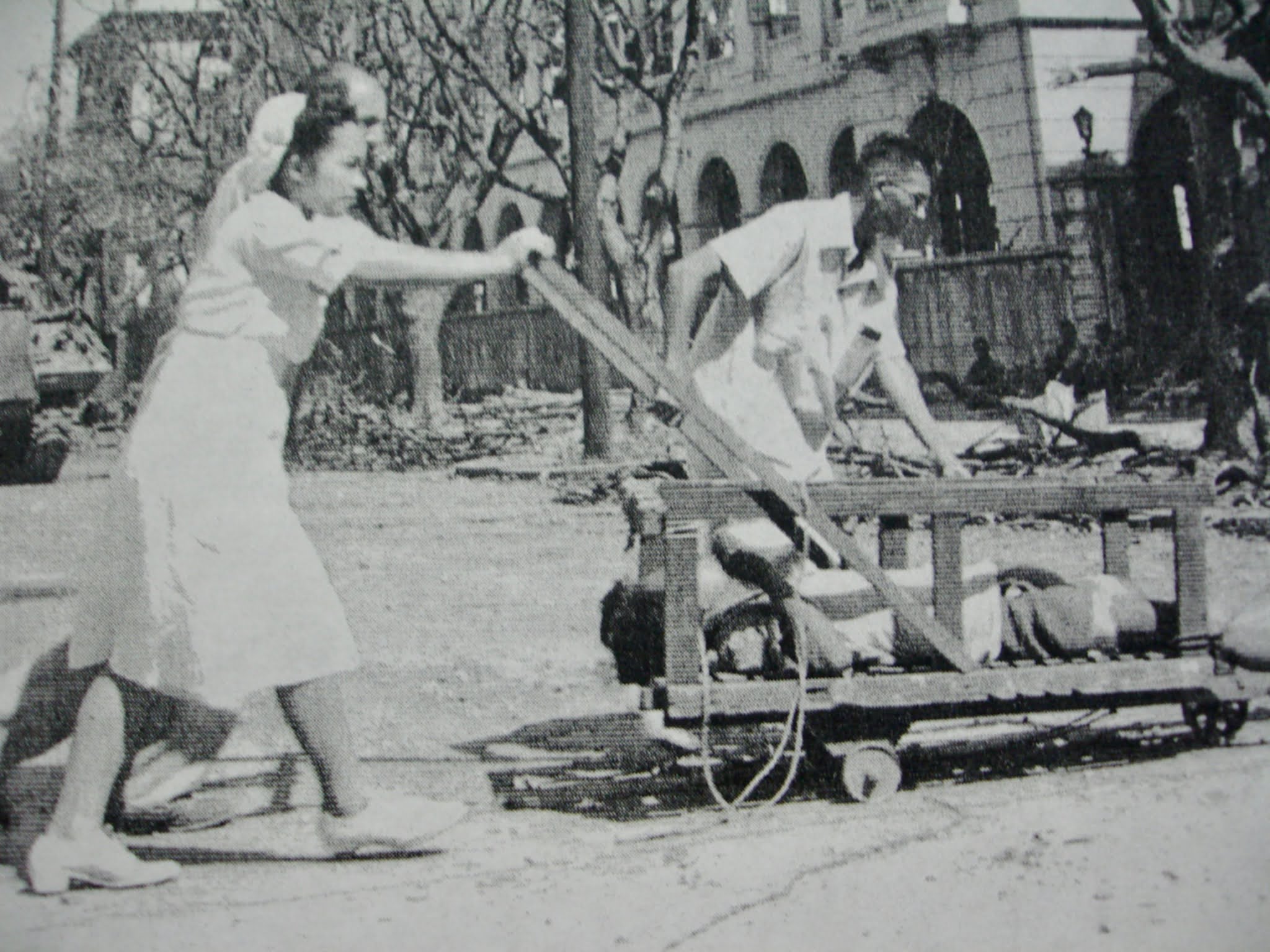
The Battle of Manila lasted a month, with 100,000 civians dead. Makesshift ambulances served the dying.

 The Battle of Manila, from February 3 to March 3, 1945, was the bloodiest month of the war. The Japanese soldiers knew that they would not get out of the battle alive and would not be able to return home. The Japanese soldiers took their anger out on the hapless citizens of Manila and involved them. The Japanese soldiers burned buildings and blew up every bridge crossing. The Japanese soldiers went into a frenzy of rape and murder against the citizens of Manila. By the end of the Battle of Manila, most of Manila was in ruins. About 100,000 Manila civilians were killed in the battle.

 As American and Filipino guerrilla forces liberated towns in Manila from the Japanese, Japanese soldiers in other towns saw all Filipinos as enemy spies and committed more massacres and atrocities. In Batanes, the Japanese soldiers massacred and massacred the Yvatans to counter the powerful guerrilla campaign. Other mass abuses and massacres also occurred in several towns in Batangas. Mass abuses and genocide also occurred in Lipa, Tar, Bauan, Tanauan, Calauan, etc. In Laguna, there was also mass abuse and genocide in Calamba's Bay. And in Tayabas, there were mass abuses and quantitative massacres of civilians in Tiaon and Infanta. Towns were burned, civilians were shot and machine-gunned, and women were raped.

 While the Japanese continued to slaughter, the Philippine military guerrilla forces fought back and forced revenge whenever possible. Fearing brutal treatment by the Japanese soldiers, those who surrendered were asked to submit to the American forces. Some of these Japanese soldiers knew why the guerrillas reacted the way they did. Other Japanese soldiers tried to forget the atrocities they had committed.

 Equally tragic, American bombers indiscriminately bombed Baguio, sweeping away civilians as well, despite reports by Philippine military guerrilla units that Japanese soldiers had abandoned the city. The U.S. forces repeatedly carried out indiscriminate aerial bombardments in the cities of Cavite, Iloilo, Cebu, and Zamboanga. In addition to aiding the American troops, the Filipino military guerrillas also fought in their own vendetta.

 At dusk on February 3, 1945, American troops invaded Manila with the support of Philippine military guerrilla units. Japanese troops arrived at the University of Santo Tomas, where Allied civilians had been housed since the beginning of the occupation. Sporadic machine gun fire stopped other vehicles that attempted to invade further. Japanese troops in Manila countered, marking the beginning of a bloody month-long battle. In terms of casualties, some 12,000 Japanese soldiers were killed in action, representing about 84% of the approximately 14,300 Japanese soldiers. About 1,010 American and Filipino guerrilla troops were killed in action, and about 5,500 were wounded. About 100,000 Philippine civilians, equivalent to about 7.7 times the number of casualties of both armies, were killed in the war.


2/28/2021

After a girl was suffered from Atomic Bomb on Hiroshima, Keloids were formed on burned her skin.

 A girl (T.Kuwabara, Denmacho) exposed to the Hiroshima atomic bomb on August 6, 1945, developed keloids on both upper limbs, back and neck. About two years later, on July 7, 1947, she was photographed in the back with a sign listing her. The poor living conditions during and after the war also contributed to the prolonged healing of atomic bomb survivors, leading to suppuration of burns, delayed wound repair, and the formation of thick subcutaneous scars. Subsequent contraction of the scar tissue also caused deformity or dysfunction. The sequelae of keloids were most pronounced on the face, neck, and fingers.

 Hibakusha who suffered significant primary burns or flash burns near the hypocenter, the center where the Hiroshima and Nagasaki bombs exploded, were also exposed to tremendous blast and radiation. On the day of the explosion, most of the survivors died instantly or from at least Stage I burns. Hibakusha who suffered burns in the area of about 1,000 to 2,000 meters from the hypocenter were accompanied by secondary burns of varying degrees, heating or scorching their clothes. In addition to moderate flash burns, contact burns and flame burns were also associated with burns. These secondary injuries were similar in nature to those observed in the case of flame burns. They resembled grade 3 or grade 4 burns in which significant damage occurred in the deep dermis and subcutaneous tissue. These lesions were often complicated by flash burns, which took a long time to heal.

 Most of the frequent flash burns (primary burns) that occurred in areas within about 2,000 to 3,000 meters from the hypocenter initially healed in a relatively short period of time, forming simple, thin scars. However, the scars caused by the flash burns resulted in significant keloid formation after about 3 to 4 months. 

 The incidence of scarring and keloids was found to be high among students from elementary to junior high school in a study of the atomic bombing of Hiroshima, Japan, in December 1946. Of the surviving atomic bomb survivors, a total of 426 cases were actually examined, including 388 cases of burns, 63 cases of radiation sickness, 39 cases of trauma, 5 cases of no trauma, and 247 cases of keloids arising from the surface of burns. The incidence of keloids in students exposed outdoors at a distance of about 1.6 km was about 89.1% (41 of 46 burns). At a distance of about 2.1 km, the rates were about 94.5 percent (52 of 55) and 87.1 percent (95 of 109). And at a distance of about 2.3 km, about 32.6 percent (51 of 156). One person who was burned indoors at about 1.2 km had keloids. Of the 19 people who were burned outdoors in the shade at about 1.3 km, seven had keloids (36.8%). And of the two in the shade of about 2.1 km, no cases formed keloids. The total number of keloids and burns in the 239 cases who developed these conditions after receiving outdoor burns was 697 outdoors and 2,128 indoors, respectively.

 In August 1946, the Nagasaki atomic bomb survey found keloids in 106 of 158 (67.1%) cases with burn scars and 24 of 114 (21%) cases with traumatic scars. Keloids occurred more frequently in females than in males (74.3% in females, 62.0% in males; most commonly in males, especially in teenagers). Most of the cases were located within about 1.6 km to 2 km from the hypocenter (55.5% of males; 56.6% of females).


2/27/2021

During the Battle of Liaoyang in the Russo-Japanese War, the bodies of Japanese soldiers killed in trenches were scattered by Russian attacks.

During the Battle of Liaoyang in the Russo-Japanese War, the trenches were littered with the bodies of Japanese soldiers killed in the attack by the Russian army. The Japanese soldier looked into the group of bodies from the periphery of the trench. The Russians also suffered increased casualties in the trenches due to the constant attacks of the Japanese troops.

 The Battle of Liaoyang in the Russo-Japanese War broke out in the wilderness of Liaoyang, Liaoning Province, China, from August 24 to September 4, 1904. Fierce fighting took place around the hillsides of the wilderness. The Japanese and Russian armies fought for the concessions from Manchuria to the Korean Peninsula and other areas. This was the first battle in which both the Japanese and Russian armies clashed. About 125,000 Japanese soldiers and 158,000 Russians, for a total of about 28,300, attacked and defended each other. The Russian army had triple fortified Liaoyang. With the vast fortifications and artillery power of the Russian army, the Japanese forces were accompanied by heavy losses.

  The Japanese army surrounded the Russian army in Liaoyang, Manchuria, but the Japanese army suffered enormous losses, and the Russian army withdrew to Shenyang in the north on September 4 with all its forces intact. The cities of Manchuria were occupied and plundered by the Japanese, Russian and Chinese forces. In the Battle of Liaoyang, about 5,537 Japanese troops were killed and about 18,000 were wounded, while about 3,611 Russians were killed and about 14,301 wounded.

  The Russian soldiers were constantly attacked by the Japanese troops, unable to rest, threatened, hungry and thirsty, and almost demoralized from the frenzied spirit. The closer the Japanese forces got, the more devious their means of warfare became. Dynamite bombs, previously used in the White Army, were later replaced by hand grenades. In the final stages, artillery shells were released from mortars that were up to about 200 meters away. The two armies also launched mine warfare to blow up each other's soldiers. The Russian army, which was neither quantitatively disadvantaged nor superior in the Russo-Japanese war, never achieved a settlement. Even though the soldiers of both armies always met in the mountainous terrain with the greatest determination, they threw down many times, and the two armies faced each other for several hours of white-knuckle fighting, sometimes for several days, and never overwhelmed each other. The Russians defended their fortifications with outstanding energy and did not passively wait for the Japanese to attack, but always countered with new and aggressive attacks. With the fortress besieged by the Japanese, the Russian forces were put to a real test, and the Russians withdrew to the north. 


2/26/2021

On July 19 of 1951, the military court meeting sentenced 5 people to shooting death for the guilt of the National Defense Forces on August 12.

 The National Defense Forces Incident occurred in January 1951 during the Korean War, when officials of the National Defense Forces Command embezzled military supplies and rice supplied to the National Defense Forces. On April 30, 1951, the National Assembly passed a resolution to dissolve the National Defense Force, which was disbanded on May 12, 1951. On August 12, they were executed by firing squad in Bansan, a suburb of Daegu. On August 12, the execution was carried out by firing squad in Bansan, a suburb of Daegu. The Syngman Rhee regime framed only the parties involved as guilty and quickly purged them, closing the curtain and covering up the crime.

  The National Defense Force is a Korean military organization formed under the Act on the Establishment of the National Defense Force of December 21, 1950, by compulsory conscription of eligible members of the Second National Army who are not students and are between the ages of 14 and 40. The South Korean government conscripted about 500,000 soldiers, who were dispersed and housed in about 51 educational regiments to form the National Defense Force to reinforce the South Korean army. on January 4, 1951, the South Korean army, under the offensive of both North Korean and Chinese forces, dared to retreat from the front line, which was called the 1.4 Retreat. The approximately 500,000 or so soldiers of the National Defense Forces were forced to move en masse to the rear, to Daegu and Pusan, by order of the command, where military service was scarce. The command of the National Defense Forces was composed of cadres of the Youth League, a white terrorist organization with no military experience.

 Due to the lack of supplies such as food, camping equipment, and military uniforms for the soldiers retreating on foot in the extreme cold, about 90,000 people died of starvation and freezing, and countless others died of disease in the "death march" of the National Defense Forces. On January 30, 1951, the National Assembly estimated that the National Defense Forces numbered about 500,000, and formulated a budget of about 20.9 billion won for three months. A parliamentary investigation revealed that about 2.3 billion won had been taken from the treasury due to padding of the number of troops, and about 52,000 stones of grain had been embezzled, resulting in a difference of about 2 billion won between the amount appropriated for foodstuffs and the actual amount executed or procured. Part of the embezzled money was used as political funds and bribes for President Lee Seung-man and members of the National Assembly. Relief supplies from the United Nations were also not allocated to the National Defense Forces, as they were not a regular Korean army.

 As of December 1950, the South Korean army had lost about 45% of its troops on the Nakdong River front due to a surprise attack by North Korean forces. Furthermore, due to the abolition of conscription in March 1950, it was not possible to call up troops. On January 4, 1951, the North Korean Army and the Chinese Volunteer Army retook Seoul, and from the 1.4 retreat, the National Defense Forces went into a deadly retreat to the south.


2/25/2021

Japanese plane is shown swooping down on a U.S. warship. In the three day battle of Leyte Gulf in October 1944, the Japanese threw Kamikaze planes into action in a desperate effort to save their fleet.

On October 25, 1944, at the Battle of Leyte in the Pacific War, a Japanese kamikaze special attack plane swooped down to hit and blow itself up against an American warship. On October 25, after three days of fighting in the Battle of Leyte, a desperate kamikaze suicide squadron was launched to save the Japanese fleet. At first, he called the kamikaze "shinpu," which was named in agreement with "That's good, because now we have to make a kamikaze.

 Shortly after 1:00 a.m. on October 20, 1944, at Nicolls Airfield in Manila, Philippines, the 201 Naval Air Squadron Command issued an order to formally organize a physical attack force and call it the Kamikaze Special Attack Force.

1. In view of the current state of the war, a strike force of 26 surface combatants (existing force) is to be formed (13 surface combatants).

   This attack will be divided into four squadrons, and will be designed to kill (or at least disable) the target task force if it appears on the eastern surface.The results are expected before the seaborne forces enter the area.The formation will be expanded as more ship battles are acquired. This strike force will be called the Kamikaze Special Attack Force. 2.

2. The commander of the 201st Air Defense Squadron will form a special strike force with existing troops to destroy the enemy task force east of the Hijima Island by October 25, if possible.The commander should prepare in advance for the formation of a special attack force with increased forces in the future. 

3. formation

  Captain Seki, commanding. 

4.  Each unit is to be named Shikishima, Yamato, Asahi, and Yamazakura Corps.


2/24/2021

One sultry July afternoon in 1934, armed Nazis stormed the Chancellery in Vienna and shocked the world by assassinating the courageous little Engelbert Dollfuss.

Suddenly, Nazi dictatorship over other countries broke out when Austrian Nazis assassinated Austrian Chancellor Engelbert Dolfos on July 25, 1934. 10 Austrian Nazis invaded the Chancellery, eliminated the unarmed guards, and assassinated Dolfos. During the occupation of the Chancellery, Dolfos was shot twice at point-blank range, the first bullet through the abdomen and into the lumbar spinal cord, and the second through the neck and throat, killing him.

 Throughout the 1930s, Nazi Germany was enthusiastic in its welcome for the Anschluss, the annexation of Germany and Austria. However, Engelbert Dollfuss, who became Chancellor of Austria on May 20, 1932, was only about 6 feet tall, but was enthusiastic about Austria's tyrannical dictatorship. On May 20, 1933, he formed Austrofascism, which organized Italian fascism in Austria against Hitler, who became chancellor on January 30, 1933. However, one sultry afternoon on July 25, 1934, armed Austro-Nazis attacked Chancellor Dollfuss in the Austrian capital, Vienna. The assassination of the brave little chancellor by Nazi Germany shocked the world. Nazi Germany failed to seize control of the Austrian government due to Italian intervention. Kurt von Schuschnick, who had put down the coup by assassination, took over the chancellorship from Dolfus.

 Eventually, Schuschnick announced the holding of a referendum on March 13, 1938 to determine the future of Austria. Hitler did not want the result of the referendum and attacked Austria soon after. on March 12, 1938, Nazi Germany crossed the Austrian border. The next day, March 13, German tanks occupied Vienna and wandered along the Ringstrasse. A new referendum was held on April 10, and Austria was officially annexed by Nazi Germany. The new government was headed by the Nazi Party member Artur Seiss-Inquart, a puppet of Nazi Germany in Austria. The Rothschild mansion became the headquarters of the Gestapo in Nazi Germany. Hitler made his first armed conquests in other countries. Vienna, the glittering jewel of the Habsburg Empire, was occupied and became nothing more than a provincial town in Nazi Germany. For Austria, Nazi Germany's tyrannical dictatorship came early. 


2/23/2021

After the Ba Gia battle (Quang Nagai province): on May 29,30, and 31, 1965, the Liberation troops put out of action 4 crack battalions of the puppet troops.

The Battle of Ba Gia, the starting point for the Americanization of the Vietnam War, broke out from May 29 to May 31, 1965. The Viet Cong liberation forces collapsed the South Vietnamese government forces, resulting in many casualties. The streets of Ba Xa were littered with the corpses of South Vietnamese troops and Viet Cong soldiers.

    Viet Cong liberation forces attacked the South Vietnamese government army base at Ba Xa in Quang Ngai Province, Central Coast Region, on May 28, 1965. On the morning of May 29, South Vietnamese government troops were dispatched from Ba Tha, and the Viet Cong ambushed them, killing about 100 people. On the morning of May 29, South Vietnamese government troops were dispatched from Ba Tha, where they ambushed and killed about 100 people. The South Vietnamese government forces dispatched a battalion from Quang Ngai City, but it was split up by an ambush by the Viet Cong liberation forces. In a fierce battle that lasted about three hours, the South Vietnamese government forces suffered heavy casualties.

 In the Battle of Ba Xa, the South Vietnamese army suffered enormous losses. The Battle of Ba Raza was the starting point for the U.S. government's decision to mainstream the U.S. Army as well as the South Vietnamese Army into the Vietnam War on July 22. The U.S. military was further increased to about 125,000 troops, bringing the total number of South Vietnamese troops to about 500,000. The North Vietnamese army increased the number of troops in South Vietnam. The Battle of Ba Xa further intensified the Vietnam War. With the increase in aerial bombardment of North Vietnam, the increase in the number of American soldiers to defend the bomber bases, the military role of the United States in the Vietnam War crossed the line from advising and supporting to offensive warfare.


Fifteen Vietnamese civilians were killed and four injured by the explosion of a mine on a country road 8 km west of Tuy Hòa, March 18, 1966.A mother became a victim of a landmine explosion and her daughter cried out beside the corpse.

About 15 Vietnamese civilians were killed and four others wounded in a landmine explosion on a rural road about 8 km west of Tuy Hoa in Sout...