4/25/2021

During Spain’s Red Terror, Exhumed corpses in front of a convent in Spain desecrated by the Loyalist militia during the Spanish Civil War, September/October 1936.

In September-October 1936, during the Spanish Civil War, militias of the leftist Republican (Loyalist) faction attacked the Catholic Church in Barcelona. They dug up the coffin and the body of a nun who was buried in the convent, and desecrated the body of the nun in front of the convent of the Catholic Church by opening the coffin and exposing it openly. Church tombs were opened and the corpses of saints, priests and nuns were exhumed in the streets, displayed and desecrated.

 Between 1936 and 1939 during the Spanish Civil War, about 6,800 or more Catholic clergy and religious in Spain were killed in red terror by the leftist Republican faction (Loyalists). In the 19th and 20th centuries, the Catholic Church supported the Spanish monarchy. In the nineteenth and twentieth centuries, the Catholic Church supported the Spanish monarchy, and during the Spanish Civil War, the Republicans abused and massacred the Catholic Church as anti-Catholic. This was the most violent and cruel persecution of the Catholic Church in Western history.

 At that time in Spain, aristocrats were tyrants in their own lands and ruled over the lives of peasants and citizens as omnipotent and absolute rulers. The priests of the Catholic Church allied themselves with the nobility and aided and benefited from their rule. The Church became the stronghold of the corrupt Catholic Church, which dominated the religious orders. In order to wrest political control from the Catholic Church, the emerging peasants and citizens of Spain were sworn enemies of the Catholic Church, which was linked to the nobility through the Red Terror. 

During the Spanish Civil War, death and destruction on the battle front coincided with murder and repression behind it. Most of the deaths in the first months of the Spanish Civil War were not from war, but from political executions of Red or White terrorists. The distinction between civilians and combatants became blurred, and atrocities were rampant against social and political enemies. The number of victims of the Red Terror was estimated to be between about 38,000 and 72,344. Red terrorism began with the killing of rebels after the failure of insurgencies in major cities. It expanded into mass arrests and executions against right-wing or Catholic churches.

 The rebel (nationalist) Francoists who won the Spanish Civil War propagated that the bloody red terror of the Republican faction had led to the extermination of a vast number of their fellow citizens. The nationalist victims who died were justly and nobly honored as martyrs. Since 1987, the Vatican, the headquarters of Catholics, has canonized some 1,916 martyrs and canonized 11 others. 


4/24/2021

A 24-year-old survivor of the Hiroshima atomic bomb was exposed in the womb of his mother and suffered from severe intellectual disability due to microcephaly.

Nobuko Kogusa, a 24-year-old girl who was exposed in utero to the Hiroshima atomic bomb, was born on March 7, 1946. Due to the explosion of the atomic bomb, the fetus, which had been in the mother's womb for about two months, suffered genetic damage caused by radiation. Microcephaly is a markedly small head circumference. Microcephaly, caused by early exposure to radiation from a short distance from the hypocenter, was recognized as an atomic bomb disease on September 7, 1967. It is accompanied by severe mental retardation, with a child's level of intelligence, which interferes with daily life and social activities. With multiple disabilities, he was born with a congenital deformity that resulted in the total loss of function of his right ankle joint. She is 24 years old, but her height is only about that of an elementary school student.

 Eighteen parents and supporters of children with microcephaly who were exposed to the atomic bomb in utero have formed the Mushroom Association at P.O. Box 119, Hiroshima City Naka Bureau. The Atomic Bomb Casualty Commission (ABCC), established by the U.S. during the occupation, published a paper in 1952 on 16 disabled children with A-bomb microcephaly. The ABCC, which investigated and studied microcephaly in children exposed in utero in Hiroshima, explained to parents of children suffering from A-bomb microcephaly that it was caused by malnutrition during pregnancy. In 1965, through research by the Hiroshima Study Group, the parties discovered a 1952 academic English paper that provided scientific evidence for A-bomb microcephaly, and in 1965, the Mushroom Association of 18 children and parents with A-bomb microcephaly was formed. In 1965, 18 children and their parents with A-bomb microcephaly formed the Mushroom Association, and in 1967, thanks to the social activism of those involved in the Mushroom Association and others, the Japanese government recognized the causal relationship between A-bomb microcephaly and the atomic bomb and issued an A-bomb Survivor Certificate.

 The name of the Mushroom Association comes from the phrase, "A life born under a mushroom cloud. Even if they live in the shade, we want them to grow up like mushrooms, pushing aside the fallen leaves" was the wish of the parents, children and supporters. The Mushroom Club for A-bomb Microcephaly suffered from the double discrimination of being an A-bomb survivor and a disabled person.


4/23/2021

During the Battle of Mukden in the Russo-Japanese War, the Japanese army pursued the Russian army while passing by the bodies of military soldiers who were killed and scattered in the battle of Lee Ganpo.

During the Battle of Mukden in the Russo-Japanese War, the corpses of slain soldiers were strewn in a heap at the Battle of Li Kang Bao on March 7, 1905. The Japanese soldiers pursued the Russians, passing by the many dead bodies. The Japanese invaded the Russian army to the north from Li Guan Bao, located about 120 kilometers west of Mukden, just after they had approached Mukden City by direct route. Li Guan Bao was the central axis that bypassed and surrounded the Russian forces. In the Battle of Li Guan Bao, the Russians attacked Li Guan Bao, the central axis of the Japanese forces.

 In Dehongtun, about 2 kilometers east of Li Guan Bao, which became a ferocious battlefield, and in the three houses to the south of it, the Japanese forces collapsed and were trapped under the siege of the Russian forces. The deaths of Yoshioka Yua, who was killed at Sangenya in the Battle of Li Guan Bao, Okoshi Kenkichi, who committed suicide because he could not report the danger to the Japanese army, and Ichikawa Kiji, who was killed in action at the Battle of Liaoyang, made the people talk about their fierce and peerless stories of loyalty and courage after the Russian War.

 However, some Russian troops had already started to retreat from Li Guan Bao to Hun River in the early morning of March 7. The Japanese troops pursued and attacked the Russian troops that had begun to partially retreat. On March 8, the Japanese army, which had been fiercely attacked by the Russians, suffered heavy losses and was destroyed and in chaos. On March 10, the Russian army was attacked from behind by the Japanese army and split up, and the area around Mukden Castle fell into a huge confrontation. On March 10, the Russian army was attacked from behind by the Japanese army, and the area around Mukden Castle fell into a major confrontation. The Russian army began a full-scale retreat to the north on March 10, but the crippled Japanese army found it difficult to pursue the Russian army to the north. 

 From February 21, 1905, the Battle of Mukden, the most costly battle of the Russo-Japanese War, broke out in Mukden (Shenyang), Manchuria, China, between about 250,000 Japanese and 350,000 Russian troops. On March 10, the last and most costly battle of the Russo-Japanese War ended with the Russians retreating and the Japanese occupying Mukden Castle. The casualties of the Japanese forces were about 70,000 (of which about 15,000 were killed in action). Russian casualties were about 60,000 (including about 9,000 killed in action and about 8,000 missing in action) and 20,800 prisoners of war. March 10, the day of Mukden's entry into the city, became Army Day to celebrate the victory.


4/22/2021

At the Battle of Gettysburg, the corpses of Confederate soldiers killed by the Union Army were scattered in an area called the "Massacre Pen" near Little Round Top.

The bodies of Confederate soldiers killed by Union troops were scattered in an area called the "Slaughter Pen" in the vicinity of Little Round Top during the American Civil War Battle of Gettysburg. Four Confederate soldiers had been killed in action in the hills near Gettysburg.

 Little Round Top is the smaller of the two rocky hills south of Gettysburg, Pennsylvania. It is the cousin of an adjacent tall hill named Big Round Top. Both the Union and Confederate armies kept up a strong barrage of fire, with repeated assaults and counter assaults. It was the site of a failed Confederate attack on the Union left flank on July 2, 1863, the second day of the Battle of Gettysburg during the Civil War.

 The Battle of Little Round Top was successfully defended by Union troops. The colonel was mortally wounded during the battle and died five days later. The Union Maine Volunteer Infantry Regiment, commanded by Chamberlain, fought a bloody battle against the Confederates. Depleted of ammunition and ordered to counterattack with fixed bayonets, they came down from their dramatic descent and charged the Confederates with bayonets, forcing the confused Confederates to surrender from Little Round Top. The Union battle that maintained Little Round Top became one of the most important engagements of the entire Civil War during the Battle of Gettysburg. The Confederate army crushed the already deflated Union army, and the possibility of pushing the Union government to the Civil War peace negotiating table disappeared.

 Of the approximately 2,996 men who had served with the Union Army at Little Round Top, about 134 were killed in action, about 402 were wounded, and about 29 were missing. Of the approximately 4,864 Confederate casualties, about 279 were killed in action, about 868 were wounded, and 219 were missing.


4/21/2021

In Kiev, the capital of Ukraine, a large number of corpses of Cheka victims slaughtered by the Red Army were unearthed at 5 Sadova Street after the withdrawal of the Soviet Red Army.

In Kiev, the capital of Ukraine, a large number of bodies of Cheker victims massacred by the Red Army after the Soviet Red Army withdrew in 1919 were exhumed at 5 Sadova Street. The area was a stronghold of Bolshevik terror. The Soviet Red Army, the Ukrainian Bolsheviks massacred the proletarians as enemies of the dictatorship. The victims of the Ukrainian Bolsheviks were stripped naked, mutilated and massacred, and their bodies were buried in the ground.

 From December 1917 to November 1921, the Soviet-Ukrainian War broke out between the People's Republic of Ukraine (Kiev) and the Soviet Union and its puppet regime, the Ukrainian Socialist Soviet Republic, over control of Ukraine. The conflict took place after the Russian Revolution and ended with the victory of the Soviet Red Army Faction. During the war, Ukrainians were subjected to significant mistreatment and massacres, with about one in ten Ukrainians killed. in December 1922, the Ukrainian Socialist Soviet Republic was incorporated into and controlled by the Soviet Union.

 During World War I, the Russian Empire collapsed in the February Revolution of 1917. This was followed in July 1917 by the creation of the Central Rada government in Ukraine. After the October Revolution in Russia, a provisional government was established by the revolutionary left. The Central Rada government proclaimed the founding of the "People's Republic of Ukraine" in November 1917. The Russian Provisional Government and the Central Rada government were at odds over the expansion of Ukraine's autonomous territories. The Russian Soviet regime refused to recognize the Ukrainian People's Republic and dispatched the Soviet Red Army to Ukraine in December 1917. In December 1917, the Soviet Red Army was dispatched to Ukraine, and the country was plunged into the Ukraine-Soviet War, which lasted about four years.

 The Riga Peace Treaty, signed in response to the Polish-Soviet War of February 1919 to March 1921, divided and dismantled the territory of the Ukrainian People's Republic between Poland and the Soviet Union. The territory of the Ukrainian People's Republic was divided, dismantled, and controlled by Poland and the Soviet Union.

 In the meantime, under the auspices of the Russian Soviet government, the Ukrainian Socialist Republic was established at the Third All-Ukrainian Congress of Soviets in 1919; in December 1922, it became a republic constituting the Soviet Union. In December 1922, it became a republic constituting the Soviet Union.


4/20/2021

General Dwight Eisenhowerand other high-ranking U.S. Army officers view the bodies of prisoners who were killed during the evacuation of Ohrdruf concentration camp in April 1945.

Allied Commander-in-Chief Eisenhower inspects the bodies of a number of prisoners at the Ohrdruf concentration camp, which was first liberated by American troops on April 4, 1945, on April 12. In order to prevent Nazi Germany from admitting to the Holocaust, all nearby Allied personnel, including military personnel, were ordered to pass through and inspect the concentration camp.

 American soldiers were not spared the horrors of Nazi Germany's atrocities. The first Nazi concentration camp to be liberated by the U.S. military was the Ohrdruf concentration camp, a branch of the Buchenwald concentration camp, which was liberated on April 4, 1945. After it was liberated by the U.S. military, Allied Commander-in-Chief Dwight D. Eisenhower inspected Ohrdruf camp on April 12 and ordered all nearby U.S. military officials to visit Ohrdruf concentration camp. Between 1937 and 1945, some 250,000 people were imprisoned in all the camps, and at least 56,000 prisoners were massacred, including probably about 11,000 Jews.

 The U.S. military also liberated the Buchenwald concentration camp in Weimar, Germany, the headquarters of the Ohrdruf concentration camp department, on April 11. When they reached the concentration camp, they broke through the thick barbed wire fence surrounding it. The fence, which prevented prisoners from escaping the horrible death camps, was electrically heated. When they broke through the fence, the unexpected Nazi German soldiers had retreated. As we scouted the concentration camp, we saw several buildings with large chimneys that had been used as crematoriums. As we approached the camp buildings, we crossed prisoners with troublesome looks in their eyes. The prisoners were skin and bones from extreme starvation. As we passed through the camp, we came upon a horrific scene at the mass grave of the Holocaust victims. The mass grave was a pile of naked corpses about 1.5 meters high, filled with stench and horrible smell. The bodies were piled up like firewood and scattered all over the concentration camp. American soldiers were shocked at the way they were taken to the poison gas chambers and killed.

 When American troops liberated the Buchenwald concentration camp, they found about 21,000 emaciated and starving prisoners and piles of dead bodies. Eisenhower wanted as many soldiers as possible to inspect the concentration camps, assuming that "the day will come when the son of a bitch will say that this never happened. He ordered soldiers to witness the horrors. The victims of the concentration camps included not only Jews, but also atrocities committed against non-Jewish prisoners. When other Nazi concentration camps were liberated, many American soldiers suffered emotional post-traumatic syndrome from the horrors they witnessed. It included tears, screams, denial, and hatred. The barbaric way in which prisoners were treated, killed, and buried in the death camps was inhumane. The release of the prisoners may have mitigated some of the devastating effects of the Holocaust, but the tragic events will forever haunt.


4/19/2021

British battleships bombarded an old-fashioned Alexandria fortress, killing Egyptian soldiers in the fortress and scattering numerous dead bodies.

The Egyptian army reinforced the defense of Alexandria with old style Krupp guns against the British fleet. The British Mediterranean Fleet bombarded the fortified Egyptian city of Alexandria from July 11 to 13, 1882. The British fleet bombarded and blasted at the outdated fortress. A large number of Egyptian soldiers were killed inside the bombarded fortress, and many bodies were scattered. Shelling from the British fleet hit the urban area of Alexandria, killing and wounding civilians. It damaged many buildings and caused fires in the area. The fires caused chaos, looting, and arson that burned the urban area to the ground. (I documented the bombardment of Alexandria in an album of about 50 pages). 

 Egypt's importance to Britain increased dramatically after the Suez Canal opened between 1859 and 1869. Travel time between Britain and India was cut by about half. after 1805, Egypt was ruled by the Ottoman Empire. Egypt was in financial ruin due to its large investments, and sold its stake in the Suez Canal Company to the British in 1875. The Egyptian Minister of War, Ullah Bey, converted Egypt into a military government in a coup d'etat in January 1882. The Egyptian military government fortified Alexandria on the Mediterranean coast to counter the British fleet occupying the Suez Canal. on June 11, 1882, a dispute over donkey fares led to riots in Alexandria city. Hundreds of people, including about 50 foreigners, were killed.

 British troops landed immediately after the bombardment of Alexandria on July 13. They held the Suez Canal gains and suppressed the anarchy in Alexandria caused by the Ulaby rebellion. From the landing in Alexandria to September 6, about 24,000 British troops and 7,000 Indian troops were assembled in Egypt. Fighting broke out with the Egyptian army at Tel Erbil, between Alexandria and the Suez Canal, on September 13. British troops took Cairo on September 14, and the British put down the Ullahbi revolution. Egypt became a British protectorate from 1914 to 1922; Egypt became independent in 1936, but the Suez Canal remained under British control after World War II. Egypt nationalized the Suez Canal on July 26, 1956, and took control of it after the Suez Crisis broke out. 


4/18/2021

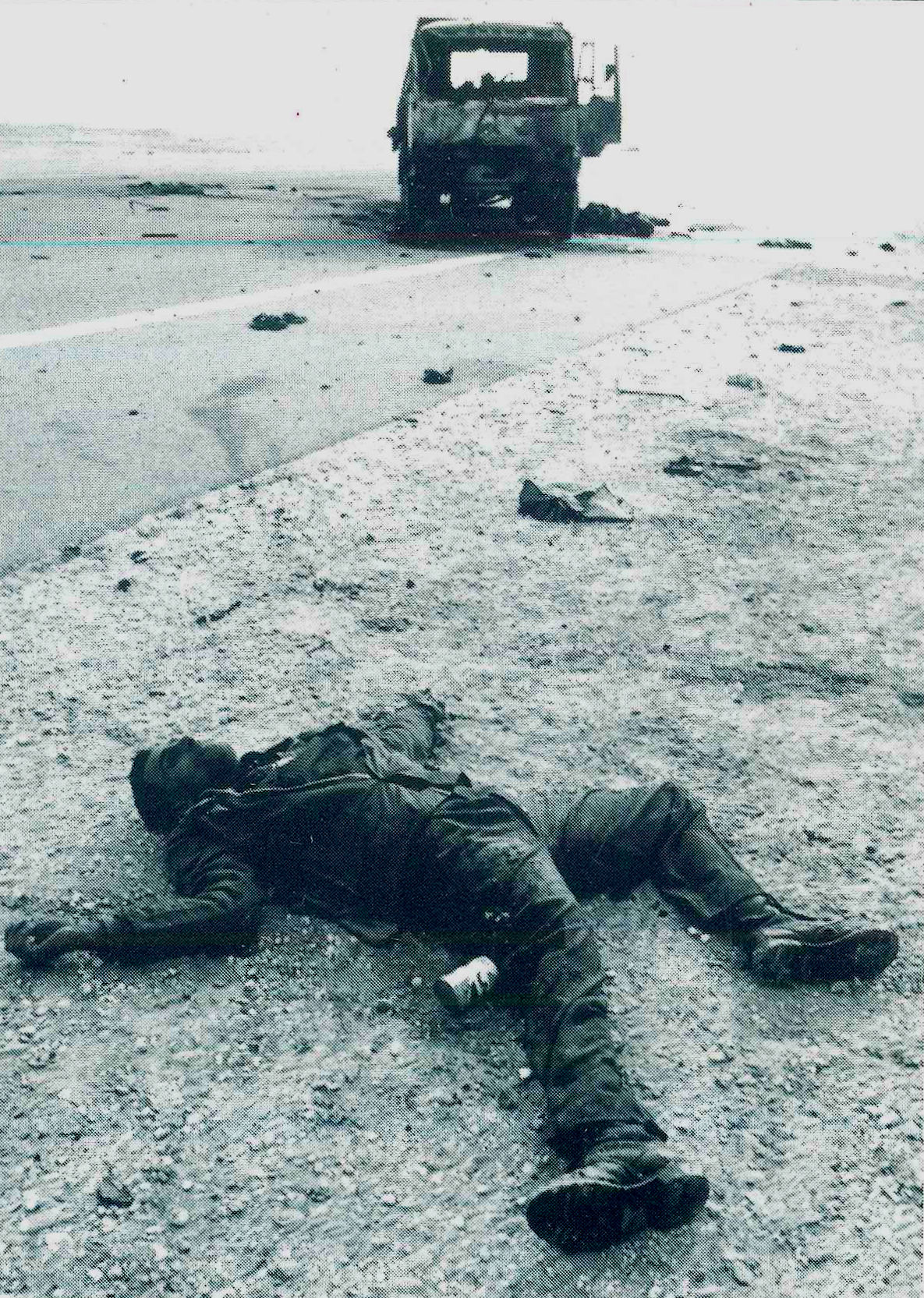
Just before the end of the Gulf War, the corpses of of Iraqi soldiers remained on the desert streets of the Highway of Death in southeastern Iraq.

 In the Gulf War, Iraqi soldiers were killed and their bodies left lying on their backs on a desert road in southeastern Iraq on February 25-26, 1991, in an attack targeting Iraqi ground troops retreating along the Highway of Death. Wreckage and bodies were abandoned from about 1,800 vehicles that smoldered from about 8 km outside Kuwait City to about 80 km just before the Iraqi border. About 10,000 Iraqi soldiers were attacked, and thousands of Iraqis were killed or wounded.

 The Gulf War broke out from August 2, 1990 to February 28, 1991, with U.S. troops leading a coalition of about 30 countries fighting against Iraqi forces. Following Iraqi claims that Kuwait was illegally drilling for oil across the Iraqi border, Iraq invaded Kuwait on August 2, 1990. Fighting was confined to the border areas of Iraq, Kuwait, and Saudi Arabia. Iraqi forces killed approximately 1,082 civilian noncombatants, including Kuwaiti women, children, and the disabled.

 A U.N. Security Council resolution passed on November 29, Resolution 678 gave Iraq a withdrawal deadline of January 15, 1991, and authorized all means of force in Resolution 660 On January 12, 1991, the U.S. Congress authorized military force to drive Iraq out of Kuwait. Immediately after the withdrawal deadline, it executed the aerial component of Operation Desert Storm, launching more than 1,000 sorties per day beginning in the early morning hours of January 17, 1991.

 The Persian Gulf War saw the use of precision-guided bombs, cluster bombs, BLU-82s, and cruise missiles in aerial operations that retained enormous killing power. Depleted uranium (DU) was first used on the battlefield in the Gulf War as anti-tank artillery; DU is a heavy metal and chemical poison that is nephrotoxic and teratogenic. On February 13, 1991, two laser-guided smart bombs killed civilian Iraqis when they were dropped on a residential area. On February 26, Iraqi forces began withdrawing across the border, and U.S. forces launched an armored assault on Iraqi forces just west of Kuwait, and conducted massive air raids on the unprotected desert areas of southern Iraq. The US military declared Kuwait liberated on February 27. 

 A Gulf War Air Power Survey (1993) of the U.S. military estimated that about 10,000 to 12,000 Iraqis were killed or wounded. In addition, about 2,300 civilian Iraqis were killed or wounded in the Gulf War. The U.S. Commerce Department's Census Bureau estimated that 86,000 Iraqi men, 39,000 women and 32,000 children were killed by coalition forces. About 2,000 Iraqi army troops surrendered. However, thousands of Iraqi soldiers were buried alive during a two-day insurrection on February 24-25, 1991. The Gulf War was widely televised, and the American public was intrigued and excited as the world watched missiles hit their targets for the first time and fighter jets take off from aircraft carriers on live TV.

  After Iraq's invasion of Kuwait in August 1990, the U.S. military engaged in a massive mobilization of military forces in Southwest Asia. Due to the massive involvement and the short-lived end of the Persian Gulf War, the US military casualties were minuscule compared to the Iraqi forces. The casualty figures were extracted from a global casualty system established by the US Department of Defense. Of the 219 U.S. military casualties (212 males and 7 females), 154 died in Gulf War combat; 65 died from non-combat causes; and 35 of the combat deaths were in Iraq. Of the combat deaths, 35 were the result of friendly fire. Eighty-three percent of all casualties were white, and the average age of death for all casualties was 26.9 years.


4/17/2021

A 4-year-old girl was exposed to the atomic bomb in Hiroshima City, and a 16-year-old girl with burns and keloids left on her left face and both hands underwent plastic surgery at the Hiroshima Atomic Bomb Hospital.

The Hiroshima atomic bomb was dropped at 8:15 a.m. on August 1945, and the explosion exposed a huge number of Hiroshima citizens to the bomb. 4-year-old girl was exposed to the bomb in Hiroshima City, and was left with burns and keloids on her left face and hands. The exposed girl was admitted to the Hiroshima Atomic Bomb Hospital on May 12, 1957, at the age of 16, to have the remaining scarring sequelae reshaped. After being admitted, the burns and keloids were formed by a surgical transplantation of skin from her thigh.

   The girl, nicknamed Ms. Kintoki, was about 4 years old when she was exposed to the bomb while sitting on the porch of her home in Fukushima-minami, Hiroshima, about 2 kilometers from the hypocenter. She lost consciousness and became trapped underneath another house. He was rescued by a neighboring acquaintance, and on May 12, 1957, he was admitted to the Hiroshima Red Cross Hospital for plastic surgery. He underwent a total of nine plastic surgeries, including scars on his left neck, left anterior neck, and right elbow joint; after a skin grafting operation from his thigh to the affected area on October 21, he was strapped to the bed with a belt and cord because he needed absolute rest. Partial rest was not obtained and bleeding spots remained on the left cheek. The skin on both thighs was pulled off for grafting, and the scars remained and became ugly. On December 14, the girl was discharged from the hospital.

 In 1954, the Hiroshima Atomic Bomb Hospital received a portion of the profits from the 1955 New Year's postcard lottery. The Hiroshima Atomic Bomb Hospital was set up on the premises of the Hiroshima Red Cross Hospital, which opened on September 20, 1956. In Nagasaki, the Atomic Bomb Hospital was established in May 1958 with a portion of the profits from the New Year's postcards.  In 1957, there were many leukemia patients in the hospital's internal medicine ward and many young people undergoing plastic surgery for scars in the surgical ward; by 1967, the internal medicine ward was taking on more and more patients with malignant tumors and cancer.


4/16/2021

An American soldier pulled out an NLF soldier who was seriously wounded to be dead in the head during Vietnam War.

 On the battlefield of the Vietnam War, the head and face of a Vietcong soldier who was shot and killed by American troops around October 1966 were covered with bright vermilion splashes of blood. American soldiers immediately immobilized his arms and took away his Chinese-made light automatic rifle. The American soldiers grabbed the fiercely fighting Vietcong soldier by the neck and pulled him up. The Vietcong soldier was oozing blood from his head. He was gasping for breath and soon fainted, and shortly thereafter he died. The American soldiers kicked him out into the ditch.

 Crossing the rice paddy area, the American tank troops entered the thin forest that stretched across the dunes and communicated with the troops and helicopters by radio. Reconnaissance from bombers firing from the air showed the area where the National Liberation Front (NLF) was hiding to be quite nearby. The thin Vietnamese forest consisted of cedar and hardwood camellias. The American soldiers were already quite deep into the central area of the battle. The sound of gunfire was faint and overpowered by the roar of tanks.

 Almost simultaneously, the ricochets of automatic weapons bullets could be heard coming from the tanks. They bounced off the tanks like rubber balls. An American soldier fell out of the tank as the Vietcong attacked. The Vietcong opened fire on the trees. The American soldiers fired frantically with their machine guns, and the heated shell casings scattered around the area. Immediately after being sniped from the trees, they could not carelessly look out. The day before, a tank had been hit by a rocket-propelled grenade, killing an American soldier who had stayed inside the tank. From time to time, I stood up and peered at the Vietcong. Continuously firing their machine guns, the tank troops reached the farmland spread out in the thin forest. There were three isolated farmhouses there. A housewife, a Vietnamese woman, passed by and stared ruthlessly at the tanks. There was a miserable single-family shack. Amidst the chaos of American and Viet Cong soldiers, the battlefield was a scene of extraordinary misery: five tanks dispersing, numerous colored smoke shells falling on the area where they had shelled the Viet Cong. The tanks opened machine gun fire on their targets. The gunner's seat was on the outside of the tank, protected by thick steel plates. Inside the tank was the scorching heat of sun-baked irons, and we sweated profusely in the steam bath. The tank stopped on the ground to fire at the armed Vietcong. The American soldiers jumped off the tank. Two Vietcong were tumbled up and down in the ditch between the farm and the sidewalk about five meters in front of us. They were still alive and tumbled over on their stomachs. One Vietcong wobbled and stood up unsteadily as an American soldier approached and pointed an automatic weapon at them.

 The black American soldier helped the other badly wounded Vietcong soldier and gave him medical attention. He was the only black man in the tank. He cradled the wounded Vietcong survivor in his arms and returned him to the tank. After roughly wiping off the blood, I tried to help him into the tank. But the PIO, a policeman, refused and ordered him to place the wounded body on the edge of the tank. The black soldier did as he was ordered. The edge was only about 60 centimeters wide and was covered with sandbags. The Vietcong soldier lay on his side, blood continuing to flow from his head. His face was pale and his eyes were vacant. He was an innocent boy of 15 or 16 years old. Command reported that a more powerful Vietcong unit had been spotted nearby. The tank unit ran through the sugar cane fields with a badly wounded boy soldier lying on the edge. A black American soldier held the Vietnamese boy's arm, took his pulse, pulled a bandage from a first aid kit, and said, "He's still alive! I said. Bleeding began to drip onto the tank, and as I sat right under the boys, blood immediately splattered on my hat and arms. 


Fifteen Vietnamese civilians were killed and four injured by the explosion of a mine on a country road 8 km west of Tuy Hòa, March 18, 1966.A mother became a victim of a landmine explosion and her daughter cried out beside the corpse.

About 15 Vietnamese civilians were killed and four others wounded in a landmine explosion on a rural road about 8 km west of Tuy Hoa in Sout...