6/13/2021

To form a buffer zone between China proper and Japanese-controlled Manchukuo, the Imperial Japanese Army invaded Jehol in Operation Nekka.

 From February 18, 1933, the Kwantung Army launched Operation Hot River as a new Manchukuo military operation to sweep the National Revolutionary Army from Hot River Province in western Manchuria. The Japanese troops invaded with tanks at the Old North Gate of Hot River Province. In the battle of Gubukou from April 21 to April 30, the Kwantung Army suffered about 74 dead and 232 wounded in battle. On January 13, 1933, the Japanese government allowed the Kwantung Army to operate under the condition that it did not cross the border north of the Great Wall of China; on May 31, the Kwantung Army signed the Tanggu Agreement, which gave the Chinese Revolutionary Army's tacit consent to the occupation of northeastern China by the Manchurian Incident.
 On March 1, 1932, they declared the establishment of the Manchukuo State, with Puyi as the regent of the Manchukuo State, which was puppeted by the Kwantung Army. The Kanto Army recognized that the province of Hot River was part of Manchukuo. However, in early February 1933, when Operation Hot River broke out, the League of Nations prepared a resolution condemning the new military action in Hot River Province by the Kwantung Army. The League of Nations' draft recommendation of condemnation denied the occupation of Manchukuo, leading to Japan being subjected to international economic sanctions according to the League Covenant. the draft recommendation that was voted on at the League of Nations General Assembly on February 24, 1933 did not recognize the establishment of Manchukuo, and denounced Japan's war responsibility after the Manchurian Incident. The result of the vote was that 42 countries voted in favor, only one country (Japan) voted against, and one country (Siam, later Thailand) abstained. The Japanese delegation to the UN immediately rejected the recommendation of condemnation and withdrew from the venue, and the Japanese government officially decided to withdraw from the League of Nations on March 27, 1933. By withdrawing from the League of Nations, Japan avoided economic sanctions based on the League Covenant, but became isolated internationally.
 At the time of the Manchurian Incident, the Japanese government exalted its national prestige while praising the Kwantung Army; it greeted the UN delegation that returned to Japan on April 27th as heroes and honored its isolation in the international community. The Japanese government of the Meiji era adhered to international norms, but since the early Showa era, it has prioritized Japan's wealth and military power over international cooperation. The invasion of Hot River Province by the Kanto Army was a dangerous starting point that led to a major crisis that connected the withdrawal from the League of Nations to the Pacific War.


6/12/2021

Hiroshima Atomic Bombing stripped the hospital with even window frames blown out , where was soon put to use again to shelter its surviving patients on lower floor as army took over above.

The building had been blown out, as well as most of the window frames, by the explosion of the Hiroshima atomic bomb. Immediately the army occupied and used the upper floors of the building first. The lower floors were then immediately used again as a first aid station to evacuate the surviving survivors of the bombing in Hiroshima City to the lower floors for rescue (Life, July 29, 1952, Vol. 33, pp. 19-25, No. 13, Time Publishing Co.) For the first time overseas, Life magazine published 14 atomic bomb photos of Hiroshima and Nagasaki that had not been censored by the US military. The uncensored photos show atomic bombing through victims' eyes, the perspective of a photographer who sees the tragedy of the atomic bombings of Hiroshima and Nagasaki as a threat to the world from the United States, the country that dropped the bombs.

 The photographers who photographed the Hiroshima bombing witnessed more tragedies than could be captured in a photograph. In aid stations, they captured the stunned faces of burned children. In the few buildings that remained, we moved cautiously through the dead bodies on each floor of the first aid room. But the sight of the worst of the hibakusha is not well documented in photographs." One photographer explained, "I tried to click the shutter many times, but the victims begged for mercy." It was too cruel, too inhuman, to ignore the hibakusha's pleas for help. If I had known it was an atomic bomb, I wouldn't have thought to take pictures," he said.

 The Japanese government estimated, as the photographer saw it, that some 260,000 people were killed, 163,263 injured or missing, an area of about 13.2 km2 destroyed, and 63,431 buildings destroyed. Although this was an enormous amount of damage and sacrifice from the bombing, it was estimated to be a statistically acceptable figure. However, it could hardly be assumed at the time that this was the result of the momentary explosion of the Hiroshima atomic bomb on August 6, 1945, as explained in the book "A-bomb Dai-ichi_Hiroshima no Keisatsu Kiroku" (Asahi Press), a book on the Hiroshima atomic bomb published and released on August 14, 1952. In the book, "Atomic Bomb No. 1: Hiroshima no Keisatsu Kiroku" (Asahi Press), a book on the Hiroshima atomic bombing that was released after the bombing, there is an explanation. A strange light suddenly flashed in the center of the city of Hiroshima. At that moment, the citizens of Hiroshima plunged their fingers in their ears, closed their eyes, and fell to the ground. As if the whole world had been blown to pieces, the huge explosion of the Hiroshima atomic bomb shook the earth and the sky. Its radiant heat was a thousand times that of the sun. Iron poles were twisted like tawashi. From about 10:00 a.m. to 2:00 p.m., the entire city of Hiroshima was engulfed in flames. The poor hibakusha, thirsty and dehydrated, begged for water, but there was none to be had. 


6/11/2021

Taksim Square massacre in Turkey: after a demonstration of the left wing of the trade unions during which their demonstrators were murdered by snipers, Istanbul, May 1, 1977.

About 500,000 workers and other Turkish citizens gathered in Taksim Square in Istanbul, the capital of Turkey, for May Day on the holiday of May 1, 1977, which was International Workers' Day. Suddenly, bullets began to be fired from sniper rifles from the rooftops of high-rise buildings in the area. About 34 people were killed and 126 were wounded in the Taksim district that day. Nearly 2,000 rounds were fired in the massacre, and five people were killed by gunshot wounds. The abuses and massacres were referred to as the Taksim Square massacre and Bloody 1 May 1977.

 About 28 of the 34 people who died were crushed to death by the panicked crowd of comrades. A crowd attempting to flee down Kazançi Hill, the nearest exit from Taksim Square, had their escape route blocked by armored vehicles of the security forces. To further frighten the Turkish citizens, they again made noise with sirens and explosives, and sprayed them with pressurized water. About 25 of them were crushed and crushed to death on the Kazanç hill. Others died after being attacked and run over by armored vehicles of the security forces.

 More than 500 protesters were detained by the security forces, and about 98 of them were put on trial. The court indictment charged that the purpose of the demonstration was to "cause intimidation, fear and panic among the people. However, none of the perpetrators were caught and disappeared. Right-wing groups associated with the Counter-Guerrilla were suspected, but records were lost of about 20 snipers who were detained by security forces and handed over to the police.

 The Revolutionary Trade Union Confederation (DISK) held a May Day demonstration in Istanbul's Taksim Square on May 1, 1977. Demonstrators filled the square and crowds streamed into the surrounding areas. By the time the president gave his May Day speech, all the roads leading to the area were filled with marchers. It was almost 7:00 PM when the last group of people arrived in Taksim district.

 As the DISK chairman finished his speech, about three gunshots rang out. Immediately after the silence, the crowd of about 500,000 people fell into a state of panic and chaos. From the high-rise buildings around the conference center, automatic weapons showered the crowd with bullets. Armored vehicles of the security forces were dispatched, and with noise bombs and automatic weapons firing, the meeting place suddenly turned into a battlefield. Thousands of people lay on the ground, and those who fled were pushed into corners and crushed by armored vehicles. In addition, automatic weapons were pointed at thousands of people fleeing the hills of Kazanchi. A truck parked in the middle of the narrow road blocked the way. The fleeing people pushed and shoved each other, overlapping each other, and many of them suffocated or were crushed to death. The massacre caused a huge shock to the press in Turkey and around the world. About 36 people were killed, hundreds were injured, and about 453 were arrested.

 According to the evidence presented in the courtroom of the trial, the police indicted about 98 people, arrested indiscriminately, as responsible for the massacre. None of them were implicated and all were acquitted. The presiding judge called on the authorities to reopen the investigation and prosecute those truly responsible, but successive governments, led by the military, suppressed the case. on May 7, 1977, Brent Ecevit, who would later become prime minister, drew attention when he said at a meeting in Izmir that the May 1 bloodbath had anti-guerrilla fingers. Under Article 102 of the Turkish Criminal Code (TCK), the case was extinguished by prescription when 20 years had passed. The massacre case was deliberately extinguished by the statute of limitations. Turkey has since commemorated this incident on May 1, but did not allow Taksim Square to be used for May Day after 1977. after the Turkish military coup of September 12, 1980, a military government was established and the May Day movement was banned for about eight years.


6/10/2021

The funeral procession over the body of the slaughtered Palestinian husband paused in front of his wife. His wife walked up to the body, put her hands on his face and kissed his forehead.

One of the senior members of Fatah, the mainstream faction of the PLO (Palestine Liberation Organization), was assassinated by an Israeli planted bomb. The funeral of the Palestinian victim was held in January 2002 in Tulkarem, Nablus in the West Bank. A crowd of Palestinians gathered for the funeral and prayed for the repose of their souls in the Islamic faith. A funeral procession carrying the body of a slaughtered Palestinian youth paused in front of his wife. The body that was being carried was slowly lowered in front of the wife. The wife walked over to her husband's body. For a final farewell, she put her hands on his face and kissed his forehead. According to Islamic custom, wives are not allowed to attend the burial of their husbands, so this was the last goodbye kiss. The couple had two children together, and he was their father.

 The West Bank in Palestine was home to a population of about three million people. In Tulkarem, in the Nablus district of the West Bank, there was also a mixture of white buildings of the gradually proliferating Jewish settlers. Surrounded by Israeli troops, passage through the area is subject to strict Israeli checkpoints. The conflict has resulted in several Palestinian casualties. Shortly thereafter, in retaliation for the conflict, Fatah killed six Jewish youths at a coming-of-age party in West Jerusalem when four deadly Hamas soldiers opened fire with automatic weapons. In retaliation, the Israeli army heavily bombed Tulkarem and blocked the main road with tanks. One by one, Palestinian children threw stones at the tanks. Allahu Akbar! Death to the Zionists! Retaliate against Israel! They shouted.

 Palestinians have been raised in conflict since birth. These same Palestinians have been killed by Israeli bombs and gunfire. We have seen too much death. Both sides have repeatedly launched retaliatory attacks. The Israeli army suspects that Hamas soldiers are hiding in the area, and homes are collapsing all over the place, leaving only piles of rubble. Children have vowed to take revenge by blowing themselves up in a martyred holy war next.The number of Palestinian refugees in 2020 was about 6.29 million, distributed among about 1.06 million in the West Bank, 1.62 million in the Gaza Strip, 2.42 million in Jordan, 650,000 in Syria, and 540,000 in Lebanon.

 Hamas, a radical terrorist organization, was founded in 1987 during the outbreak of the Intifida, a popular uprising movement of Palestinians. It was derived from the Muslim Brotherhood, a Sunni Islamic fundamentalist organization in Egypt. Hamas opposed the flexible line of the mainstream Palestinian PLO. It dared to carry out suicide bombing operations as a jihad, a holy war against Israel. In recent years, the number of Hamas supporters has been increasing in Palestine.

 The dictatorship and pollution by Fatah, the mainstream PLO, has been antagonized by the Palestinian population. Foreign aid is stagnating only to PLO officials. Pama's support for Palestinians living in impoverished areas has been particularly strong among the poor. Both sides, however, have exacerbated the conflict with Israel.

 In 2005, Israel withdrew from the Gaza Strip and sealed off the area; when Hamas took control of the Gaza Strip in 2006, it sealed it off completely. When Hamas took control of the Gaza Strip in 2006, it sealed it off completely, and if there was a military conflict, Hamas launched rocket attacks. In May 2018, the U.S. embassy was relocated from Tel Aviv to Jerusalem in a clash with the U.S. In an exchange of fierce attacks on May 12, 2021, about 30 people were killed in the Gaza Strip. About 30 people were killed and rockets were fired against Tel Aviv. 


6/09/2021

Russians crowd around the heads of decapitated Manchurian men. Many in Manchuria were sympathetic to, or even pro the Japanese during the Russo-Japanese War those who made this public seldom retained possession of their heads.

In 1904, in northern Manchuria, the Russians executed many pro-Japanese Manchurians by decapitation and decapitation. Manchurian executioners requested by the Russians tied the rebellious residents with ropes around their bodies and arms, then cut off their heads and decapitated them. The Russians thought that by openly cutting off the heads of rebellious Manchus, they would be able to suppress any opposition to the Russians among the Manchus. Russian soldiers and Manchurians crowded around the decapitated bodies of Manchurians. During the Russo-Japanese War (Feb. 8, 1904-Sept. 5, 1905), many residents of Manchuria (present-day northeastern China) sympathized or even agreed with the Japanese army. The Manchu population, which had become openly pro-Japanese against the Russian forces, rarely held their heads. The peasants of Manchuria complained about Russian colonization during the Russo-Japanese War. The Russian imperial government sent a defeating expedition from the Russian Empire to the Manchuria region.

 From the latter half of the 19th century, Manchuria was caught up in the era of great expansion of Western colonies. The West, with its superior technology in arms, pressed China and Japan for unequal treaties and the opening of ports. Belonging to the Qing Dynasty in China, adjacent to the Korean peninsula, and blocked off from the Sea of Japan by a projection from Russia, Manchuria was not economically attractive and was not a target. The Russo-Japanese War was triggered by advances in transportation, including railroads and steam navigation. The natural environment of Manchuria favored the opening of ports in the central plains and the south. The decisive factor for the outbreak of the Russo-Japanese War was the concurrent colonial policy chosen by China, Japan and Russia. The combination of new conditions in Manchuria - the security principle of colonization and the peace regime with an armed and well-equipped army - drew it into the vortex of a severe war. In other words, it was a small recreation of the European military system from 1871 to 1914. Between colonialism, tradism and securityism were intertwined and geographically juxtaposed with overlapping interactions; it was the two Far Eastern wars, the Sino-Japanese War of 1894 and the Russo-Japanese War of 1904, that foreshadowed Europe's great wars after 1914.

 Russia's military colonization of the Far East was almost entirely confined to Manchuria. Colonization broke out in three stages in a short period of time under specific circumstances: 1896 (Trans-Manchurian Railway), 1898 (Lushun, Dalny, and South Manchurian Railway), and 1900 (diffuse occupation against Yihe Dan). In particular, after acquiring the leased land in Liaodong and Lushun, it became the terminus of the Trans-Siberian Railway and a naval base. Russia's military colonization of Manchuria built an infrastructure of fighting resources for Europe. To avoid the ice in winter, they chose Lushun over Vladivostok. Built and reinforced for military purposes, Manchuria's railroads and ports reinforced colonial rule as a transport and food resource. During the Russo-Japanese War, Japan and Russia were supposed to withdraw from Manchuria militarily after the conclusion of the Treaty of Portsmouth (September 1905), but Japan reopened the South Manchurian Railway in 1906, which became a source of economic conflict. The relationship between military resources and economic activities became Manchukuo due to Japanese colonization in 1931, and the garrison base of the Kwantung Army became the industrial base of the country.


6/08/2021

US infantrymen on Angaur passed a Japanese casualty lying across the narrow gauge railroad of the island.Remaining groups of the enemy were holed up in the northwest part of the island.

American infantrymen at the Battle of Angaur in the Pacific War pass the corpses of Japanese soldiers lying on the island's narrow gauge railroad tracks. The remaining Japanese forces were holed up in the northwestern part of the island. Angaur was declared safe on September 20, 1944, but the fighting continued. It took about another four weeks or more before the Japanese completely cut off the resistance after a fierce meat-and-pound battle using flamethrowers, grenades, and explosives. Next, the Japanese forces, starving, thirsty, and damaged by American artillery and bombing, were annihilated in a final slashing assault on October 19. Of the approximately 10,000 American troops, the casualties were approximately 260 dead, 1,354 wounded, and 940 lost in non-combat roles. Japanese casualties were about 1,338 dead and 59 prisoners of war. The American casualties of about 2,560 outnumbered the Japanese casualties of about 1,397.
 The Battle of Angaur in the Pacific War broke out on Angaur Island in the Palau Islands from September 17 to September 30, 1944. Angaur Island is a small volcanic island about 4.8 km long, separated from Peleliu Island by a 9.7 km strait, which was suitable for the construction of an airstrip. It was located at the southernmost tip of the Palau Islands, about 800 km east of Mindanao. When it became apparent that the U.S. military was going to invade Palau, the Japanese military evacuated the civilian population and local residents from Angaur Island to the main island of Palau. About 180 young local men, along with Koreans, were sent to help the Japanese army as soldiers. American troops also landed on Angaur Island and were involved in the fighting, starting with the bombardment of the island by artillery and dive bombers on September 11, followed by the landing on September 17. American troops landed on the northeast and southeast coasts on September 17. The invasion was delayed when they encountered about 1,400 Japanese mines and snipers. They were caught in dense terrain infested with Japanese machine guns and snipers. The Japanese had also invaded the caves. In order to secure the cave, the American troops used bulldozers to seal off the entrance to the cave. The lack of food and water on the battlefield gradually drove the Japanese soldiers back, and the inside of the cave shelter took on the appearance of a dough prison with the moans of the seriously wounded as they sought suicide grenades. The Battle of Peleliu had already broken out between September 15 and November 27.
 Sergeant Hiroshi Funasaka, mortally wounded by the American onslaught, charged the American command post with a pistol in his left hand, a hand grenade in his right, and five grenades strapped to his body. He was shot in the left neck, fell into a coma, and lost consciousness for about two days before being rescued. Even though he was a prisoner of war wounded, he still attempted to attack the observers and blow up the airfield. After demobilization to Japan, he ran a bookstore where he learned about the advanced American culture that leads to prosperity and peace. He opened a bookstore in front of Shibuya station with just one tsubo (one square meter). This led to the creation of the Taiseido Bookstore, the first book department store in Japan to occupy an entire building.


6/07/2021

The field postcard from 1916 shows the Italian Reichstag deputy Cesare Battisti, executed as a high traitor, with his smiling executioner, Josef Lang; reprinted in: Karl Kraus, The Last Days of Mankind.

 A photograph of the corpse of Cesare Battisti, an Italian member of the Reichstag who was also hanged as a traitor, and his executioner, Josef Lang, became a postcard in 1916 during World War I. The smiling executioner and his assistant pose as if they were in a bar. The hanging prisoner is held like a trophy by the proud executioner, who shows ownership of the body with both hands. Numerous onlookers posed for pictures with the victims on the gallows. Executions were carried out openly as a voyeuristic ritual of violence, the gruesome spectacle provoking fascination and a certain lust. Photographed together with the corpses hanged on the gallows, the pictures and cards of the "Laughing Austrian Executioner" spread all over the world.
 Cesare Battisti was hanged in Trento, Austria-Hungary on July 12, 1916. he was elected to the Parliament in Vienna in 1911, but when Italy went to war with Austria in May 1915, Battisti joined the Italian army. During the Italian invasion of the Trentino region, he was captured by the Austrians on July 11, 1916. Sentenced as an Austrian and a traitor, in a summary court-martial on July 12, Battisti claimed to be a prisoner of war, but was outright rejected and sentenced to be hanged for treason. Men, women, and children were executed in large numbers by military tribunals as spies and traitors. Deportations, detentions, and systematic executions suppressed the people as suspicious civilians.
 Prisoners were taken directly from the courtroom to the gallows. The rope that had first strangled them was cut, and the tradition of commuting sentences was ignored, and the hangings were carried out with a new rope. Battisti shouted "Viva Trento Italia" (Long live Trento Italy!). After the hanging, the body was dumped into the castle sewers without a coffin or any markings. The executioner, József Lange, was Australian from 1900 to 1918. He served until the abolition of the Hungarian monarchy and was the executioner for 39 death sentences during that time. He was photographed on the gallows with the bodies of the hanged, and his picture and card of the "Laughing Austrian Executioner" went around the world. The executioner was often received at the station like a guest of honor and enjoyed a high social reputation.
 Australian authorities photographed the hangings and created photo cards to make an example and deterrent. It backfired and Battisti became a martyr, giving the Austrians a barbaric image. Even though the authorities soon realized it, they stopped distributing the cards, making their distribution difficult to retrieve. The photos ended up in the hands of Italians and became material for anti-Austrian propaganda in Italy.
 Various proponents of the war believed that it would strengthen the country, make the people stronger, and make them greater. They saw war as a way to unite the people and make them patriotic. They saw war as an opportunity to gain personal power. They sought opportunities to gain personal fame, adventure, and honor. He sought to gain great power status, to protect and expand his interests, and to acquire colonies. Bhatti's main goal was based on ethnic-centered nationalism. In Austria, he was condemned as a traitor, but in Italy, he was still considered a patriot, hero, and martyr.


6/06/2021

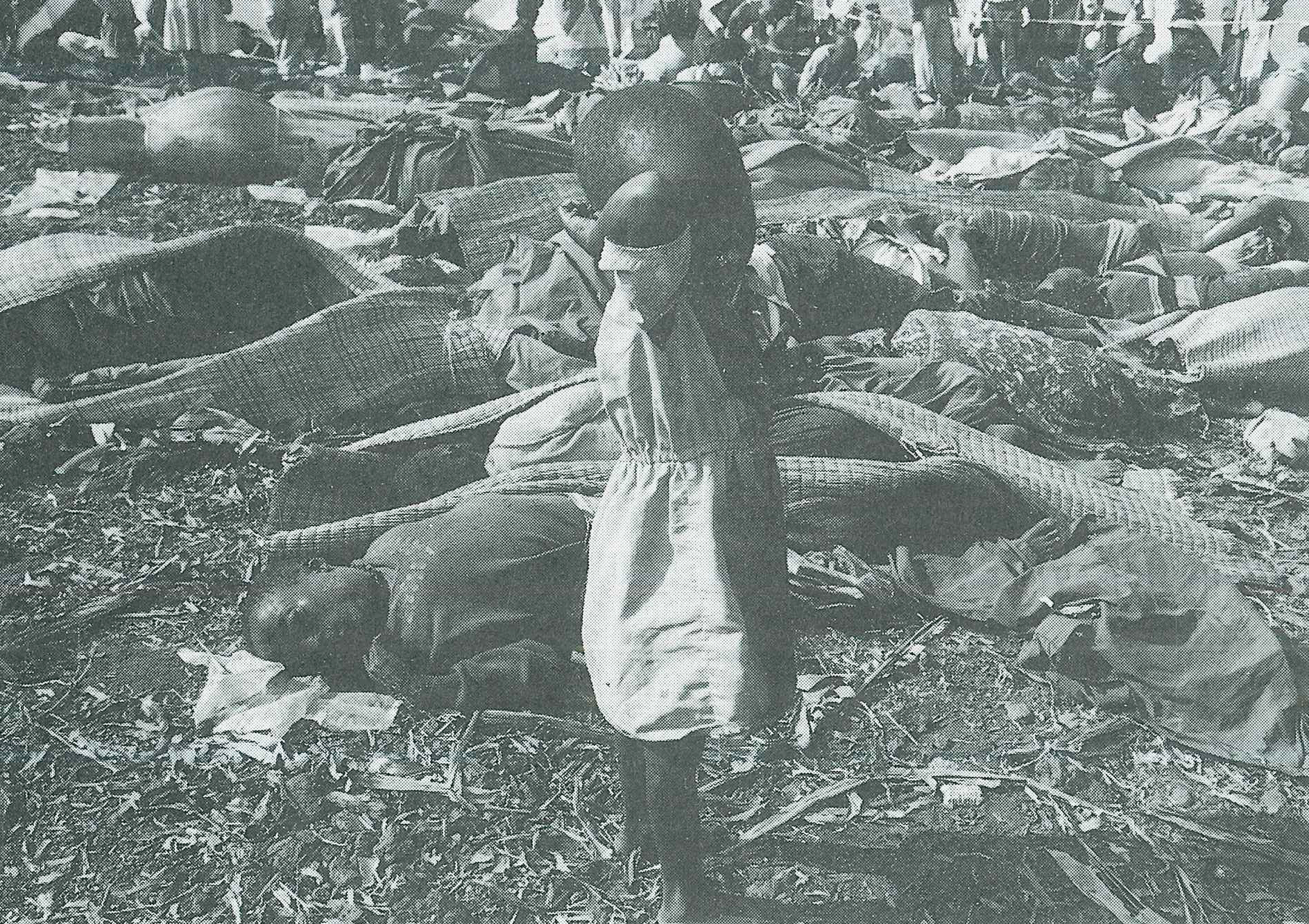
In Rwanda, massacres have been common in recent years. Piles of dead bodies became a common sight in the ethnic killing, creating problems of disposal and potential disease for the already weakened populations of this region.

Rwanda's civil war led to frequent massacres in the 1990s. The civil war between the Tutsi and Hutu ethnic Rwandans, who were killing each other, often left piles of dead Rwandans. For Rwandans in already weakened areas, the problem of disposing of the corpses was one source of potential disease.

 Rwanda's inequalities were more unevenly distributed regionally, with those in power dominating in the north and benefiting most from bribes in Rwandan government positions, economic activities they managed, and development projects they supported. This favoritism was further accelerated during the 1958-1962 revolution, when the Catholic Hutus overthrew the Tutsi monarchy. Implicitly supporting the revolution were decolonial forces who feared a Tutsi regime that would maintain foreign control of Rwanda for many years. Many Tutsis were killed in the revolution, and most of the former Tutsi authorities in Rwanda fled to other countries, including Central Africa.

 The reign of violence began to tighten in 1962, and in 1961-1962 exiled Tutsis fought back against Rwanda from their bases in Burundi and Uganda. They were easily subdued by the Hutu army. Tensions rose, and in 1962, about 2,000 Tutsis were executed, and in 1963, about 10,000 were killed. About 140,000 to 250,000 Tutsis fled the country, and the Tutsi population dropped from about one-half to three-quarters of its original size.

 The two regimes that ruled Rwanda from 1966 to 1993 killed or forcibly removed Tutsi authority figures. the two regimes were very repressive and gave legitimacy to the Hutus. First, state-led development by the Rwandan regime was for the benefit of the Hutus. It convinced the people that it was a democratic effort to give the Hutus the upper hand. Second, after hundreds of years of domination by the Tutsi minority, the ideology of Hutu ownership made the Rwandan government appear to favor Hutu hegemony. While giving legitimacy to the repressive regime, the Hutus' fear and prejudice against the Tutsis grew incrementally. In fact, the Rwandan government systematically fostered prejudice against Tutsis. Over the course of about 20 years, it turned prejudice into radical hatred of Tutsis. Eventually, it escalated the violence against Tutsis, and in 1994, it attempted to exterminate them. By focusing Hutu attention on the Tutsis, the Rwandan regime diverted public attention from its failures.

 It was strictly forbidden for Tutsi refugees to return to Rwanda. A quota system was introduced that allowed Tutsis to participate in socioeconomic activities according to about 9% of the population. Within the government, the quota of approximately 9% was never realized. In less regulated sectors such as commerce and non-governmental enterprises, the number of Tutsis far exceeded about 9 percent.

 In the early 1990s, the events of the conflict generated a genocide that massacred. Antipathy toward the Rwandan government grew in the underdeveloped areas of the Hutu population. The Rwandan government favored the northern part of the country, and the Hutus in the south became increasingly angry, leading to an intra-Hutu conflict. In 1990, the descendants of Tutsis who had been exiled between 1959 and 1963 invaded Rwanda. This added fuel to the fire of ethnic hatred. The Tutsis were well-funded and well-supplied, and the invasion was able to overrun the northern areas. The resurgence of Tutsi rule fueled a sense of urgency among the Hutus, and by 1992, the international community, led by the United Nations, demanded that the newly returned Tutsis integrate with the Hutus and demanded that the Hutu government negotiate the establishment of a more inclusive government.

 The negotiations, demanded by the UN in Arusha, Tanzania, have added to fears that Tutsis will invade Hutu-controlled Rwanda. On April 6, 1994, Rwanda's Hutu president was killed in a plane crash on his way back from negotiations in Arusha. On April 6, 1994, the Hutu president of Rwanda was killed in a plane crash on his way back from negotiations in Arusha, and thousands of Tutsis were killed in the Hutu uprising that followed the shooting down of the plane. UN officials were evacuated from Rwanda. These riots led to a 100-day civil war in which some 800,000 mostly Tutsis were massacred. The Rwandan Patriotic Front (RPF), a Tutsi group in the north, resumed its invasion and captured the Rwandan capital, Kigali, on July 4, 1994. On July 4, 1994, the RPF took over Kigali, the capital of Rwanda. About two million Hutus fled to the Democratic Republic of Congo (formerly Zaire) with many army and government officials to regroup. By 1999, at least 200,000 Hutus and Tutsis had been killed in Rwanda, hundreds of thousands had fled to neighboring countries, and hundreds of thousands had been displaced within Rwanda and were being held in refugee camps.

 The situation in Rwanda has become very volatile. The presence of large numbers of refugees inside and outside of Rwanda has led to a gradual increase in prejudice and fear that the Hutus will control their lives unless the Tutsi minority is exterminated. The presence of large numbers of refugees has squeezed the resources of other countries in Central Africa, making the possibility of renewed conflict and carnage in Africa in the 21st century much more likely. in April 2000, President Kagame, a Tutsi from the RPF, took office in Rwanda, and the African economic miracle began. In the meantime, he was re-elected president in August 2017 to a long-term dictatorship until 2034 by extending his re-election with amendments to the new constitution in May 2003 and December 2015. 


6/05/2021

In Matsuyama-cho, Nagasaki, the hypocenter of the atomic bombing, which the Atomic Bomb Casualty Commission visited from September to October 1945, the dead of the bombing had been cremated and cremated in the gutters of a residential area, and their white bones were scattered all over the area.

An academic research team of the Atomic Bomb Casualty Commission visited Nagasaki City on September 10, 1945. In Matsuyama-cho, Nagasaki City, the hypocenter of the bombing, dead bodies that had been exposed to the bombing were cremated and buried in the gutters of a residential area. Their white bones were scattered all over the gutter.

  Immediately after the Hiroshima atomic bomb was dropped and exploded at 8:15 a.m. on August 6, 1945, a Kure Jinbu survey team investigated the city of Hiroshima on the same day. The Imperial Japanese Army Headquarters in Tokyo dispatched the General Staff Headquarters, the War Ministry, and an Army Ministry relief survey team, including Yoshio Nishina of RIKEN, to Hiroshima City on August 8. Yoshio Nishina, who was in charge of Operation No. 2, the atomic bomb development program, verified the atomic bomb, and on August 10, at a joint Army-Navy special bomb research meeting in Hijiyama-tonan, Hiroshima City, he reported, "Atomic bomb narrative recognized. The hypocenter was assumed to be about 300 meters south of Gokoku Shrine at an altitude of about 550 meters, and a survey team sent by the Agency of Technology to Hiroshima on August 8 also reported to the government and the Army and Navy in Tokyo on August 10 that it was an atomic bomb.

 On August 9, 1945, at 11:02 a.m., the Nagasaki atomic bomb was dropped and exploded; at midnight on August 9, the Soviet Union entered the war, and at 10:30 p.m., the Supreme War Leadership Council was held in the Imperial Palace in Tokyo. Shortly after 11:02 p.m., the Governor of Nagasaki sent a telegram to the Western Military District General Staff announcing the dropping of a new type of bomb similar to the Hiroshima bomb on Nagasaki City. At around 11:30 a.m., the Ministry of Home Affairs or the Imperial Headquarters was informed of the new Nagasaki bomb. It was reported to the Supreme War Leadership Council of the Imperial Court, which resumed after 2:30 pm. Later, at around 2:30 a.m. on August 10, the acceptance of the Potsdam Declaration was decided at a meeting in front of the Showa Emperor.

 On August 8, the War Ministry's Medical Department dispatched the Army Medical School's Hiroshima Disaster Investigation Team. On August 10, the team determined that the bomb was radioactive, based on X-ray film sensitivity. A second survey team was dispatched to Hiroshima on August 14. The second survey team was dispatched to Hiroshima on August 14, and measured radioactivity in Hiroshima City using a Lauritzen electroscope until August 17. On the morning of August 15, Yoshio Nishina announced the atomic bomb in the newspaper.

 In late August and early September, the Tokyo Imperial University School of Medicine and other universities and research institutes participated in the survey and relief efforts in Hiroshima and Nagasaki. Masao Tsuzuki of the University of Tokyo, who was the leader of the Hiroshima delegation, the Army Medical Academy, and the Institute of Physical and Chemical Research participated in the investigation of Hiroshima city on August 29 as the third investigation team of the Ministry of the Army. Pathological autopsies and Geiger counters were used to investigate the effects of radiation, and on September 3, the world's first lecture on A-bomb diseases was held at the Hiroshima Prefectural Government. On August 27, Kyoto Imperial University was requested by the Commanding General of the Chinese Military District to enter the city of Hiroshima on September 2, but the investigation was abandoned when 11 people died in the Makurazaki typhoon on September 17. In Nagasaki City, Kyushu Imperial University and Kumamoto Medical College participated in the survey and relief efforts from late August to early September.

 After the end of the war, the U.S. Army entered Japan, and a number of survey teams, including the Manhattan District Survey Team, which arrived at Yokohama Port on August 30, began to investigate and study the atomic bomb. On September 4, after liaison and coordination with Masao Tsuzuki, the head of the survey team at the University of Tokyo, the team entered Hiroshima City from Atsugi Air Base on September 8, and entered Nagasaki City on September 9 to begin the survey.

 On September 14, 1945, the Science Research Council of Japan (the predecessor of the current Science Council of Japan) formed the Special Committee for Research on the Atomic Bomb Disaster by the Science Education Bureau of the Ministry of Education. The committee was composed of approximately 33 members, 150 researchers, and 1,500 assistants. On September 22, 1945, the U.S. General Headquarters (GHQ) formed a joint military committee to investigate the effects of the atomic bomb in Japan. The GHQ issued restrictions on speech, press, and publishing in Japan on September 19, 1945, and these restrictions remained in place until the San Francisco Peace Treaty in April 1952. (Just before that, on September 5, reporter William Burchett reported for the first time in the Daily Express that some of the damage caused by the atomic bombs had been reported overseas.) On November 30, GHQ issued a strict prohibition on the publication of atomic bomb disaster research by the Japanese, and in January 1946, the medical materials on the Hiroshima and Nagasaki atomic bombs were transferred from the Port of Kure to the Superintendent of Military Medicine in the U.S., where they were kept in secret until 1973.


6/04/2021

William Carr, a Child murderer, was brutally hanged in public inside the Clay County Courthouse in Liberty, Kansas City, Missouri, with a crowd of about 800 people and photographing his execution.

On December 17, 1897, child murderer William Carr was publicly hanged by about 800 people inside the Clay County Courthouse in Liberty, Kansas City, Missouri. As Carr was taken to the gallows for the last time, he made a pitiful appearance. He raised himself convulsively and climbed the gallows with relative strength. It was 10:34 a.m. when the sheriff pulled the trigger on the gallows. Two minutes later, the life of the killer of his own child ended. His neck snapped and there was the sound of a whip being used. In the split second after the gallows fell, about eight hundred spectators, screaming, crying, shrieking, laughing, as if driven by a single impulse, crowded under the gallows, close to the dangling corpse. They were not satisfied until they got a close look at the hanging man's body. The crowd angrily cursed at each other, tried to force their way up the gallows steps, and cried and howled at the sheriff.
 Finally, the crowd tried to break down the barricade surrounding the scaffold. Sheriff Hymer rushed in from the first breakthrough and excitedly warned the crowd not to engage in further violence. The crowd paused for a moment as the sheriff's guards surrounded the body. Suddenly, all at once, there was a loud shout and the crowd shook off the guards and broke through the sturdy fort. Inside the gallows, there was more shouting and emotional outbursts. Finally, after the concluding execution, which was safely dismissed and settled into a small riot of a few minutes, a photographer entered the enclosure to capture the final events of this abominable tragedy in horrific detail. The filming machine operated for the duration of the time Carr was in the enclosure until the bodies were mutilated. About 1,800 pictures were taken on about 1,000 feet of film. The same gang that had been in prison when Carr was a prisoner in the county jail in Kansas City exhibited these photos around the country.
 The same gang convinced Carr to recite the story of the murder to a phonograph while he was a prisoner in the county jail in Kansas City. William Carr's crime was one of the most brutal in Missouri history: on October 15, 1896, the body of Belle Carr, a three-year-old child born to the killer William Carr's first wife, was found on a sandbar in the Missouri River near Kansas City. Carr was arrested at his home in Liberty on October 2 for the incident. Carr initially denied the crime. Later, Carr, a skinny 37-year-old country boy, told how he carried his child out of the house, tied his hands and feet tightly, tied a heavy rock to the child's chest, and asked, "What are you going to do, Daddy? " and admitted that Mrs. Carr had told her to get rid of the child. It also turned out that she had been brutal to Bell. Carr stubbornly insisted that his wife had nothing to do with it. For a while, Carr invited his notoriety and told his visitors plainly about his crime. But then he begged to be wiped off the face of the earth as soon as possible; at his trial on November 16, Carr was immediately convicted. Carr became increasingly weak, and on Sunday, a week before his execution, he attempted suicide by swallowing a piece of glass he had struck. Carr spent a restless night the day before his hanging, and when breakfast was brought to him, he cut it off in disgust, lit a cigar, and looked out the window for a long time. Eventually, the mortician asked Kerr if he wanted to dispose of the body. My wife will take care of it," he said. Oh, let my wife take care of it," he said, sobbing. The priest then appeared and urged him to face his fate like a man. 'I will try. It's the best I can do," Carr said. The Bible was read and hymns were sung, all the while Carr was crying and shaking like a child.
 At the end of the nineteenth century, the frontier towns of the Old West were a lawless land of gun battle combat, fought to the death in a vacant lot near the OK Corral in the American West in October 1881. The duel was brief, as men of low morals reached for their six-shooters when they disagreed or had a problem to solve. It became a lawless region where law and order lagged behind, and the frontier was settled by all kinds of people: itinerant cowboys, prospectors, railroaders, hot-tempered young men from the East, fugitives, and swindlers. Wealth of gold and silver flowed out of the mines in the surrounding hills. Life in the open air, rides at night, the spice of danger, domination over humans, and the pride of keeping the mob at bay became wild adventures that made the veins tingle. As a saloon keeper, he was found drugging customers and robbing them of their money, and citizens hanged a police officer. The sheriff of Ada County, Idaho, was found to be a horse thief, and the vigilantes hanged him. Justice in the courtrooms of those days was just as bland as justice in the prisons and on the streets. Many of the early judges had not studied law and were working on the sidelines. Without courts and tribunals, they rendered their verdicts in stores and taverns, where informality reigned.


Fifteen Vietnamese civilians were killed and four injured by the explosion of a mine on a country road 8 km west of Tuy Hòa, March 18, 1966.A mother became a victim of a landmine explosion and her daughter cried out beside the corpse.

About 15 Vietnamese civilians were killed and four others wounded in a landmine explosion on a rural road about 8 km west of Tuy Hoa in Sout...